






In new research, Patrick Crawford and Vincent Geloso find that areas in Lower Canada with more newspaper competition were more likely to rebel in Quebec’s 1837 Rebellion. Irrespective of political leaning, newspapers in more competitive markets helped citizens to share grievances and coordinate their actions.
Economists have long argued that competitive markets channel conflict into peaceful cooperation. From Montesquieu’s idea of doux commerce to Douglass North, John Wallis, and Barry Weingast’s account of institutional development, a long tradition holds that competitive markets foster environments that prefer polite exchange to violence. The same logic extends to the press: competitive newspapers have been shown to increase voter turnout, improve governments’ responses to natural disasters, and hold public officials accountable. Our results clarify this logic. Competitive newspapers create accountability by making shared concerns visible. Whether that accountability produces democratic reform or political rebellion depends on the economic and political institutions through which it flows.
In a new working paper, Vincent Geloso and I find that in the years before Quebec’s Lower Canada Rebellion of 1837–38, subdistricts with more competing local newspapers were more likely to join the rebellion. The mechanism was coordination: competing newspapers helped citizens discover that others shared their grievances and were prepared to act, turning private frustrations into publicly observable common knowledge. A newspaper’s political leaning made no difference. What mattered was how many papers competed.
When accountability has no peaceful outlet
Lower Canada, a British colony from 1791 to 1840, was not a democracy in any meaningful modern sense. While there was an elected assembly with a very broad franchise beginning in 1792, that democratic body had limited powers. Real political authority remained with appointed colonial officials in the Conseil législatif as well as with the executive branch, whose members aligned with the conservative Château Clique, the small group of officials affiliated with anglo merchants. The reformist Patriotes won an overwhelming majority against the Loyalists and Moderates in the elected Legislative Assembly in 1834. They then adopted the 92 Resolutions, which demanded greater self-government. London rejected all such demands. It is in the aftermath of this rejection that the rebellion erupted.
This institutional dead end created a useful setting for studying the political effects of media competition. The central grievance was already present throughout the colony. What varied was not dissatisfaction with colonial rule, but the local information environment through which citizens learned about petitions, meetings, protests, and each other’s willingness to resist.
Most research on media and politics struggles to differentiate between newspaper competition and broader economic development. Places with many newspapers also tend to be wealthier, more urban, and more politically active. Lower Canada offers a rare opportunity to disentangle these effects. Newspapers were printed almost entirely in Montreal and Quebec City, while their distribution depended largely on colonial postal routes and commercial networks rather than local political conditions. Because newspaper distribution largely followed existing postal routes rather than local political conditions, nearby communities often differed in how many newspapers they received for reasons unrelated to politics or the rebellion itself.
Measuring competition before the rebellion
No reliable circulation records for newspapers in 1830s Quebec survived. Instead, we reconstructed the market from an overlooked historical source: the newspapers themselves.
Most newspapers regularly printed lists of parish agents where readers could subscribe, purchase issues, or collect deliveries. We geocoded every agent listed in all 29 identified extant newspapers before the outbreak of rebellion, creating a detailed map of newspaper distribution across 260 local subdistricts.
From this network, we constructed a version of the Herfindahl-Hirschman Index (HHI) to measure market concentration. We allowed for neighboring localities to be potentially influenced by nearby newspapers, even if the newspapers weren’t sold there directly. Areas served by only one dominant newspaper had high concentration; areas where several newspapers competed had low concentration. We also coded each newspaper’s editorial position as Patriote, Loyalist, or Moderate, allowing us to distinguish competition from ideology. On average, subdistricts faced an effective number of roughly 10 competing newspapers, ranging from one in the least competitive markets to 16 in the most.
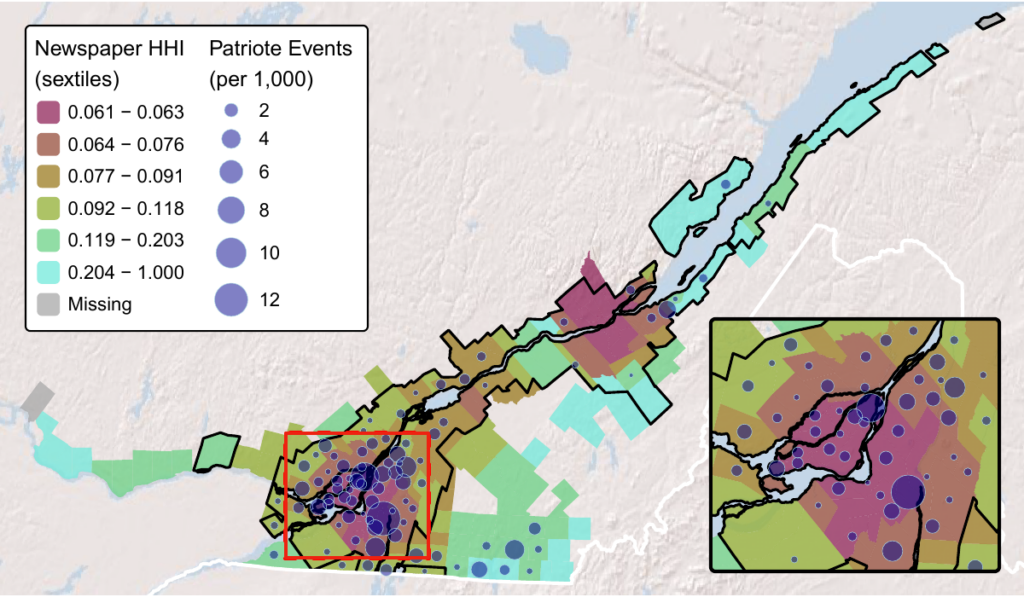
Competition mattered. Partisanship did not.
Across every specification we estimated, more competitive newspaper markets consistently predicted higher rates of participation in the rebellion.
The estimated magnitude is significant. To put this in perspective, the predicted increase—0.84 rebel events per 1,000 inhabitants—is about one and a half times the average level of rebellion observed across all parishes. The largest gains came when markets moved from monopolistic to competitive, with diminishing effects as additional newspapers were present in a subdistrict’s market. This reflects variation across subdistricts in the years before the rebellion, not market changes occurring during 1837–38 itself.
The editorial stance, by contrast, explained remarkably little. Whether a locality’s newspapers leaned Loyalist or Patriote was statistically unrelated to participation once competition itself was taken into account.
This is perhaps the paper’s most surprising finding. Conventional accounts often assume newspapers influence politics primarily through persuasion. Our evidence points toward a different mechanism.
Even newspapers hostile to the Patriotes still reported on Patriote meetings, petitions, speeches, and demonstrations. Readers learned not only what political leaders argued but also that political mobilization was occurring, where it was occurring, and how many others were participating. Competing newspapers repeatedly informed readers that collective action existed, even when they condemned it.
Competition changed less what people believed than what they understood about other people’s beliefs.
Markets can solve coordination problems
Political participation is rarely an individual decision. Joining a protest—or a rebellion—depends on expectations about what others will do.
Economists and political scientists often describe this as a coordination problem. Citizens may privately share the same grievance while remaining inactive because each doubts that others feel similarly or will act alongside them.
Competitive newspaper markets reduce that uncertainty by repeatedly reporting on the same meetings, speeches, petitions, and demonstrations. Readers no longer simply know that a grievance exists. They learn that thousands of others know it exists as well. Our results strongly support this interpretation.
The effect of newspaper competition was substantially stronger in areas governed under the seigneurial system than in neighboring freehold townships. The seigneurial system was a French feudal transplant of a land tenure regime that granted strong monopoly rights, allowing landlords to extract high exactions from settlers and creating barriers to labor mobility. In 1791, the British had frozen the boundaries of the regime and allowed all new settlements to occur under freehold tenure where no such monopoly rights existed. During the rebellions, people from areas which had previously fallen under the seigneurial system concentrated their economic and political grievances around a visible local institution. Competition among newspapers amplified those shared grievances into coordinated political action. Where the underlying grievance was weaker (in freehold tenure areas), competition had much smaller effects. Therefore, competition alone did not create rebellion, it amplified an existing political conflict.
Why this matters today
The case of the Lower Canada Rebellion offers a broader lesson. Economists usually emphasize that competition improves information quality—disciplining producers and exposing bad behavior. That is true. But competition also performs a function that receives far less attention: it helps citizens discover that other people share their concerns.
In functioning democracies, this is overwhelmingly beneficial. Citizens who recognize shared concerns can organize campaigns, petition governments, vote, or create advocacy organizations. Competitive media help transform private concerns into peaceful political participation. Lower Canada lacked those institutional outlets. Elections had already demonstrated popular support for reform, yet meaningful political change remained blocked. The same coordination that would normally strengthen democratic accountability instead contributed to rebellion.
This perspective sheds light on contemporary debates over media concentration. Discussions about declining local journalism often focus on viewpoint diversity or misinformation. Those are real concerns. But competition itself provides a further civic benefit: sustaining local public spheres in which citizens can observe shared concerns and organize collectively. This may help explain why governments that resist accountability frequently target independent media. Restricting independent media makes it harder for citizens not only to obtain information but to recognize that others share it.
Markets do not determine whether citizens rebel or reform. They determine whether citizens can recognize mutual grievance, but institutions determine what happens next.
Authors’ Disclosures: The newspaper distribution data were collected by the authors from historical newspaper archives. Rebellion, demographic, and geographic data are drawn from primary historical sources. The authors report no conflicts of interest. You can read our disclosure policy here.
Articles represent the opinions of their writers, not necessarily those of the University of Chicago, the Booth School of Business, or its faculty.
Subscribe here for ProMarket’s weekly newsletter, Special Interest, to stay up to date on ProMarket’s coverage of the political economy and other content from the Stigler Center.