





In new research, Nandini Gupta and Swarnodeep Homroy show that firms in the United States are choosing politically-aligned suppliers to insure their supply chains against disruption. Aligned relationships are markedly more resilient when shocks hit, but the insurance is paid for in higher input costs and less innovation.
Supply chain disruptions have become one of the defining corporate risks of the past decade. The Covid-19 pandemic, war in Ukraine, the Hormuz blockade and counter-blockade, and a steady stream of tariff shocks have each exposed how quickly production networks can break. Formal contracts, even carefully written ones, cannot specify all contingencies. The standard playbook for managing this sort of risk is to build inventory buffers, source critical inputs from multiple suppliers, or engage in vertical integration that gives a producer ownership over its inputs. Recently, American policymakers have started to encourage companies to relocate their international production facilities to allied countries (“friend-shoring.”)
In a recent paper, we document that another way firms in the United States are buffering their domestic supply lines is by choosing suppliers who share their political affiliation. We find that this political alignment may not be solely an ideological statement, but rather serves as a way to manage supply-chain risk when social and political trust runs low. These partisan relationships prove to be markedly more resilient when disruption, such as a natural disaster or regulatory shocks, strikes. However, this partisan alignment comes with a tradeoff in the form of higher input costs and less innovation.
The partisan realignment of US firms
Partisanship in firms’ sourcing decisions has been growing for some time. PublicSq, an online “woke-free” marketplace launched in 2021, openly markets itself as a way to connect conservative businesses with conservative suppliers and consumers. Similar initiatives exist on the other side of the aisle related to environmental, social, and governance efforts and diversity, equity, and inclusion criteria. By matching links between suppliers and their business customers from FactSet Revere to CEO campaign contribution data from OpenSecrets, we examined the politics of the domestic supply chains of more than 6,000 publicly listed U.S. firms between 2004 and 2020. We classified firms as Republican-leaning (61%), Democratic-leaning (23%), or politically neutral (16%) based on their CEOs’ political donations and linked these classifications to one-to-one customer-supplier relationships. Figure 1 plots the basic pattern: politically-aligned matches have grown steadily over this time, while cross-party relationships have declined.
Figure 1. Time-series trend of politically-aligned customer-supplier matches.
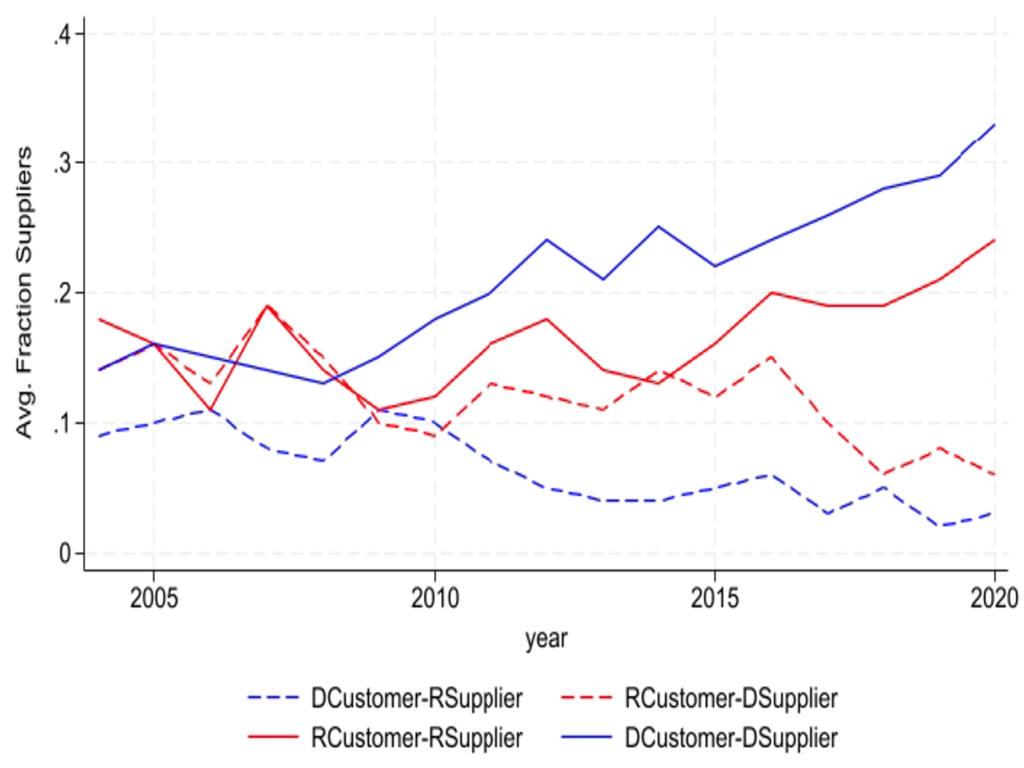
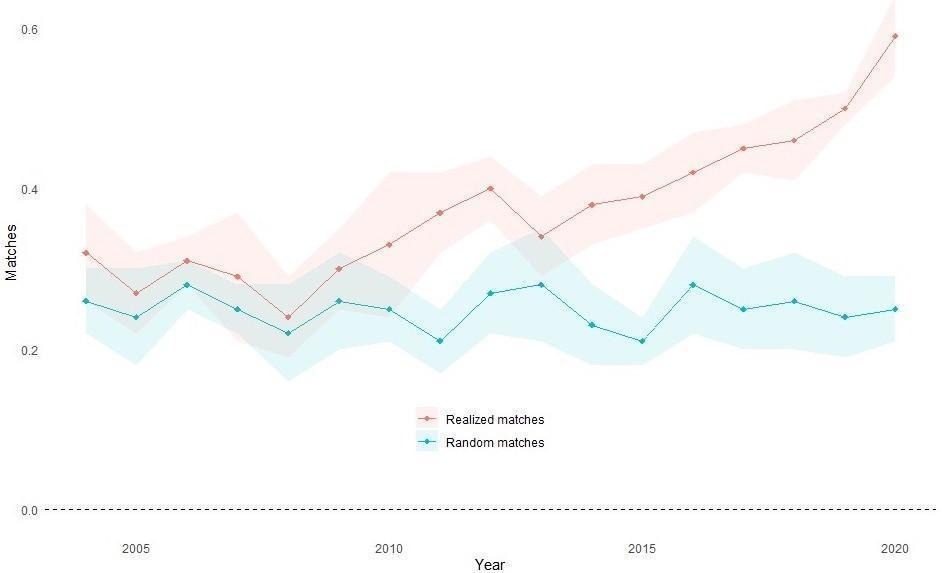
Figure 2 compares how these partisan patterns differ from what we would expect to see based on a random selection of a firm’s suppliers from their state. Observed partisanship consistently exceeds the partisanship of the random selection; this gap has widened over time as polarization has deepened. Firms are not simply operating in more partisan industries or sorting by geography. They are actively selecting suppliers along political lines.
Figure 2. In this figure, we compare the actual fraction of partisan-matched suppliers of sample firms and the counterfactual potential matches if firms chose suppliers randomly within the same industry and state. The realized matches were 0.36 in 2004 (0.28 in randomized scenario) and 0.58 in 2020 (0.25 in randomized scenario).
To estimate the overall likelihood of partisan matching, we show that Republican-leaning customers were more than 60 percentage points more likely to choose Republican-leaning suppliers, and Democratic-leaning customers were over 30 percentage points more likely to choose Democratic ones, relative to politically-neutral firms. These patterns hold after controlling for industry and geographic political trends, and for the natural tendency of firms in particular states to source from familiar nearby industries. Interestingly, partisan matching is more concentrated in manufacturing sectors. Customers in California, Ohio, Michigan, and Texas are also more likely to have partisan-matched suppliers.
Why are US supply chains becoming polarized?
Why would politics enter what is, in principle, a question about cost, quality, and complementarity? Standard theories of supplier choice emphasize transaction costs, comparative advantage, and input specificity—not ideology. If anything, political diversity might reflect distinct capabilities and market access, making cross-party relationships more valuable than less. For example, political heterogeneity might proxy for distinct capabilities and market access, making cross-party relationships more valuable. Regulatory and procurement regimes vary across jurisdictions and alternate with electoral outcomes, so partners in opposing coalitions span a wider market and hedge against political risks.
The economics of supply chains, however, also has a long-standing recognition that contracts and the risks and costs they cover are rarely complete. Suppliers make relationship-specific investments, like improved technology or equipment that can make business more efficient and benefit both parties, with no contractual guarantee of return. When disruptions occur, such as a hurricane that restricts their production capacity, suppliers have to decide which customers to prioritize. In settings where discretion outside the contract matters, shared identity and trust can substitute for contractual protection. Our hypothesis is that political alignment now serves as a kind of insurance, protecting business customers against opportunism and deprioritization when disruption strikes.
Four pieces of evidence support the insurance interpretation. First, partisan matching intensifies precisely when risk rises. We studied two regulatory shocks. The first was California’s 2007 CARB greenhouse gas regulation, which created compliance costs for California suppliers and business customers. Meeting the standard required suppliers and their business customers to coordinate on specifications and timelines, and neither side can easily include in their legal contracts. The second was the staggered state-level adoption of the Uniform Voidable Transactions Act, which states adopted piecemeal from (2014–2018) and which strengthened supplier creditor rights in cases of unfair transactions by business customers. This increased the bargaining power of suppliers when they owed money to customers. Following each shock, firms became substantially more likely to form new relationships with politically-aligned suppliers in the affected states. This pattern holds for both Republican- and Democratic-leaning firms.
Second, politically-aligned relationships prove more resilient when economic shocks actually hit. Following natural disasters, severe weather events, and regulatory shocks in the supplier’s state, politically matched business partnerships are 4-15 percent less likely to break.
Third, and consistent with investors recognizing the resilience of partisan relationships, firms whose suppliers were caught in Hurricane Sandy (2012) and Hurricane Harvey (2017) experienced significantly smaller stock-price declines if they had a higher share of politically-aligned suppliers. A one-standard-deviation higher share of aligned suppliers reduced abnormal losses around Hurricane Harvey by roughly 61 percent relative to the mean.
Fourth, alignment intensifies where contracts are most incomplete. Consider customers with above-median political risk: energy, utilities, and healthcare firms whose earnings calls are dominated by regulatory uncertainty. After a shock, these customers are 45 (Republican) and 32 (Democratic) percentage points more likely to choose an aligned supplier. That is a 90% and 64% increase over the mean. High-ESG-risk customers show the same pattern. On the supply side, the effect concentrates among R&D- and patent-intensive suppliers of semiconductors, specialty chemicals, and precision components. These inputs are built to a customer’s specification and cannot be re-sourced quickly. Here alignment rises by 35 and 31 percentage points.
The cost of politically polarized supply chains
Insurance, however, has a price. Firms pay politically-aligned suppliers experiencing an economic shock markups on continued service that are 22 percent higher than those paid to unaligned suppliers facing the same shock. The premium appears to be a price for stability. There is also a price to productivity. Firms with a higher share of politically-aligned suppliers patent less and announce fewer new products after supply-chain shocks. Partisan supply chains optimize for continuity over recombination. This preference for stable, trusted relationships reduces the incentive to seek better inputs or to form partnerships with suppliers offering different capabilities.
Conclusion
Political polarization is not often studied in the context of industrial organization or supply-chain management. Yet, modern economies rely on networks of long-term inter-firm relationships, and trust, coordination, and informal cooperation are exactly what those networks run on. Our evidence shows that, in a polarized environment, firms are willing to pay a premium for relational insurance and that markets are willing to reward them for it. That tradeoff may be rational at the firm level, but it possibly reduces supply-chain recombination and efficiencies, narrows knowledge spillovers, and slows technological progress. Empirically substantiating these possible costs should be the subject of further study.
Our results open new questions for public policy. Supply chain diversification programs, reshoring incentives, and supplier development initiatives can deliver less than expected if partisanship limits the pool of suppliers with which firms are willing to engage. The current toolbox of tariffs and subsidies can shift production location. However, they cannot restore the erosion of efficiencies and innovation that polarization is draining from U.S. supply chains. Managing that friction may prove as important as any single industrial policy.
Authors’ Disclosures: The authors report no conflicts of interest. You can read our disclosure policy here.
Articles represent the opinions of their writers, not necessarily those of the University of Chicago, the Booth School of Business, or its faculty.
Subscribe here for ProMarket’s weekly newsletter, Special Interest, to stay up to date on ProMarket’s coverage of the political economy and other content from the Stigler Center.