




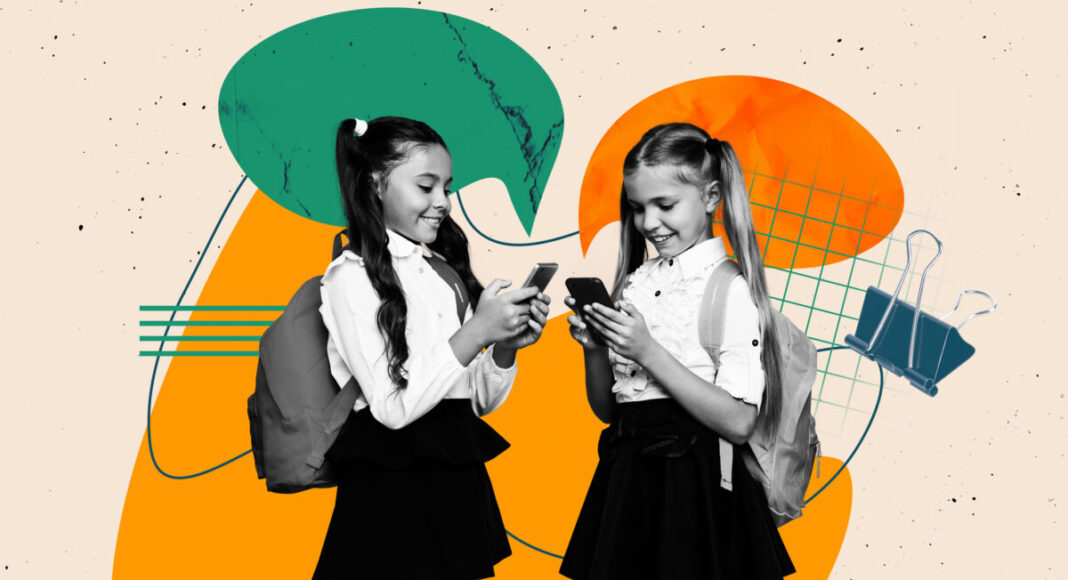

Following a decade of declining youth mental health, many states have attempted to limit children’s access to social media and the internet by banning smartphones in schools. In new research, Henry Saffer finds no evidence that in-school smartphone bans have any effect on the screentime or mental well-being of young Americans.
The declining mental health of teens has emerged as a critical public health concern. Research shows an increase in persistent feelings of sadness, hopelessness, and thoughts of suicide among young Americans. An increasing number of public health researchers, including the United States Surgeon General, have argued that the use of social media is a factor in the decline in the mental health of young people. This operates through several mechanisms, including sleep deprivation, attention fragmentation, loneliness, and social comparison. Time spent on social media also reduces time spent in real-world activities, which are important for developing social skills, navigating risks, and building resilience. This can lead to increases in anxiety, depression, self-harm, and suicide risk.
Researchers and public health officials have explored several approaches to reduce the harms from social media and other online activity. One approach centers on smartphones. These devices provide access to useful everyday information and help youth with learning and homework assignments. However, they also provide ever-present and easy access to social media, artificial intelligence, gambling, and other potentially problematic forms of online interaction and entertainment. The average age at which young people get their first smartphone is around 11.6 years old. Over 40% of American children have a smartphone by age 10, rising to over 70% by age 12.
State-mandated smartphone bans in schools have become a widely adopted policy to mitigate these negative effects on teens. These bans are popular with parents and are easier for states to enact than policies limiting access to large internet platforms. Schools have had some form of phone restrictions for many years. However, these older restrictions relied on teacher-led enforcement, such as verbal warnings or confiscating phones. Currently, more than 30 states have adopted some form of mandated school ban on smartphones, and more are considering adopting this policy.
School bans are appealing, but they often encounter problems with enforcement and may require funding to obtain secure storage solutions for student devices during school hours. School bans may also require schools to provide reliable methods for parents to contact their children during the school day to address emergency concerns. There are also no causal studies showing that these bans have any effect on children’s mental health.
My research is the first to examine the causal effects of school smartphone bans on youth mental health in the U.S. I compare states which imposed the school bans with states that did not. To better estimate the effect of the policy, I used a statistical procedure that creates a group of untreated states which closely matches the outcomes in the treated states before the treatment was imposed. The data came from the National Survey of Children’s Health (NSCH) from 2016 to 2024. These data are collected in every state and include extensive yearly information on the mental health of about 18,500 children each year. However, currently only three states have any post-ban data available for comparison, making my estimates preliminary.
The study examines total screen time and assesses mental health using eight measures of psychological well-being. The first seven are positive measures of well-being, such as caring about doing well in school, doing the required homework, and showing interest and curiosity. Each of these measures declined significantly from 2016 to 2024. Typically, these measures fell from about 95% positive in 2016 to about 82% positive in 2024. The eighth measure assesses being bullied, picked on, or excluded by others. This measure is a negative factor in psychological well-being, and it increased from about 5% in 2016 to 11% in 2024. Total screentime, which includes all devices with a screen, also increased by about 30 minutes over this period.
Overall, the preliminary statistical results provide no evidence that school smartphone ban policies reduced screentime or improved the psychological well-being of students. That is, the declines in well-being were statistically the same in states with school smartphone bans and states without these bans.
Other research papers have also explored the impact of reducing smartphone use on children’s well-being. One paper studied the effects of requiring students to store their smartphones in lockable pouches rather than implementing school bans. Required storage in pouches differs from state mandated bans in that not all state mandates require the use of pouches and schools can choose to require pouches without a state level mandate on smartphones in schools. The researchers measured students’ sense of well-being while at school and how connected students felt to their teachers and peers. The survey also included data on supportive relationships outside the classroom but, unlike my paper, did not assess psychological well-being when outside of school. The researchers found that pouch adoption substantially reduced phone use in schools. Furthermore, during the first year after adoption, students’ reported in-school well-being declined but improved in later years. They found no impact on test scores and little evidence of effects on school attendance, self-reported classroom attention, or perceived online bullying.
The lack of evidence of beneficial mental health effects from state-mandated school smartphone bans in my study could be due to three alternative factors. First, bans reduce in-school phone use, but neither my paper nor other studies find evidence that they reduce total weekly smartphone use. As a result, the bans are unlikely to affect overall mental health. Second, declining mental health among children with limited parental support may lead these young people to turn to online contact with friends and others for support. School bans could therefore reduce mental health for these students, resulting, on average, in no observable overall effect. Third, not enough time has elapsed for the effects of school bans to become apparent.
Reducing the harmful effects of smartphones on youth may at this time seem like an impossible challenge. However, cigarette smoking among young people provides a partial historical parallel. The two differ in that cigarettes have no positive value, while smartphones clearly do. Thirty years ago, many people thought that young people would never quit smoking. Today, however, almost no young Americans smoke cigarettes. Achieving that outcome took many years and relied on a wide variety of anti-smoking policies. The current research suggests that addressing the problems associated with smartphones and youth will require more than in-school phone bans.
Other options for reducing the harms associated with smartphones include legal challenges. Forty state attorneys general have filed lawsuits against Meta, claiming that it is harming young people and contributing to the youth mental health crisis by deliberately designing features on Instagram and Facebook that get children addicted to its platforms. Another legal approach involves lawsuits brought by parents alleging that social media platforms deliberately addict and harm children. Like the tobacco companies before them, social media companies strongly contest these claims, arguing that they have extensive safeguards to prevent misuse by young people. Schools could also provide digital literacy and emotional regulation training. To identify an effective path forward, more causal empirical evidence on the effects of these approaches on youth mental health is essential.
Authors’ Disclosures: The author reports no conflicts of interest. You can read our disclosure policy here.
Articles represent the opinions of their writers, not necessarily those of the University of Chicago, the Booth School of Business, or its faculty.
Subscribe here for ProMarket’s weekly newsletter, Special Interest, to stay up to date on ProMarket’s coverage of the political economy and other content from the Stigler Center.