



Henry Simons, the “Crown Prince” of the Chicago School and a professor in the economics department and the law school prior to World War II, sought to develop a laissez faire economics program devoted to eliminating monopoly and pursuing egalitarian goals. George Stigler and the Chicago School abandoned Simons’s anti-monopoly and egalitarian program. The best market became one driven by the search for profits, and the best-functioning marketplace of ideas arose where winning ideas reflected the greater funding backing them, writes Edward Nik-Khah.
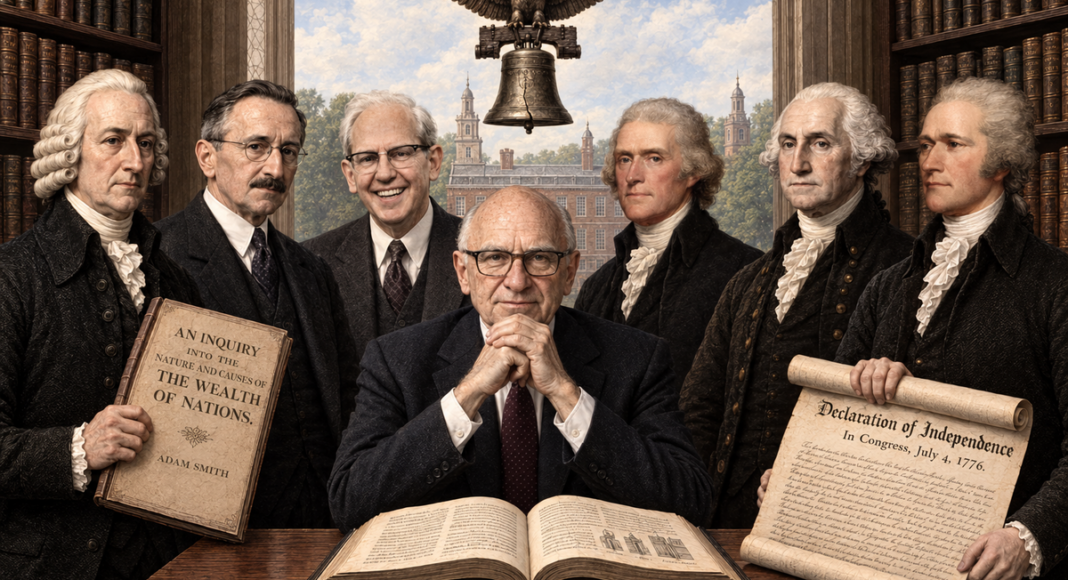
Editor’s note: This year celebrates the 250th anniversaries of the American Declaration of Independence and the publication of Adam Smith’s Wealth of Nations. It is also 50 years since Milton Friedman won the Nobel Prize in economics. This article is part of a symposium revisiting the ideas of freedom and political economy expounded by the American revolutionaries, Adam Smith, and the Chicago School of economics, and how they connect to contemporary concerns about capitalism and democracy. You can read the rest of the articles here as they are published, with contributions from Peter Boettke, David Mitch, Robert Van Horn, Sandra Peart & David Levy, Maha Rafi Atal, Edward Nik-Khah, and Richard R. John. We welcome responses, which you can send to promarket@chicagobooth.edu.
In his 1974 biographical essay on his former teacher Henry Simons, George Stigler wrote: “Henry Calvert Simons was the Crown Prince of that hypothetical kingdom, the Chicago School of economics, and even at this late date it is desirable to present the main facts about the man and his career.” Today there are two ways people speak of Simons’s legacy, and both may claim a measure of support from Stigler’s memorable description.
The first takes Stigler’s “Crown Prince” moniker as conclusive evidence of Simons’s authoritative influence. This impression may claim additional support from Aaron Director, Milton Friedman, and Allen Wallis’s acknowledgments of his influence at Chicago during the 1930s and ‘40s, offered during Edmund Kitch’s “Fire of Truth” roundtable. It resurfaced at a 2015 Becker Friedman Institute conference, which devoted itself to exploring “the lasting impact of [Frank] Knight, Simons, and [Jacob] Viner in shaping Chicago economics.” These were among the most important Chicago economists during the interwar period.
According to Douglas Irwin: “Simons had an enormous impact on many Chicago economists, so much so that George Stigler referred to him as the ‘Crown Prince of the Chicago School.’” George Steele’s recent book on Simons took “Crown Prince of the Chicago School” as its subtitle, adding that “better accolades are not readily found” and insisting that this “tenor of appreciation has endured.”
But omitting Stigler’s qualification “of that hypothetical kingdom” has the effect of obscuring the verdict he delivered in that very same essay: “the evolution of institutions and theories has moved [the Chicago School] beyond Simons’ positions.” Stigler noted several such positions found within Simons’s Positive Program for Laissez Faire, particularly its “strong egalitarian element,” its “extensive and intricate set of tasks for the state,” and its “vague and contradictory picture of the state.”
Taking this rejection as its point of departure, the second approach to assessing Simons’s legacy emphasizes the decisive influence of Friedrich Hayek who, in The Road to Serfdom, had positioned himself as an opponent of the laissez-faire liberalism previously encountered within Hyde Park. Nevertheless, those then present at Chicago would enthusiastically support what they referred to as the “Hayek Project.” In 1946, Friedman wrote to Wallis: “A project is being set up in the law school to prepare a ‘positive program for laissez-faire.’ This is Hayek’s baby… I think it would be something both of us would have a strong interest in and would put considerable effort on.’” Decades later, following his receipt of the Bank of Sweden/Nobel Prize, Stigler linked the birth of the Chicago School of Economics to that of Hayek’s Mont Pelerin Society: “there was no Chicago School when the Mt. Pelerin Society first met at the end of World War II.” It was Hayek’s “positive program,” rather than Simons’ original one, that was formative for the Chicago School of Economics. Simons’ Positive Program was henceforth rejected on the grounds that it was too close to “collectivism” for comfort.
Stigler’s fellow laureate, the MIT economist Robert Solow, has maintained there were not one but two Hayeks. The first was the author of the “Use of Knowledge in Society,” a scholar concerned with addressing the role of knowledge in the economy and society. The second was the author of the Road to Serfdom and unfortunately prone to politically motivated overstatement. Without necessarily fully subscribing to Solow’s interpretation, it is reasonable to wonder whether Hayek’s views on knowledge also rubbed off on Chicago. They did indeed, in far too many ways to recount here, and none more consequential than in Chicago’s reconsideration of the economist’s relationship to knowledge, a transformation whose significance we may appreciate by considering Simons as a baseline for comparison.
In his Positive Program, Simons had placed himself within a long tradition of opposition to those pamphleteers of what Adam Smith labeled “the mercantile system.” From his 1930s vantage point, Simons dreaded that “both capitalism and democracy are soon to be swept away forever by a resurgence of mercantilism.” Smith’s Wealth of Nations had combined a concern with political corruption (merchants’ proposals should be paid “the most suspicious attention”) with an attack on the epistemic standing of merchants and their apologists. It admonished parliaments and princes for routinely deferring to their judgments on trade policy issues. Pursuit of the wealth of the nation required a different kind of knowledge and an expertise willing and able to call upon it in service of the public interest. The form of discourse inspired by this view became specialized and professionalized—first as “political economy,” later as “economics”—as its participants claimed to rise above the din of competing interests to gain scientific authority.
Chicago came to see matters quite differently. In his essay “The Intellectuals and Socialism” (which Director arranged to have published in the University of Chicago Law Review), Hayek famously blamed the ascendance of collectivism on the “professional secondhand dealers in ideas,” his derisive term for intellectuals whom he accused of hewing to the prevailing “climate of opinion.” Director continued its line of attack with the accusation that intellectuals placed too much confidence in democratic discussion and not enough in economic exchange. To make his case, Director appropriated the “marketplace of ideas,” a term originally understood to support calls to protect unpopular political speech and foster democratic discussion. He intended to wrongfoot those prioritizing the market for ideas over the market for goods. But his gambit unwittingly raised a thorny question: if both markets generally worked, then why did the marketplace consistently produce the wrong economic ideas?
Stigler took primary responsibility for working out Chicago’s answer. He had previously linked markets to higher education as early as the 1957 Mont Pelerin Society meetings, and he argued that the same forces operated in trade and intellectual life in his 1963 The Intellectual and the Market Place. His work exploring information in markets led Stigler to assert, “economic agents learn all the precisely knowable things it pays them to know—always on average—and act with due regard to this knowledge.” He exempted no one from what he called the “Chicago Credo,” going so far as to accuse Friedman, who regularly engaged in public intellectualism, of violating it: people “buy the amount of economic information that’s appropriate for them to have. And they don’t go home every night and say, ‘I wonder what Friedman wrote today that I can read.’” Rational actors learn all that is worth for them to know and have no need to consume the ideas of public intellectuals.
Stigler contended that science might succeed in challenging collectivism where Friedman’s “preaching” failed. Yet his view of science was highly unorthodox. Sharing Hayek’s and Director’s misgivings about intellectuals, he leveled a similar criticism against scientists, including his fellow economists: “I cannot believe that any amount of economic training would wholly eliminate the instinctive dislike of a system of organizing economic life through the search for profits.” Although Stigler is well-known for arguing the study of economics may make one “conservative,” he held that in practice this would rarely happen. Economic training would have little effect in eliminating collectivist policies. He arrived at a startling conclusion: “An elite must emerge and instill higher standards than the public or the profession instinctively desire.” Self-regulation was appropriate for the economic market, but not the scientific community. Stigler called for an external shock to the academic system. The Chicago School could help provide this shock.
The question of how to challenge collectivism, considered in light of the Chicago Credo, became a question of how to find patrons willing to fund the jolt. Complicating matters was that there were few suitable candidates: they must be uncontaminated by the egalitarian views shared by the government, most of academia, and the public at large. Fortunately, they were out there, and they were motivated. In a talk entitled “To What Tune Does Science Dance?” Stigler observed that antitrust and industrial organization economics in the United States “was generated by both public policy and business defenses against it.” Business became the obvious ally. Although this alliance certainly included “Hayek’s baby,” Hayek personally would have thought it best to keep a lid on such financial arrangements with business. (“If [the liberal] takes advantage of such support as he can get from the men of affairs, he will almost certainly discredit himself with those on whom he depends for the spreading of his ideas.”) Stigler had no such reservations: “Being paid to do something is the basis between an amateur and a professional, and professionals are commonly more skilled than amateurs.” In the marketplace of ideas, the economist was a “customer’s man” and attracting a paying clientele served as evidence of competence.
By the 1970s, Chicago’s view of the marketplace of ideas had come into focus: the scientific community’s capacity to discover knowledge was inferior to that of the market; advertising, corporate sponsorship of research, and direct forms of corporate participation in knowledge production were part and parcel of the market’s proper operation. Later, as the research process was reengineered accordingly, the distinction between economist and businessperson would blur. For example, among members of the Chicago School, Becker’s affirmation of famed junk bond investor Michael Milken, who was investigated for fraud and pled guilty to felonious securities and tax law violations, might have raised an eyebrow: “Mike [Milken]’s most important achievement is that he thinks like a Chicago economist. He never studied here formally, but he does things like a Chicago economist.” No longer.
Stigler took his own advice. In 1971, he hit upon the idea of building a research institute. It would be privately funded, its appeal to patrons lay in its ability to deliver of an influence that Friedman’s preaching could not: “The relevance of this work to public policy will be both indirect and decisive.” Stigler proposed two kinds of studies. The first aimed to develop what he called “intelligent guides”: techniques for auditing and guiding, and thereby controlling, regulatory bodies. The second would study the “capacities of democracy” for the purpose of counteracting the unrealistic views of political scientists and economists or, as Stigler inimitably put it, “shatter the fond hopes of the scholarly professions.” This research would study the determinants of the growth of government and regulation and develop pressure group models. Stigler’s “capture theory” of regulation served this purpose by treating politics as a market, and hence as an expression of private interest. Taken together, these studies not only would offer a corrective to the sort of “vague and contradictory picture of the state as an instrument of economic policy” Stigler attributed to Simons and his (non-Chicago) contemporaries alike but also would redirect state policy.
But did this work escape contradiction? If regulation was sought by and operated for the benefit of industries, what to make of the pharmaceutical industry’s enthusiastic participation in Chicago’s attacks on the Food and Drug Administration? Of Stigler’s personal role in these attacks? More important perhaps than maintaining a rigorous consistency between theory and practice was endorsing the position that the discovery of knowledge was properly the market’s responsibility.
It was a watershed moment. Since Adam Smith’s time, concerns that commercial interests would undermine or corrupt knowledge had been bound up with the very possibility of a dedicated expertise on the economy. Now Chicago championed the position that pecuniary interest would advance knowledge. Two hundred years after the Wealth of Nations, Stigler opened The Center for the Study of the Economy and the State. Its funding by Proctor and Gamble, Amoco, and Getty, as well as the Scaife, Lilly, and Olin Foundations could be interpreted as evidence it had earned the market’s imprimatur. According to the new thinking, this affirmation was the one that truly mattered.
Author’s Disclosure: The author reports no conflicts of interest. You can read our disclosure policy here.
Articles represent the opinions of their writers, not necessarily those of the University of Chicago, the Booth School of Business, or its faculty.
Subscribe here for ProMarket’s weekly newsletter, Special Interest, to stay up to date on ProMarket’s coverage of the political economy and other content from the Stigler Center.