






In new research for the Foundation for Individual Rights and Expression, David M. Primo uses campaign contribution data to show that professors at leading universities are more politically active than the average American and skew heavily to the left politically, raising concerns about the diversity of perspectives on college campuses.
The majority of faculty members at leading universities in the United States lean to the left politically, and professors are much more likely to be registered to vote as Democrats than Republicans. This much is well-known. But, these stylized facts do not speak to two important questions in higher education: how politically engaged are faculty members, and how ideologically diverse is the professoriate? (To be a registered Democrat, for example, elides a wide spectrum of liberal beliefs that a Democrat might hold.) In a recent study, I find that faculty are very politically engaged but are also very similar to one another ideologically, raising important questions for whether John Stuart Mill’s marketplace of ideas, which calls for the unbounded exchange of competing arguments, is truly thriving in higher education.
The Foundation for Individual Rights and Expression (FIRE) commissioned me to study these questions by analyzing how faculty members at 55 leading private and flagship state universities contribute to political campaigns. This is the same set of universities that FIRE studied in a 2024 faculty survey on freedom of expression and academic freedom. (To ensure my independence as a scholar, I had complete editorial control over the project, and all conclusions are mine.)
This approach is novel, but not unprecedented, in studies of faculty ideology. Researchers typically use voter registration data or surveys to study faculty ideology. Voter registration data tells us the Democrat and Republican breakdown of faculty members in the 30 states where registered voter party affiliation is publicly available. Registered Democrats outnumber registered Republicans among faculty by a ratio of 8.5 to 1, but we can’t say much more about the views of the faculty based on these data. Surveys offer more detailed data by asking respondents to place their ideology and party identification along a left-right scale. For instance, FIRE’s 2024 faculty survey measured party identification on a seven-point scale from Strong Democrat to Strong Republican, finding that Strong Democrats outnumbered all Republicans by a factor of 2.5 to 1. One limitation of surveys is they rely on self-reports and often have low response rates. Moreover, neither voter registration data nor survey-based ideology measures capture whether faculty members are politically engaged.
Campaign contributions, on the other hand, are based on observed behavior and, thanks to methodological innovations by Stanford political scientist Adam Bonica, can be used to place donors, candidates, and elected officials on the same ideological scale. Bonica’s methodology analyzes over 850 million campaign contribution records, primarily from federal campaigns. The intuition is that if we know the ideology of candidates and elected officials, we can then use the behavior of donors to estimate their ideology. For instance, a donor who gives to moderate Republican Senator Susan Collins is likely to be ideologically distinct from someone whose donations all go to the more conservative Republican Senator Ted Cruz. Bonica refers to this estimate, which looks at the history of an individual’s donor behavior, as a CFscore. A more positive score represents a more conservative individual, while a more negative score represents a more liberal one.
Donation behavior is thus useful as both a way to measure ideology and as a proxy for political engagement. This measure is widely used by researchers, including to study the ideology of corporate executives.
So what does the data tell us about the faculty at schools like Harvard, Stanford, UPenn, and Texas A&M? First, over a quarter of the faculty at these schools are politically active (defined here as having a CFscore). Stanford has the most politically-engaged faculty—over 40%. In 2024, faculty members at the 55 schools in FIRE’s sample were four to five times more likely to make a campaign contribution than the average American.
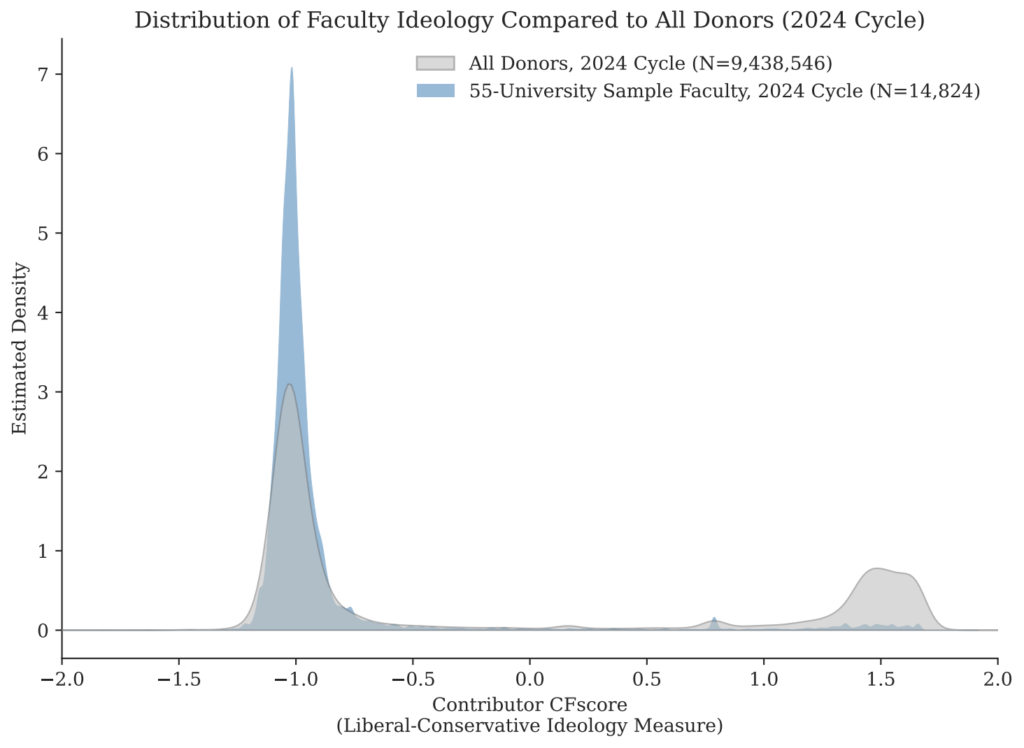
Second, there is a notable dearth of ideological diversity among faculty donors. Figure 1 below shows the ideological distribution of faculty donors from the FIRE 55 schools in 2024 compared with all individual campaign donors across the country who gave in 2024. The comparison looks similar when I study all faculty donors in 2024, not just faculty at the FIRE 55 schools.
There are two noteworthy features of Figure 1. First, the typical faculty donor is very far to the left (in the ballpark of Alexandria Ocasio-Cortez and Bernie Sanders, the most liberal members of Congress). Second, there is a clear presence of conservative donors among the American public, and virtually none among the faculty. This reflects a narrowing of views among faculty donors which has intensified in the past three decades.
Figure 1: Distribution of Faculty Ideology Compared to All Donors (2024 Cycle)
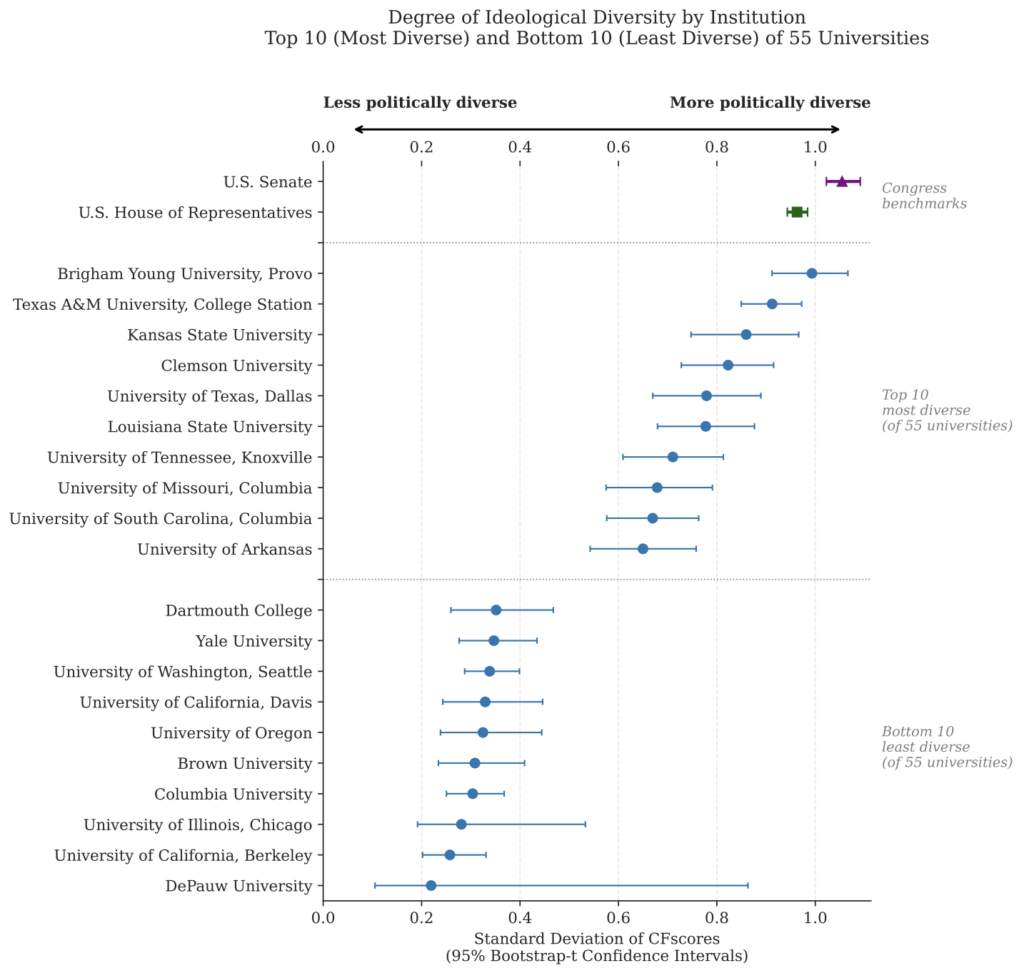
To be sure, there is variation in ideological diversity (measured here as the spread of faculty donors across the CFscore ideological scale) at these schools, with increased diversity driven by at least a smattering of conservative representation among faculty donors. Figure 2 depicts the most and least diverse schools ideologically, with flagship Southern state universities among the most diverse, and many Ivies and state schools on the West Coast among the least diverse ideologically.
Figure 2: Degree of Ideological Diversity by Institution
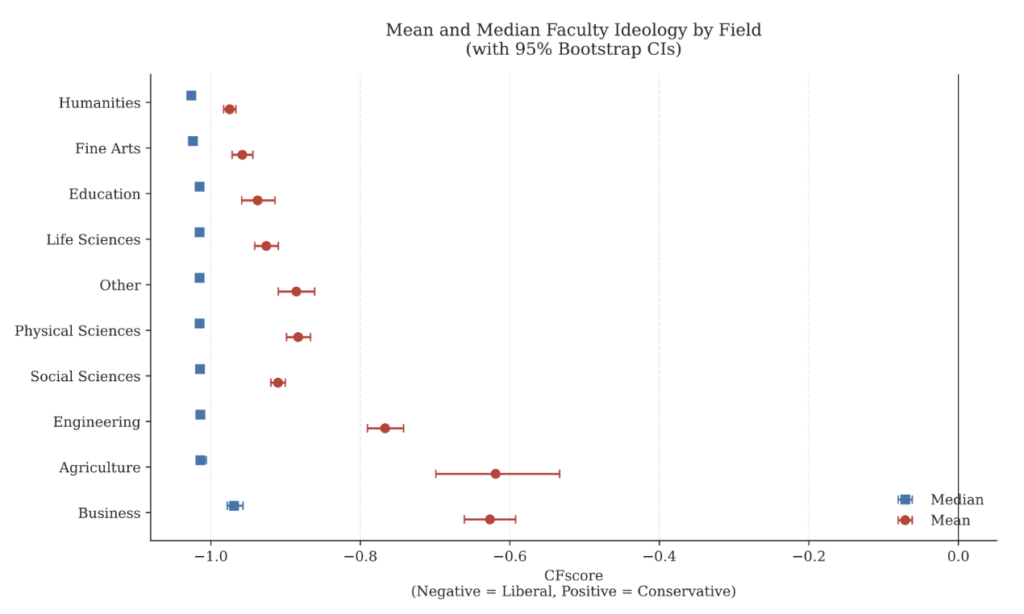
There is more, but still limited, variation in faculty ideology across fields. Business, as expected, is more ideologically diverse than the humanities, but it is far from conservative, as the conventional wisdom would have you believe. In fact, as Figure 3 shows, the median business faculty member has much in common ideologically with the median humanities faculty member, and even the mean business faculty member is well to the left on the CFscore scale.
Figure 3: Mean and Median Faculty Ideology by Field
Critics have noted that my research does not address whether faculty donors are representative of the faculty as a whole at these schools. For instance, it’s possible that conservative faculty are less likely to declare a party affiliation when registering to vote or make public donations to political campaigns, perhaps because doing so risks professional ostracism. This merits further study, but representativeness is not obviously a greater concern with campaign finance data than with survey or voter registration data. Furthermore, if fear of ostracism is an explanation for variations in behavior between conservative and liberal faculty, then this would itself be evidence that the marketplace of ideas is not functioning as well as it should.
Either way, the lack of ideological diversity has implications for universities—institutions that are vital for the effective competition among ideas. Just as consumers benefit from competition among firms, so too does science benefit from competition among ideas. Of course, anyone who has spent time on a college campus knows that ideas are debated and are contested. But what we don’t see are the questions that are not asked, or the answers that are not published, because scholars fear they will be viewed as verboten by their peers.
Jonathan Haidt and his coauthors pointed this out in the context of social psychology, arguing that limited political diversity changes the nature of research questions that are asked and increases the risk of confirmation bias when assessing findings. One example they provide is a study that characterized disagreement with environmentalist beliefs as a “denial” of reality, even though the measures relied on disputed or vague claims rather than clear facts.
In finance—hardly viewed as a bastion of liberalism—papers questioning the returns to environmental, social, and governance (ESG) policies within firms were virtually nowhere to be found in top journals prior to the backlash against ESG in 2021, at which point they began to appear. While it is difficult to prove causality, it is not hard to imagine that papers with results at odds with the dominant narrative on ESG were more likely to be rejected (or never submitted in the first place).
The bottom line is this: When the professoriate, and especially its most politically engaged members, is ideologically homogeneous, some questions may not be asked, some findings will be harder to publish, and some arguments are less likely to be presented in the classroom.
Of course, we have much more to learn about how faculty ideological diversity shapes higher education as an institution. Just as political scientists devote significant effort to studying the impact of politically engaged Americans, so too should scholars be interested in better understanding the role of politically active faculty members on college campuses (and beyond). Do politically engaged faculty members have an outsized role in faculty governance and curriculum design? Are they the most vocal faculty members on campus?
My hope is that this research will spur more conversation about how higher education can increase the diversity of views in research and teaching. Doing so won’t address all the challenges facing higher education. But it’s a start.
Authors’ Disclosures: The author reports no conflicts of interest. You can read our disclosure policy here.
Articles represent the opinions of their writers, not necessarily those of the University of Chicago, the Booth School of Business, or its faculty.
Subscribe here for ProMarket’s weekly newsletter, Special Interest, to stay up to date on ProMarket’s coverage of the political economy and other content from the Stigler Center.