




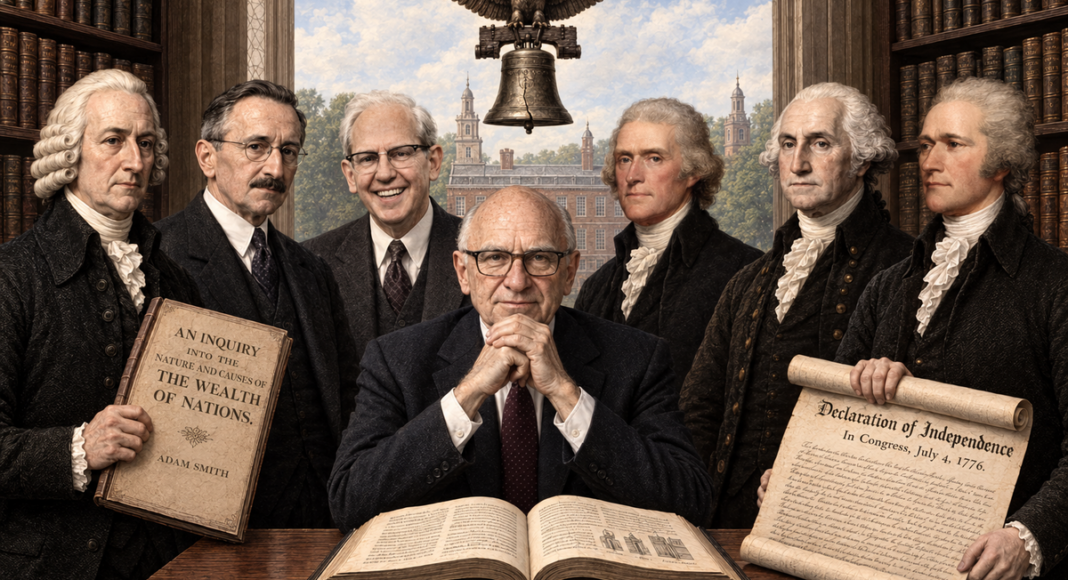

Adam Smith’s theory of political economy did not begin with the isolated individual but rather the individual who operates to earn the respect of others. Wealth and freedom grew from these relationships and engaging with others to create a free society, or what 20th century philosopher Isaiah Berlin’s would call positive freedom. In the 1970s and ‘80s, the Chicago School abandoned this aspect of freedom in preference of the isolated individual, which in turn produced a weaker concept of freedom, morality, and society that has stifled the cultivation of all three in the United States, writes Maha Rafi Atal.
Editor’s note: This year celebrates the 250th anniversaries of the American Declaration of Independence and the publication of Adam Smith’s Wealth of Nations. It is also 50 years since Milton Friedman won the Nobel Prize in economics. This article is part of a symposium revisiting the ideas of freedom and political economy expounded by the American revolutionaries, Adam Smith, and the Chicago School of economics, and how they connect to contemporary concerns about capitalism and democracy. You can read the rest of the articles here as they are published, with contributions from Peter Boettke, David Mitch, Robert Van Horn, Sandra Peart & David Levy, Maha Rafi Atal, Edward Nik-Khah, and Richard John. We welcome responses, which you can send to promarket@chicagobooth.edu.
Two texts published in 1776 have shaped the American understanding of freedom over the past 250 years. The Declaration of Independence announced that all men possess an inalienable right to liberty. Adam Smith’s An Inquiry Into the Nature and Causes of the Wealth of Nations argued that free exchange was the foundation of a prosperous society. Though they are often remembered separately, both texts were interventions in a fierce Enlightenment debate over the meaning of freedom. That debate took into consideration freedom of religion, freedom of association and expression, freedom of movement, and freedom from tyranny alongside freedom of contract and trade. Indeed, for Enlightenment theorists, these freedoms were not separable, but part of a broader social whole.
This is the context in which to understand what the Chicago School did with Adam Smith. Our contemporary American understanding of Smith has been mediated substantially by the reading offered by Friedrich Hayek and Milton Friedman. In The Road to Serfdom, Hayek drew on Smith to critique economic planning as a stepping-stone to totalitarianism: “Economic control is not merely control of a sector of human life which can be separated from the rest; it is the control of the means for all our ends.” In Capitalism and Freedom, Friedman cited Smith as the intellectual foundation for the claim that “Economic freedom is… an indispensable means toward the achievement of political freedom.” Both authors therefore invoked Smith to make the case for economic freedom as undergirding, perhaps even as tantamount to, freedom in general.
In doing so, as Glory Liu has argued, they shaped a usable Smith for the Cold War political moment, centering the “invisible hand” and market self-regulation. The “Chicago Smith” could be deployed to endorse the broad deregulatory policy project of neoliberalism. The imprimatur of legitimacy conveyed by laying claim to Smith played a role in that project’s implementation by governments and international organizations in the late 20th century—a project that did produce significant economic growth and the expansion of global trade, even as it also generated rising inequality and environmental harms. In the process, however, the Chicago School reduced Smith’s broad conception of freedom to a narrower economic one.
This article argues that only by recovering Smith’s more capacious understanding of freedom can we remedy the problems facing the United States in 2026.
Freedom in commercial society
Smith was writing at a time of profound upheaval. The Glasgow of Smith’s era epitomized this transition, rapidly shifting from a medieval cathedral city into the industrial capital of Scotland. The city’s absorption into the British imperial network transformed it into a strategic nexus for the transatlantic tobacco and cotton trades, deeply entangling its economic rise with the brutal trade in enslaved labor. Concurrently, domestic disruptions like the Highland Clearances that privatized communal farming drove a wave of displaced labor into the city, tripling Glasgow’s population in just fifty years. Living on campus at the University of Glasgow, at the heart of the central business district, Smith observed this transformation firsthand.
In this new “commercial society,” no longer bound by feudal hierarchies or the supreme authority of monarchs and popes, how would people learn to live together peacefully? How would they decide what was right and what was wrong? These were philosophical questions and Smith sought theories of human nature in response. In particular, Sankar Muthu has argued, Smith theorized “commerce” as something broader than trade to encompass social and cultural exchange across borders. The proto-globalization of the time, manifest in the imperial trading networks connecting Glasgow to the Caribbean, the Cape of Good Hope and India, was also a web that pushed disparate societies into direct contact. Enlightenment theorists viewed commerce as an engine of civilizational encounter—a mechanism through which humans could communicate across deep geopolitical divides.
This is why Smith’s Theory of Moral Sentiments and the Wealth of Nations must be read together. Collectively, they advance the view that human beings are social creatures. We imagine ourselves in the situations of others. We feel, however imperfectly, what they feel. It was this capacity that Smith believed was the foundation of decent society, in which people are driven to do good to others because we strive to be recognized as good. This moral framework directly governs the economic interactions of the Wealth of Nations: for Smith, markets work because human empathy tempers the pursuit of self-interest and prevents it from collapsing into predation.
Smith’s freedom—commercial liberty—is simultaneously economic, moral, and social. Most of all, it is relational, co-constituted through our encounters with each other. Because it is relational, commercial liberty cannot be reduced to the “negative liberty” of freedom from external control or government intervention. It is a collective property of societies, rather than a property of individuals. To achieve this form of freedom, society must be governed in ways that promote free commerce in the eighteenth century sense of the term.
Commercial liberty as positive freedom
The Enlightenment concept of commercial liberty was a form of what Isaiah Berlin would later classify as positive liberty. The wealth of a nation, for Smith, was not its aggregate stock of gold or the profits of its merchant class but the quality of life it afforded to ordinary people —including time for leisure, for family, for the social connections and cultural ties that make life worth living. “Every man is rich or poor,” Smith wrote, “according to the degree in which he can afford to enjoy the necessaries, conveniences, and amusements of human life.” Markets mattered insofar as they enabled people to achieve all three dimensions of a good life. Smith called this “the liberal reward of labour”: when wages are sufficient to raise workers’ living standards in each generation, those rising living standards incentivize workers to further productivity gains. Smith deemed this virtuous cycle the primary measure of a well-functioning economy.
Smith’s opposition to slavery followed directly from this, because only free workers, who share in the proceeds of their labor, can participate in the liberal reward. Enslaved labor was therefore both morally wrong and economically irrational. Markets for Smith could not be free if anybody was coerced into participating in them.
Smith extended the same logic to corporate monopoly: when powerful actors rig the rules, they restrict access to “free commerce” for others, corrupting the market itself. Smith wrote that when “people of the same trade seldom meet together, even for merriment and diversion, but the conversation ends in a conspiracy against the public, or in some contrivance to raise prices.” He reserved his harshest critique for the East India Company, a private corporation that had acquired sovereign power and used it to eliminate the competition, govern India without consent, and preside over ruinous famines. Smith called it “the worst of all governments,” and argued that expense of its tyranny meant it could never be profitable if subjected to real competition: “if the trading spirit of the English East India Company renders them very bad sovereigns, the spirit of sovereignty seems to have rendered them very bad traders.” Smith’s critique positioned economic freedom as contingent on a broader set of political and social conditions without which free exchange was impossible.
The Enlightenment conception of freedom was a universal one, but the gap between these stated principles and reality could be vast. Thomas Jefferson, while writing that “all men are created equal,” owned slaves, as did almost all of the men who co-signed the Declaration. In subsequent generations, that hypocrisy would be condemned, but it would also prove generative: It is because Enlightenment notions of freedom were stated universally, that they were available to be turned against their authors’ own limitations, by campaigners for abolition, racial equality and gender justice.
As Liu notes, the abolitionist Frederick Douglass compared racial slavery to the “commercial fallacies long ago exposed by Adam Smith,” and his analysis of slaveholders’ love of pride and domination closely echoes Smith’s own account of why slavery persisted against economic rationality. In his famous address “What, to the slave, is the Fourth of July,” delivered on Independence Day 1852 he placed the universal commitment to freedom in all its dimensions set out in the Declaration of Independence against the hypocrisy of the men who wrote and signed it: “What, to the American slave, is your 4th of July? I answer: a day that reveals to him, more than all other days in the year, the gross injustice and cruelty to which he is the constant victim.” But, in what was to become a great tradition of civil rights campaigners, he used the contrast not to reject the Declaration but to position it as a promise unfulfilled: “The principles contained in that instrument are saving principles. Stand by those principles, be true to them on all occasions, in all places, against all foes.” As CLR James chronicles in Black Jacobins, the Haitian revolutionary Toussaint Louverture similarly drew on the Enlightenment commitments of the French Revolution in his campaign to secure both the abolition of slavery and Haiti’s independence from France. Decades later, civil rights activist and feminist writer Audre Lorde would invoke this universal indivisibility of freedom within the women’s movement, famously declaring, “I am not free while any woman is unfree, even when her shackles are very different from my own.”
These thinkers understood, as Smith had, that the dimensions of freedom could not be disaggregated without distorting them.
The neoliberal narrowing
The Enlightenment concept of commercial liberty was fundamentally indivisible. It comprised an integrated architecture in which economic exchange was structurally inseparable from its political, moral, and social foundations. The core intellectual innovation of the Chicago School was to disrupt this holistic framework by isolating commercial liberty as economic freedom, while repositioning other dimensions of human liberty as the downstream consequences of that economic foundation. Whereas Smith viewed a free market as contingent upon moral sympathy and the institutional absence of domination, the Chicago School inverted this causal order. In their formulation, market freedom became the primary guarantor and originator of political and social rights.
This conceptual inversion can be understood through the framework of Isaiah Berlin’s negative and positive liberty. Neoliberal theory elevated a thin version of negative liberty—defined as the absence of state interference—as the ultimate political good. Yet negative freedom from the state is insufficient for individual agency if actors remain subjected to private domination, which is in turn sustained by the absence of moral sympathy and mutual recognition. By discarding the positive dimensions of commercial liberty, the Chicago School hollowed out the internal logic of Smith’s architecture, failing to account for the ways in which unconstrained markets generate distinct configurations of private coercion.
This inversion had significant consequences for how markets have been governed in the last half-century. First, the Bork revolution in competition law elevated the goal of consumer welfare, measured through price efficiencies, as the objective of competition policies. By this standard, corporate concentration that generates economies of scale might be seen as beneficial, in contrast to a Smithian approach to treating dominance, in and of itself, as a harm. In tandem, labor protections were dismantled under the banner of flexibility. As Angus Deaton has argued, the insulation of market mechanisms from broader social and moral obligations has produced a structural failure in which real wages for less-educated workers have stagnated or declined over the last half-century despite steady gains in corporate profitability, subverting the “liberal reward of labour.” Globally, the freedom of multinational corporations to source wherever labor costs are lowest and regulatory constraints weakest replicates not Smithian commercial liberty but the predation of the East India Company. This trajectory culminates now, as it did then, in the corporate capture of the state itself, whether through the revolving door between regulatory agencies and industry, or the “oligarchic sovereignty” of figures like Jeff Bezos and Elon Musk looming over the sovereignty of states.
The problems facing the United States in 2026—concentrated corporate power, stagnant wages, supply chains built on coerced labor, the erosion of democratic governance by private wealth—are not problems a narrow conception of economic freedom can address, but problems that framework helped create.
Conclusion
A return to Smith’s conception of commercial liberty does not require rejecting markets. It requires understanding what markets need to be free, recovering the Enlightenment insight that economic liberty cannot be separated from broader civic and moral freedoms. In this Smithian sense, antitrust enforcement that targets market concentration as an inherent harm is an essential defense against the economic tyranny of monopolies, restoring a vital layer of liberty that the Chicago School’s narrower doctrine dismantled. Similarly, establishing baseline legal protections for worker autonomy—such as collective bargaining rights—is what truly guarantees the “liberal reward of labor,” expanding the foundational freedom of association and expression within the workplace. This insistence on indivisible liberty extends globally, demanding comprehensive accountability across supply chains because a market system that profits from external coercion can never be considered free. It also mandates strict boundaries on corporate political influence to prevent private entities from subverting democratic governance by capturing the regulatory environments that govern them.
Far from a departure from Smith’s legacy, these interventions rescue his expansive vision of freedom from the restrictive, purely economic reading imposed by neoliberalism. Historically, the thinkers who extended Smith’s logic most rigorously fully understood that commercial liberty is a hollow concept if it is isolated from human dignity; reclaiming this holistic view is not an exercise in historical nostalgia, but the necessary prerequisite for building a truly free society in the twenty-first century.
Author’s Disclosure: The author reports no conflicts of interest. You can read our disclosure policy here.
Articles represent the opinions of their writers, not necessarily those of the University of Chicago, the Booth School of Business, or its faculty.
Subscribe here for ProMarket’s weekly newsletter, Special Interest, to stay up to date on ProMarket’s coverage of the political economy and other content from the Stigler Center.