






For decades, parts of the antitrust community have viewed private antitrust litigation skeptically, believing it is often frivolous or even inimical to robust federal antitrust enforcement. In new research, Filippo Lancieri argues that neither the law nor empirical evidence supports these claims and that private enforcement provides many positive social benefits to antitrust enforcement.
One of the most important, and still under-explored, developments in United States competition policy in recent years has been the “rebirth” of private antitrust enforcement in monopolization and merger cases. Significant wins by private parties and state attorneys general include Epic v. Google, labor antitrust cases, the Ticketmaster, Duke Energy, and NASCAR monopolization cases, blocking the Nexstar-Tegna merger, unwinding other mergers that harmed competition, and promising lawsuits against private-equity rollups. We have also witnessed the launch of new law firms and even technology startups dedicated to assisting plaintiffs suing to prevent anticompetitive actions. States have passed laws to implement a pre-merger review program that complements federal review.
This revival is already leading to pushback. Recently, the Department of Justice Antitrust Division implied that state attorneys general should not interfere with the review of mergers involving “federal interests” or whenever a merger’s effects extend beyond a single state (the fact that the federal antitrust laws apply only to “interstate commerce” notwithstanding). The American Chamber of Commerce, which has led the campaign against private enforcement rights more broadly, has also positioned itself against the “expansion” of private lawsuits in antitrust. This is but the latest iteration in a decades-long attempt to “cabin” the role of private antitrust litigation. For example, in 2003, Federal Trade Commission Chairman and General Counsel Bill Kovacic, now a (legendary) professor at George Washington University, gave a speech in a transatlantic competition forum where he affirmed that “The dosage of private rights injected into the enforcement mix is crucial to the policy result. A person who takes two aspirin will cure a headache; a person who swallows the entire bottle will die.” The message was and remains clear: “sound” competition policy requires a limited role for private plaintiffs.
In a recent article titled “Rethinking the Key Role of Private Antitrust Enforcement,” I explain why this view is historically and normatively wrong and lacks empirical support. On the contrary, as long recognized by U.S. legislation, sound antitrust policy requires an expansive and robust role for private litigation. That is because it plays a central role in: (i) providing enforcement resiliency that protects the system from undue political influence; (ii) increasing consumer awareness and creating political backing for antitrust enforcement; and (iii) creating a countervailing interest group that protects the marketplace of ideas on appropriate antitrust standards and intervention. This enforcement revival is very welcome, and much more is needed.
The misguided attack on the historical mandate for private antitrust enforcement
Start with the legislative and historical mandate: since their inception, the U.S. federal antitrust laws have conferred on private plaintiffs some of the most expansive private rights of action under any federal statute. They foresee, for example, expansive standing rights, treble damages, and the repayment of reasonable attorneys’ fees, and they allow private plaintiffs to litigate under legal standards similar to those used by federal enforcers when condemning cartels, monopolization, or even blocking mergers (criminal cases aside, obviously). These rights were later strengthened by the explicit granting of powers to state attorneys general to sue on behalf of their constituents, to private plaintiffs to obtain injunctive relief in a wide array of cases, and by stricter antitrust laws (such as the Robinson-Patman Act). From its inception, this expansive dual public-and-private enforcement system was seen as an essential part of U.S. antitrust policy, and these laws have not changed. To the contrary, the latest changes to federal antitrust laws—the 2022 State Antitrust Enforcement Venue Act—made it easier for state attorneys general to independently litigate antitrust cases and passed with broad bipartisan support.
The system responded as Congress intended: private antitrust enforcement has historically accounted for the bulk of U.S. federal antitrust litigation, enabling the federal government to focus on large, resource-intensive, and industry-transformative cases such as those against AT&T and IBM.
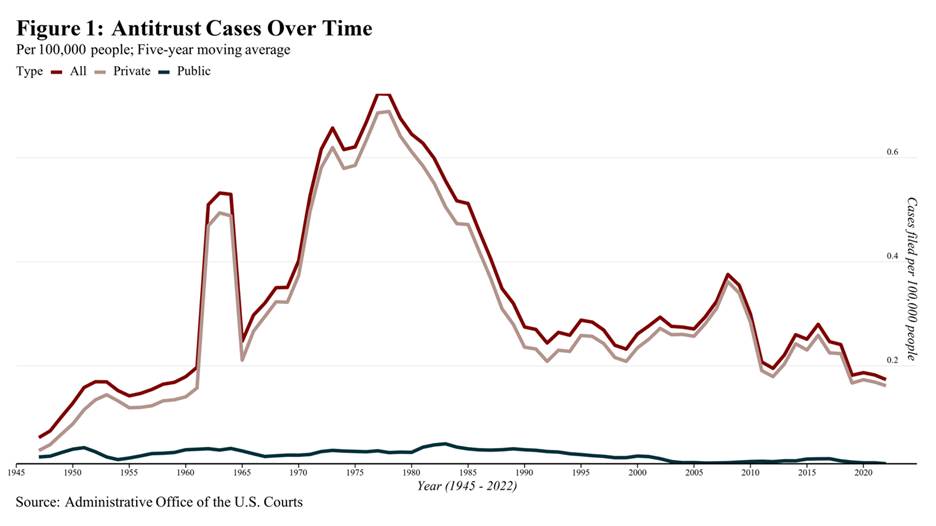
The late 1970s and early 1980s, however, marked a shift against private enforcement more broadly, including in antitrust. This broader shift matched a couple of important theoretical contributions by Steve Shavell and Louis Kaplow (among others), who indicated that there could be a divergence between private and public interests in litigation, as plaintiffs do not internalize all the costs of their lawsuits. The business lobby quickly appropriated these advancements to push for “tort reform,” often misleading the public discourse. Many will recall the private lawsuit against McDonald’s for serving “too hot coffee” as the epitome of how private litigation strays into the frivolous. However, what the McDonald’s case best exemplifies is how special interests and poor reporting deliberately hid facts and decontextualized the case to such an extent that HBO prepared an entire award-winning documentary to set the record straight.
In particular, in antitrust, most claims against private antitrust enforcement have rested on either circular reasoning or anecdotal evidence. Several careful surveys of private antitrust litigation have found no evidence that cases are frequently frivolous. The most detailed survey was conducted by my former colleagues Steve Salop and Lawrence White: the “Georgetown Study of Private Antitrust Litigation” comprehensively examined 2,350 cases filed between 1973 and 1983—the height of private antitrust enforcement—in five important judicial districts. The study concluded against claims that antitrust litigation costs were excessive and indicated that any push to limit private litigation required careful consideration of the actual costs of litigation weighed against their purpose to deter anticompetitive practices that are naturally difficult to detect and prove and compensate for their substantial harms. Such an analysis did not and does not exist.
This did stop those who sought to limit private antitrust enforcement. The Reagan administration proposed to remove treble damages from the antitrust law to diminish “frivolous lawsuits,” leading Salop and White to write a separate article in which they called the proposal “flawed.” The Reagan proposal failed, and unlike in other legal areas such as securities litigation, attempts to change the text of the antitrust laws to cabin private litigation have always faced significant political pushback and have never become law. Rather, the diminishment of private enforcement came from the courts, after significant lobbying by special-interest groups. Different, important opinions restricted private plaintiffs’ standing, tightened motion practice, made class certification harder, enforced arbitration clauses against statutory harms and redefined the contours of antitrust harm (among many others). These cases became part of the historical trend of U.S. courts, beginning in the 1970s, ruling in an explicitly anti-textualist manner in antitrust matters, even though there are no antitrust exemptions to the rules of statutory interpretation. Still, these reforms led U.S. private anti-monopolization and anti-merger litigation—which once accounted for almost 65% of all federal antitrust cases (with private merger challenges accounting for 6% of the cases)—to decline precipitously.
More recent academic studies indicate that these changes to private enforcement have led to both significant under-deterrence of antitrust violations and consumer harm, contributing to the widely recognized under-enforcement of American antitrust laws.
The normative case
The normative case to “cabin” private antitrust litigation to a small role was and remains equally weak. This is because antitrust litigation is unlike the baseline case described by Shavell and Kaplow (which offered only mixed theoretical welfare results, anyway). Rather, private enforcement generates at least three positive societal externalities that are not fully appropriable by plaintiffs.
The first is the diminished risk of regulatory capture. When antitrust enforcers do their job, they regularly face the largest, most politically powerful companies in any given economy. What is more, these companies have high-powered incentives to lobby against antitrust enforcement, as the introduction of competition means the immediate loss of (illegal) supra-competitive profits. In simple terms, if the breakup of a monopoly means a company will lose $1 billion in illegal future profits, and all power to file or drop a case rests with a single authority (e.g., the DOJ Antitrust Division), it is rational for the company to invest $999 million in lobbying against such enforcement. Indeed, companies have long successfully hired lobbyists to weaken antitrust enforcement, a trend that has accelerated in recent years. By increasing the number of parties that can bring lawsuits, private litigation diminishes incentives for regulatory capture—special interest groups now need to influence dozens of different potential plaintiffs. This dispersion of power helps to align antitrust enforcement more closely with the public interest in both merger and monopolization cases. It also shows why the DOJ’s recent claim that private plaintiffs should be confined to within-state mergers is short-sighted. Enforcement resiliency is the goal.
The second is thatcompensating consumers for harm caused by antitrust violations provides two important benefits to the antitrust system. First, it makes harmed people whole, a basic principle of a fair and just legal system. Second, increasing awareness of antitrust harms increases political support for enforcing the antitrust laws. It is no coincidence that the current political push for increased competition litigation is paired with increased political support for affordability and anti-corruption agendas on both the left and the right of the political aisle. Special interests thrive in quiet politics, and strong antitrust enforcement has always been correlated with strong popular scrutiny. Private enforcement provides an avenue for harmed parties to directly participate in the antitrust process and be compensated for their participation, shaping the broader political environment.
Third, bringing in more well-resourced actors diversifies the marketplace of ideas. Antitrust enforcement is characterized by substantial information and resource asymmetries among antitrust defendants, regulators, and society more broadly. Supra-competitive profits have historically flowed into the marketplace of ideas, making conflicts of interest and epistemological capture a major problem in competition policy. Defendants have funded think tanks, engineered astroturfing campaigns, captured academics, established revolving doors with regulators, organized networks to file amicus briefs in cases, and more. For example, since the mid-1970s, almost 80% of former FTC commissioners and DOJ Antitrust Division assistant attorneys general have gone to work for antitrust defendants immediately after leaving their public jobs, a pattern that correlates with a significant decline in federal antitrust litigation. A strong private bar can help offset these influences by creating a well-resourced, well-articulated interest group that can articulate and promote a pro-enforcement message. Think of the American Antitrust Institute or the Coalition for App Fairness, two important and sophisticated pro-enforcement groups that private litigators have historically funded, or of the growing number of antitrust professors working as plaintiff expert witnesses. A much stronger private enforcement regime would mean a more diverse and less biased marketplace of ideas than the one we have right now.
The 2026 midterms are the latest iteration of Americans’ decades-long tendency to vote for candidates from both parties who promise major change to the country’s economic policy. This will require a true, long-standing revival of U.S. antitrust enforcement, which in turn will require an equal, across-the-board revival of the private enforcement system. To speed up this process, Congress should resume the role it has long played in promoting competition policy. Almost all reforms to U.S. antitrust laws since the 1890 enactment of the Sherman Act have been passed with a single goal: increasing enforcement. Almost all reforms that have curtailed the antitrust laws since the 1970s have come from regulators and the Supreme Court. Congress needs to resume its role in reinvigorating the tools and purpose of the antitrust laws.
In particular, Congress should expand what U.S. antitrust law currently considers anti-competitive behavior and remove many of the restrictions the Supreme Court has placed on private plaintiffs’ ability to bring suit (e.g., the indirect-purchasers rule, the enforcement of arbitration clauses, or restrictions on class certification). These much-needed changes will bring us closer to a truly sounder competition policy.
Author’s Disclosure: The author reports no conflicts of interest. You can read our disclosure policy here.
Articles represent the opinions of their writers, not necessarily those of the University of Chicago, the Booth School of Business, or its faculty.
Subscribe here for ProMarket’s weekly newsletter, Special Interest, to stay up to date on ProMarket’s coverage of the political economy and other content from the Stigler Center.