




Advertiser boycotts, content moderation coalitions, and other forms of coordinated conduct increasingly pursue both commercial and social objectives, blurring the line between protected expression and unlawful collusion. In a new paper Madhavi Singh argues that extending First Amendment immunity to these “prosocial cartels” would undermine antitrust law and that they should instead be evaluated under the rule of reason.
In recent years, antitrust scrutiny of ostensibly “prosocial” coordination has increased significantly. Most of these disputes involve allegations of group boycotts or concerted refusals to deal. Antitrust law traditionally recognizes two categories of boycotts: economic and political. Economic boycotts, like most cartel activity, could be per se, or inherently, illegal. Political boycotts, by contrast, are protected by the First Amendment and largely exempt from antitrust liability. In a recent paper, I argue that this binary is incomplete. Most contemporary cases do not fit either category. Instead, they involve what I call “mixed-motive” boycotts—agreements motivated by both commercial and expressive objectives—which should be evaluated under the rule of reason, requiring a balancing between anticompetitive effects and procompetitive justifications, rather than the per se rule.
The recent surge in antitrust scrutiny of prosocial coordination
Consider the advertiser boycott of X (formerly Twitter). After Elon Musk acquired the platform, X changed its content moderation policies, and reports emerged that ads of major brands like Apple and IBM were appearing next to antisemitic and other offensive content. In response, a coalition of advertisers led by the World Federation of Advertisers suspended advertising on the platform. Musk filed an antitrust lawsuit alleging that the advertisers, as a cartel of advertisement buyers, had engaged in a per se illegal group boycott. The advertisers, in turn, argued that forcing them to associate with or subsidize speech they reject would amount to compelled speech and violate their First Amendment rights. In 2025, the House Judiciary Committee lent support to Musk’s position and argued that coordinated advertiser boycotts of platforms constitute per se unlawful group boycotts.
Media coalitions that cooperate to enforce content moderation have likewise attracted antitrust scrutiny during the second Trump administration. The nonprofit Children’s Health Defense sued in 2023 the Trusted News Initiative (TNI), a coalition comprising media organizations like the BBC, Associated Press, and The Washington Post, together with technology companies like Google and Meta. The complaint alleged that TNI operated as a “truth cartel” by collectively suppressing or removing the content of conservative publishers and other fringe news outlets, including reporting relating to COVID-19 and the Hunter Biden laptop controversy. The defendants argue that editorial discretion and content curation are expressive activities protected by the First Amendment and that they cannot be compelled to carry speech they reject.
These are not isolated disputes. Republican state attorneys general have investigated climate and environmental, social, and governance (ESG) collaborations as potential antitrust violations. The Federal Trade Commission has issued warning letters to law firms regarding their diversity, equity, and inclusion (DEI) certification programs. Most recently, the Department of Justice opened an antitrust investigation into the White House TV press pool’s temporary suspension of White House coverage, examining whether the suspension constituted an unlawful group boycott. Together, these cases suggest that antitrust authorities are increasingly investigating economic collaborations that pursue social, political, or ethical objectives.
Law of group boycott
These cases are controversial because they involve economic actors coordinating economic conduct, but that conduct is also expressive of the actors’ ethical or ideological commitments. The question, therefore, is when concerted economic conduct that is also expressive of an ethical or ideological position is protected by the First Amendment, and when it is subject to antitrust liability.
The law concerning group boycotts attempts to answer this question by distinguishing between two categories of boycott: political and economic. In NAACP v. Claiborne Hardware, the Supreme Court recognized that political boycotts are protected by the First Amendment and exempt from antitrust liability. These boycotts are typically organized by nonprofits or civil society organizations, directed at parties who are neither rivals nor trading partners, and motivated by political objectives. Although participants may intend and foresee economic harm to the target party, they do not profit from reducing competition in the boycotted market. Economic boycotts, by contrast, are the archetypal antitrust violation. They involve economic actors collectively seeking to reduce competition in the boycotted market by excluding rivals or extracting higher prices or other favorable trading terms. Such conduct may be condemned as per se illegal.
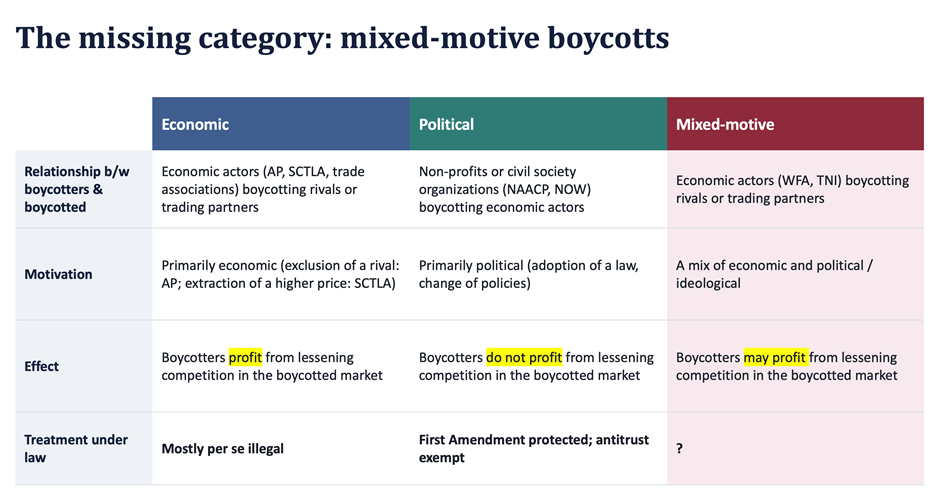
But what about boycotts organized by economic actors against other economic actors with whom they have commercial relationships, where the boycotters may (but do not necessarily) benefit from reducing competition in the boycotted market? Most of the recent investigations and lawsuits fall within this category. My paper argues that these cases constitute a third category of group boycott, which I call “mixed-motive” boycotts. The following table summarizes the distinctions among the three categories of boycotts.
Table 1. Different categories of boycotts and their defining characteristics
Risks of extending First Amendment immunity
In the current era of expanding corporate speech rights, there may be a temptation to extend First Amendment immunity to mixed-motive boycotts, particularly because these boycotts often do not appear to harm competition in any properly defined antitrust market (as discussed below). However, extending categorical First Amendment immunity to such conduct would risk creating an exit hatch. Sophisticated economic actors could characterize concerted economic conduct as an expression of ethical or ideological commitments and thereby evade antitrust scrutiny, undermining the law of group boycotts and shielding genuinely anticompetitive conduct from liability.
This is not merely a hypothetical concern. The evolution of the Noerr-Pennington doctrine, born from the 1961 case Eastern Railroad Presidents Conference v. Noerr Motor Freight, Inc. and 1965 case United Mine Workers of America v. Pennington, offers a cautionary parallel. The doctrine originally extended First Amendment immunity to collective petitioning activity and insulated such conduct from antitrust liability. Over time, however, through doctrinal creep and the gravitational pull of First Amendment deference, its protection has expanded beyond petitioning to protect even fraud, bribery, and misrepresentation. The history of the Noerr-Pennington doctrine illustrates how categorical First Amendment exemptions can gradually expand beyond its original contours to shield increasingly anticompetitive conduct. Extending similar immunity to mixed-motive boycotts risks repeating that trajectory.
Per se versus rule of reason
At the other extreme, condemning mixed-motive boycotts as per se illegal, like most cartel activity, is equally inappropriate. The per se rule is reserved for conduct that is so manifestly anticompetitive that courts need not undertake a detailed inquiry into its actual market effects. Mixed-motive boycotts, however, are not so obviously harmful to competition. Indeed, some may be competitively neutral or even competition-enhancing.
For content moderation coalitions, one could argue that these coalitions reduce output in the market for online news by removing content they regard as misinformation. Equally, however, one could argue that the market for online news would not exist in the absence of some degree of content moderation. Studies have shown that unmoderated platforms are eventually overrun by spam and misinformation, driving away publishers, advertisers, and users. Some degree of collective content moderation may therefore be necessary for the market itself to exist or even increase output by encouraging participation.
The same ambiguity exists in the context of advertiser boycotts. On one view, advertisers may leverage their collective power to force platforms to lower ad prices or comply with their demands. On another, coordinated withdrawal from the platform merely reallocates advertising expenditure to other platforms in response to a deterioration in the quality of the platform. Rather than restricting output, the boycott reflects advertisers’ preference for a higher-quality product and thus the ordinary operation of competitive markets. In neither case is it obvious that the conduct is harmful to competition and that makes the per se standard ill-suited.
The rule of reason is better suited to resolve these cases because it permits courts to assess the actual competitive effects of the challenged conduct. Whether an advertiser boycott reduced output in the market for digital advertising, or whether a content moderation coalition reduced output in the market for online news, are empirical questions that can be evaluated through the ordinary rule of reason framework. Likewise, questions such as whether advertisers switched platforms because of a deterioration in quality can be examined through the use of expert testimony, consumer surveys, and other economic evidence. Although these inquiries may appear complex, antitrust courts routinely evaluate competitive effects in markets involving content and speech, both in ex post enforcement actions and ex ante merger review.
The rule of reason is also more consistent with First Amendment principles. In O’Brien, the Supreme Court held that regulation could have an incidental effect on speech provided that: (1) it furthers a substantial governmental interest and, (2) the regulation imposes a burden on speech no greater than necessary to advance that interest. In FCC v. Turner and Moody v. NetChoice, the Supreme Court recognized that preserving competition constitutes a “substantial governmental interest” which would justify incidental burden on speech. The remaining question, therefore, is whether per se illegality or the rule of reason imposes a burden no greater than necessary to further that interest. The rule of reason satisfies O’Brien because it burdens speech only where the challenged conduct is shown to produce actual anticompetitive effects. By contrast, the per se rule would burden expressive concerted conduct even where it causes no competitive harm.
What stops every cartel from claiming a conscience?
A natural objection is that many cartels have historically claimed ethical or social justifications for their conduct ranging from patient welfare to public safety to opposition to style piracy. What, then, prevents every cartel from claiming a mixed motive and thereby escaping per se condemnation in favor of the more lenient rule of reason? The answer is that “mixed-motive” is not a label that parties can invoke at will. Rather, it describes a category of conduct whose competitive effects are genuinely unpredictable. Where the competitive effects of a category of conduct remain predictable, the conduct continues to warrant per se treatment irrespective of any asserted social justification. Consider a tobacco cartel that fixes prices while claiming that higher prices hypocritically promote public health by discouraging smoking. Such a cartel would not become a mixed-motive boycott merely because it invokes a public interest objective. Price-fixing remains a category of conduct with predictably anticompetitive effects and therefore continues to warrant per se condemnation.
Moreover, my argument is confined to a narrow sub-category of Section 1 conduct. It does not extend to price fixing, market allocation, or bid rigging, all of which remain the paradigmatic forms of collusion subject to the per se rule. Rather, it is limited to group boycotts, an area in which the courts have already moved away from categorical per se treatment. Beginning with Northwest Wholesale Stationers and in subsequent decisions involving professional and trade associations, courts have increasingly recognized that group boycotts are too heterogeneous a category to warrant per se condemnation. Recognizing mixed-motive boycotts as a distinct category would not provide cartels with a free pass to lengthy and expensive rule of reason litigation where their conduct remains predictably harmful to competition.
Conclusion
Coordinated conduct is pervasive in markets, and ideally antitrust agencies should exercise regulatory discretion to bring enforcement actions only where there is plausible harm to competition in a properly defined market. That element appears to be missing in many of these recent cases. However, now that these disputes have reached the courts, they present a familiar danger: hard cases make bad law. The absence of any obvious competitive harm, coupled with the expressive dimension of these boycotts, may tempt courts to adopt the doctrinal shortcut of extending categorical First Amendment immunity to such conduct. But the history of the Noerr-Pennington doctrine counsels against that approach. Categorical First Amendment immunities have a tendency to expand beyond their original justifications, eventually shielding anticompetitive conduct that has little claim to constitutional protection. Instead, mixed-motive boycotts should be evaluated under the rule of reason, which avoids per se condemnation where competitive effects are uncertain while preserving Section 1’s ability to reach genuinely anticompetitive conduct.
Author’s Disclosures: The author reports no conflicts of interest. You can read our disclosure policy here.
Articles represent the opinions of their writers, not necessarily those of the University of Chicago, the Booth School of Business, or its faculty.
Subscribe here for ProMarket’s weekly newsletter, Special Interest, to stay up to date on ProMarket’s coverage of the political economy and other content from the Stigler Center.