







Across three studies, Jana Friedrichsen, Julia Schwarz, and Michel Clement explore how generative AI will change the music industry. They find that while consumers enjoy and even prefer AI-generated music, preferences shift upon learning that the song was AI-generated.
In March, book publisher Hachette pulled a horror novel from its catalog after concerns that generative artificial intelligence helped write it. AI has become advanced enough that it can create quality video games and visual artwork with just a series of text prompts. Google’s MusicLM is a text-based AI model trained on vast datasets of existing songs that can be used to automatically create original music that is difficult to distinguish from human-made music.
August 1, 2024 marked the first time that an AI-generated song entered the German charts. The advance of AI into cultural industries poses two questions. The first, normative, is what will happen to the many artists whose livelihoods depend on their work. The second, economic, is if consumers even enjoy AI-generated art, and are they willing to support a cultural industry that would be increasingly filled with AI-generated work?
AI’s impact on music artists
Streaming platforms such as Spotify and Amazon Music collected 69% of recorded revenues in the global recorded music industry in 2024, amounting to $20.4 billion. Seventy percent of this sum went to the artists (and their labels) who published on their platforms, with funds allocated according to their market shares of streams. AI will influence how funds flow to artists in the future.
On the one hand, AI could allow artists to generate music faster, enabling those most adept to increase production and personal revenue. However, AI services like Google’s MusicLM require very little knowledge of music production and open access to music production to those with little musical capability. Non-musicians handy with AI like IT professionals could “flood” platforms with their own content. The platforms themselves might also recognize an opportunity to increase their share of total revenue by generating their own content.
It’s not even obvious that the music AI generates needs to be high quality for participation to make sense. To be profitable, AI music must either be sufficiently attractive to consumers to secure a significant market share, or it must be produced in large enough quantities to compensate for potentially low individual success rates. Economically, there is no difference between one song generating one million streams and one million songs each generating a single stream.
Do consumers want AI-generated music?
Still, the success of AI-generated music, and the future of traditional, skilled music artists, will depend on the preferences of human listeners. To understand consumers’ preferences and willingness to pay for AI-generated music, we conducted three empirical studies.
In our first study, which we conducted in two waves back in 2018 and 2021, we analyzed attitudes toward the use of AI to generate music when AI was not yet present in the public consciousness. OpenAI did not release ChatGPT until November 2022. At this time, we found that a majority of the respondents were not averse to AI-generated music.
In our second study, conducted in 2024, we complemented these observational insights with results from an experimental study to understand how listeners evaluated playlists and individual songs based on whether they were labeled as AI-generated or not. We used electronic dance music and varied whether songs came with vocals or were purely instrumental. We found that disclosing a song was AI-generated did not result in inferior evaluations of songs or playlists, with or without vocals.
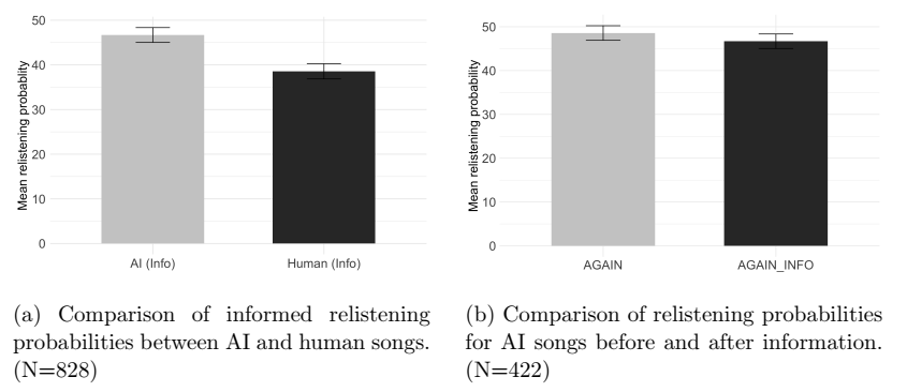
In our final study from 2024, we conducted a similar experiment to study how listeners compared human-made songs to AI-generated ones. Our study varied whether songs were human-made or AI-generated (song origin) and whether the listener received this information or not for pop and electronic dance songs. In addition to listeners’ stated preferences, we also measured how much they were willing to pay to listen to the song as a second measure of preference. We found that listeners actually perceive AI-generated songs to be superior. However, if the music is disclosed to be AI-generated, their desire to relisten to the song and their willingness to pay decreases. This effect is mainly driven by pop listeners.
How AI will change the music industry
Our findings provide four insights for relevant stakeholders in cultural industries:
1. AI-generated music is well-perceived by consumers. AI can support artists in creating, producing, and distributing music faster (and maybe even with higher quality).
2. The widespread availability and usability of AI tools (e.g., MusicLM or Suno) to generate likeable music, even for non-experts, will result in lower barriers to entry for non-artists that target the royalty pools of streaming services. While one may argue that this is a democratization of music generation, others may argue that it will dilute the royalty pool, resulting in job displacement and a devaluation of musical skill.
3. People are less willing to pay for AI-generated music. If all they end up encountering on digital streaming platforms is AI-generated music labeled as such, the royalty pool may shrink. If listeners are able to easily access human-generated music that they know was created by humans, a significant proportion of royalties may still flow to human music artists skilled enough to create high-quality music.
4. Consumers can only make informed choices if artists and music platforms are transparent about the use of AI. Contemporary regulatory initiatives like the EU AI Act take a step toward demanding the labeling of AI use but do not demand that all use of AI be labeled. For example, AI can be used to generate song lyrics or musical backing without it being labelled as AI-generated as long as a human retains final oversight over the full process. This may not be enough for consumers to act on their preferences.
These insights can be generalized to other creative industries. In the publishing industry, platforms offering e-books are also confronted with a large number of books generated by AI. Regulators will need to keep the scope of generative AI’s impact in mind when designing policy to mitigate its adverse effects. As workers, creative or not, worry about how AI will displace jobs, our studies suggest that transparency may spare artists while giving consumers what they want.
Authors’ Disclosures: The authors report no conflicts of interest. You can read our disclosure policy here.
Articles represent the opinions of their writers, not necessarily those of the University of Chicago, the Booth School of Business, or its faculty.
Subscribe here for ProMarket’s weekly newsletter, Special Interest, to stay up to date on ProMarket’s coverage of the political economy and other content from the Stigler Center.