







In new research, Louis Pape and Michelangelo Rossi find that the European Union’s Digital Markets Act’s prohibition on self-preferencing had little effect on the popularity of Google Maps relative to competitors. User preference for the incumbent service appears to outweigh frictional barriers to access.
In June 2009, facing early antitrust scrutiny, a senior Google executive offered what would become a standard defense of dominant digital platforms. Competitors, he said, are “only a click away.” The argument has been repeated many times since, and its logic is straightforward. If reaching an alternative requires nothing more than moving a finger, then market position should reflect user preference rather than entrenched advantage. Interface design, default settings, and integration are, on this view, competitively innocuous.
Testing that argument empirically has always been difficult, because the behavioral distance a click poses to users, and thus the advantage an incumbent enjoys over its rivals by being a default or promoted setting, is rarely disturbed. In January 2024, it was.
A policy change that created a natural experiment
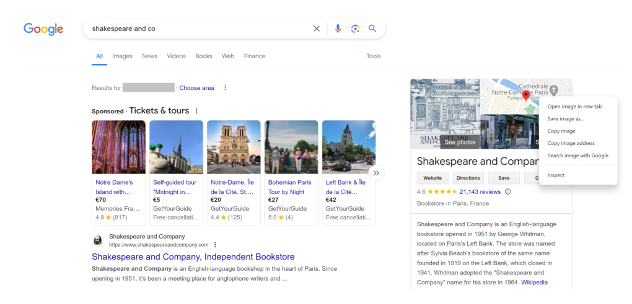
To comply with the European Union’s Digital Markets Act (DMA), which prohibits self-preferencing on digital platforms, Google modified its desktop search interface for users in the EU. Previously, a search for a location through Google Search defaulted users to Google Maps. Now, when someone searches for a location, such as a café, a museum, or a street address, the map that appears at the top of the results page is no longer clickable, and the direct link to Google Maps gone. Users can still reach Google Maps, but they now have to type a query, navigate manually, or use the narrower “Directions” button, which only provides navigational instructions. Outside the EU, nothing changed. Figure 1 shows what EU desktop users see today when they search for a location.
In our new paper, we use this contrast to ask a simple question: when the click disappears, do users actually find their way to competitors?
Figure 1
What happened in the data
Combining search-query data with website traffic estimates across EU and non-EU countries in a difference-in-differences design, we found that EU users responded immediately and substantially to the redesign. Their response, however, suggests that both Big Tech and competition enforcers are overly optimistic that competition is really just one click away.
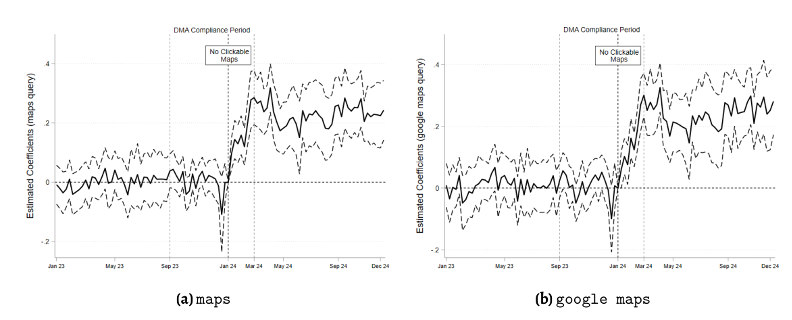
Searches for both “maps” and “google maps” rose by more than 21% in the EU relative to non-EU countries after January 2024 (Figure 2). These two queries moved together, and that is the point worth dwelling on. One might have expected the generic term “maps” to grow faster, since it is the more natural gateway to alternatives. Instead, the branded query increased by essentially the same amount, signaling that users who lost the shortcut did not pause to reconsider their mapping service of choice. They typed the name of the incumbent. The pre-DMA trajectories for EU and non-EU countries are flat and indistinguishable, which is the comparison the design relies on. The break coincides precisely with the January 2024 redesign and persists throughout the year that follows.
What happened to rivals? Very little. Search volumes for Bing Maps, Mappy, and OpenStreetMap showed no robust movement. Apple Maps showed a detectable increase of roughly 28%, but from a base that is orders of magnitude smaller than Google Maps’ (equivalent to less than 0.2 percent of Google Maps’ search volume), and the effect is not robust across alternative ways of handling the data. For example, when we exclude country-weeks datapoints with no recorded Apple Maps searches rather than imputing a small value, the effect was no longer statistically significant. Website traffic tells the same story: no meaningful increase in visits to Bing Maps, and overall desktop traffic to Google Maps essentially unchanged.
The France case is particularly telling. France is the only country in our sample where a credible local competitor, Mappy, had higher pre-DMA search volume than Google Maps. If any market was set up for a DMA-induced reallocation, it was this one. Yet, after January 2024, searches for Mappy drifted downward and were overtaken by searches for Google Maps. A ready-made alternative, in a country where users clearly knew it existed, did not benefit from the removal of Google’s shortcut.
Figure 2
Rerouting, not reallocation
The more revealing result concerns the composition of search traffic. While total visits to Google Maps using a desktop browser did not change significantly, the channels through which users arrived shifted sharply. Organic search traffic (visits originating from Google Search) increased by roughly 33-40%, while direct traffic from URL entry or bookmarks was flat. In other words, users compensated for the lost click by generating a new one themselves. Instead of typing a location and clicking the default Google Maps option, they instead typed “google maps” into the search bar and clicked the first result.
We also observe modest changes among individual Google Maps users. Average visit duration fell by about five percent, and the bounce rate (the percentage of users who left the site after viewing only one page) rose by 16%. These patterns are consistent with a small deterioration in user experience, likely connected, at least in part, to the fact that some users are now routed through the “Directions” interface, which opens Google Maps on an itinerary view (they only see the directions to a destination) rather than on the location they were looking for, with all of its topographical and business review information.
Taken together, the findings describe a specific and policy-relevant pattern. The DMA changed the paths users take to Google Maps. It did not change the destination.
What this means for DMA enforcement
Our results are not a verdict against the DMA. They are a warning against conflating formal compliance with competitive effect. Google’s redesign removed a clear instance of self-preferencing, and enforcement achieved precisely what it formally required. But the market outcome, which is the object the DMA actually cares about under its contestability mandate, barely moved.
Why not? Mapping services are a demanding environment for default-removal remedies. Data coverage and feature quality vary substantially across providers. Users have learned one interface and hold strong beliefs about its reliability. And some of the most plausible alternatives, notably Apple Maps, have historically lacked a usable web presence at all. In such a market, the frictional costs introduced by default-removal policy do not redirect demand. They are absorbed.
This suggests that when the European Commission assesses gatekeeper compliance, the more interesting question is not whether an interface has been made preference-neutral, but whether alternatives are positioned to benefit. Other remedies may be better suited to that task. A choice screen for mapping services, of the kind Google itself implemented for browser search engines, would confront users with competing options directly rather than relying on them to seek alternatives out. Regulators might also look more closely at features that now effectively reintegrate Google Maps content into Google Search, such as the “Places” and “Places sites” modules that display business listings and reviews inline. Removing one clickable map while allowing new forms of vertical integration to remain may not fully achieve the intended competitive effects.
There is also a distributional point worth naming. Because users did not switch services, the principal effect of the intervention was to impose a small time cost on each EU user who previously relied on the shortcut. The benefits on the competition side have yet to materialize. Whether that trade-off is worth making depends on whether complementary measures to reduce the impact on user experience follow.
The click matters less than what lies beyond it
Returning to the original claim: is competition really only one click away? Our evidence suggests the click was never the binding constraint. Even with the shortcut gone, the users who reached Google Maps continued to reach Google Maps, and the rivals who were supposed to benefit did not. Contestability in digital markets is shaped less by the friction between a user and an alternative than by what that alternative actually offers once reached. Choice architecture is a lever regulators can pull, but it is not, on its own, a substitute for viable competition.
Author Disclosure: The author reports no conflicts of interest. You can read our disclosure policy here.
Articles represent the opinions of their writers, not necessarily those of the University of Chicago, the Booth School of Business, or its faculty.
Subscribe here for ProMarket’s weekly newsletter, Special Interest, to stay up to date on ProMarket’s coverage of the political economy and other content from the Stigler Center.