




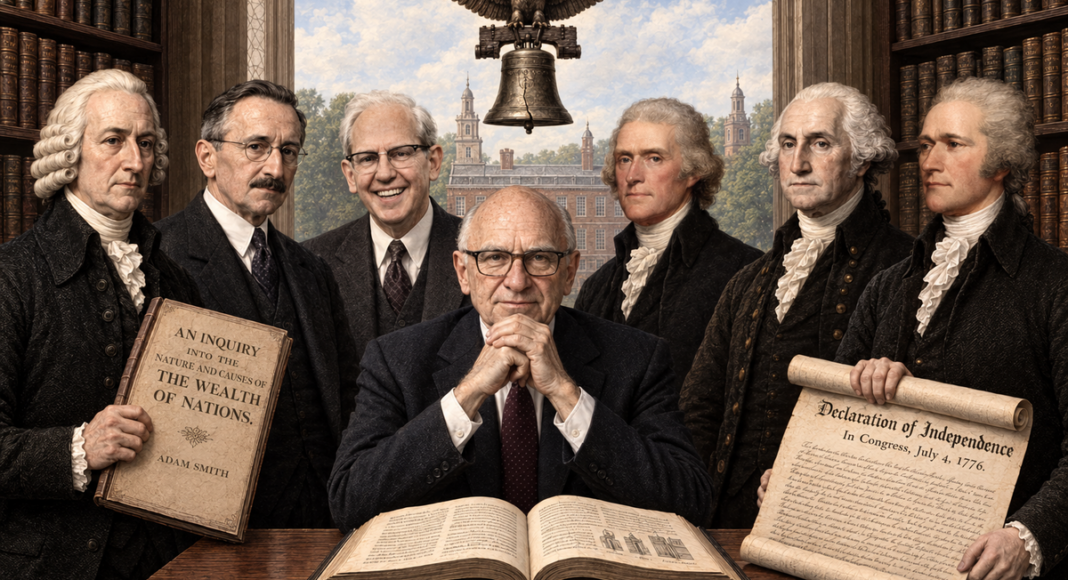

The Chicago School is often associated with laissez-faire economics that reads into Adam Smith’s philosophy of political economy justifications for self-interest and prudential motivations. However, a careful history of the University of Chicago’s early Economics Department and School of Commerce and Administration reveals a more complicated understanding of how economics and business were to interact with one another and society. The early University of Chicago pursued a program that emphasized that laissez-faire economics and a concern for the public interest were not antagonists but perfectly compatible, writes David Mitch.
Editor’s note: This year celebrates the 250th anniversaries of the American Declaration of Independence and the publication of Adam Smith’s Wealth of Nations. It is also 50 years since Milton Friedman won the Nobel Prize in economics. This article is part of a symposium revisiting the ideas of freedom and political economy expounded by the American revolutionaries, Adam Smith, and the Chicago School of economics, and how they connect to contemporary concerns about capitalism and democracy. You can read the rest of the articles here as they are published, with contributions from Peter Boettke, David Mitch, Robert Van Horn, Sandra Peart & David Levy, Maha Rafi Atal, Edward Nik-Khah, and Richard John. We welcome responses, which you can send to promarket@chicagobooth.edu.
In 1926, the University of Chicago commemorated the sesqui-centennial of the publication of Adam Smith’s Wealth of Nations with a symposium of lectures. The vision of Smith’s work articulated in these lectures gave a nuanced and complicated view of Smith and his relation to laissez-faire principles. Scholars like Jacob Viner presented Smith as a theorist of political economy who incorporated moral restrictions on asocial commercial behavior. This vision was later contrasted with a supposed Chicago school view of Smith articulated in the second half of the century by George Stigler, Milton Friedman, and Friedrich Hayek that accentuated the role of self-interest and prudential motivations.
The year 1926 also saw two much less heralded developments at the University of Chicago. First, what had been the Department of Political Economy changed its name to the Department of Economics. Second, a change in leadership structure led to a common director of both the Department of Economics and the School of Commerce and Administration. The change in title reflected a decades long tendency at the University, and more generally across America academia, to integrate teaching and research in economics with that in business. Although the Department of Economics at the University of Chicago has long been associated with laissez-faire economics, a proper understanding of its history should incorporate as well the Department’s long-standing commitment to applying economics to real-world developments, a mantra of the Chicago Price Theory approach. This emphasis on practice can been seen as resonant with the motto of the University and a theme in its early years: “Crescat Scientia Vita Excolatur,” commonly translated as “Let Knowledge Grow from More to More and So be Human Life Enriched.” The last clause suggests the importance of useful knowledge rather than knowledge for its own sake counter to some depictions of the University of Chicago as a pure ivory tower institution.
A proper history should also recognize that the interactions between the Department of Economics and School of Commerce and Administration did not reflect what we think today as a focus on profits and shareholder returns associated with Milton Friedman and the Chicago School. Rather, it was an exchange in which ideas of social welfare and the social interest were incorporated into the inculcation of America’s future industrial leaders. Economics was a study of moral outcomes, and the pursuit of laissez-faire policy was one compatible with a concern for the public interest. An investigation into the early years of the University of Chicago’s economics and business pedagogy reveals a much more complicated understanding of economics and business, their relation to one another, and their relation to the rest of society.
The founding of Chicago’s Department of Political Economy and its Journal of Political Economy in 1892
Numerous previous accounts suggest that both the recruitment of J. Laurence Laughlin as the founding professor of the University of Chicago’s Department of Political Economy and his founding at the outset of his term of the Journal of Political Economy (JPE) was entangled with controversies roiling the United States economics profession in the later nineteenth century. During this time, Laughlin was embroiled in controversy with Richard T. Ely regarding their respective preferences for laissez-faire versus interventionist policies. Chicago’s founding president, William Rainey Harper, had attempted to recruit Ely to head of the Department of Political Economy prior to offering it to Laughlin. Harper himself had sympathies with Ely’s Christian social reform tendencies and insisted that Edward Bemis, another reform-minded economist, be hired at Chicago, which resulted in extended controversy. Laughlin’s founding of the JPE can be interpreted as reflecting not only his antagonism towards Ely but also towards the American Economic Association, which Ely was instrumental in founding in 1884, as well as towards Laughlin’s alma mater, Harvard, which had not renewed his teaching contract in 1888.
Laughlin’s opening article in the inaugural issue of the JPE made known his hostility towards the anti-laissez-faire clause in the founding constitution of the AEA. Although not explicitly stated in Laughlin’s article, one interpretation of it is that the choice of “political economy,” both in the title of the journal and in the name of the new department that Laughlin founded, was a reaction to the reform efforts of the new political economy associated with Ely. Laughlin’s “political economy” implied the term’s return to, and revival of, the laissez-faire principles of the “old” political economy of Adam Smith.
In apparent response to concerns from his mentor, Charles Dunbar, that Chicago’s new journal would detract readership from his own recently established Quarterly Journal of Economics in 1886, Laughlin concluded his inaugural article with the following paragraph claiming scope for his own new journal:
From this brief review of the conditions of practical economic problems, it can be readily seen why new means of communication between the investigator and the public should be created. In view of the peculiarly attractive field for economic study in the United States; especially in view of the practical opportunities for investigation in the central states of the Union; and in view of the extent of the subject of Political Economy,-embracing, as it does, many subjects, each of which may well demand a scholar’s life-work,-it has seemed that a distinct place exists for a journal of political economy which, while welcoming the discussion of theory, may be devoted largely to a study of practical problems of economics, finance and statistics. Inasmuch as existing scientific journals have a tendency largely towards discussions of theory, and as popular journals do not usually treat practical economic problems scientifically, the JOURNAL OF POLITICAL ECONOMY may, therefore, find for itself in the scientific study of this latter class a free field.
The point mentioned by Laughlin, in the very last sentence of his article justifying the launch of the JPE, is also worthy of emphasis that of “treat[ing] practical economic problems scientifically.” Alfred Bornemann contrasts the emphasis on theory at Harvard in the later nineteenth century with Laughlin’s early emphasis on applied economics. He goes on to suggest that this could imply a greater affinity for the alliance of economics with business education at Chicago than at Harvard or the University of Pennsylvania, with the latter’s protectionist thrust.
One specific way in which the focus on useful knowledge was manifested in the case of Chicago’s Department of Political Economy was a search for ways to make training in economics/political economy useful and appealing to aspiring businessmen and women.
Establishing the School of Commerce and Administration at Chicago and its connection with the Department of Political Economy
In 1894, Laughlin presented the University of Chicago Senate with a proposal for a “School of Commerce and Industrial Science.” This can be seen as reflecting a perception that there was a substantial population in the Chicago area intending careers in commerce and public administration who could benefit from academic training and education. Not until 1898 was a College of Commerce and Politics established, though it had no separate faculty or dean. Instead, it offered degrees based on courses offered elsewhere in the university. By 1902, the name of the College had changed to that of Commerce and Administration with provision for its own faculty and dean.
One issue of controversy, not only at Chicago but more generally in establishing a university program in commerce anywhere, was whether the University had anything useful to teach those preparing for a business career and if so, what the relevant curriculum would look like
Laughlin argued that training in economics would cultivate problem-solving and reasoning skills with real-world applicability while also engaging the interest of the student. He suggested that what he termed “newer subjects,” such as economics, had as much capacity for cultivating “cultural and disciplinary efficiency” as older, more traditional subjects.
In 1907, Laughlin recruited Leon C. Marshall to Chicago from Ohio Wesleyan University. In 1909, Leon Marshall became Dean of the College of Commerce and Administration. Johan Van Overtfeldt opines that it was only at this stage that the college became fully established.
Throughout his time at Chicago, L.C. Marshall took a quite active interest in the relation between instruction in economics and business. The theme would be a recurrent one in articles in the JPE between 1910 and 1920, with Marshall a recurrent contributor.
Marshall and other authors in these articles suggested that aspiring business executives would benefit from exposure to introductory economics or political economy by getting a sense and spirit of public interest and the welfare of society as a whole. They believed the business enterprise should have a sense of public purpose rather than just pursuit of private gain. In addition, a point stressed by Marshall, the business executive would benefit from having an understanding of the structure and processes of the overall industrial society in which he was participating and making decisions.
On the other hand, Marshall and others argued that economics would benefit by contact and interaction with business affairs by being forced to confront concrete, everyday situations and to go beyond “closet philosophizing.”
As noted above, the Board of Trustees approved in May of 1926 a change in name of the department from Political Economy to Economics. I have not found in Economics Department records, University announcements, records of the Office of the President, or other administration sources any mention of the specific reasons behind the timing of this name change. This lack of any evidence of deliberation or discussion can be regarded as a “hound that did not bark,” reflecting a nominal change in language not requiring further justification.
However, the minutes of the Board of Trustees and articles in the JPE do show substantial discussion about the University’s decision around this time to appoint an overall director of both the Department of Political Economy and the School of Commerce and Administration “who shall have general charge of the whole work in this field” and “with a view to securing better co-ordination of the work in Economics and Business Administration.” The director appointed to this position was Leon Marshall himself.
More general views both contemporary and current on the relationship between business and economics education
The relation between work in economics and business has been a recurrent theme over the last century or so both in terms of substance and in terms of academic organizational structure. Doubts have been continually raised as to whether training in economics really contributes to the effective training of those aiming at careers in business. However, some common themes that resonate with those raised by L.C. Marshall above include creating an awareness of public responsibility for the business executive, creating an understanding of the overall system in which the executive is operating, and an executive role requiring a general, strategic perspective in contrast with more specialist or technical positions. Communication between economics and business education were argued to bridge the distinction drawn between the economist’s disinterested interest in the system as a whole versus the business executive’s focus on private profitability. Roswell McCrea, Dean of the Columbia Business School, wrote in 1926:
In my own view, economics, wherever else it may or may not belong, does belong in the school of business. Both business and economics need to be saved from themselves. Without the presence of economics in some vital form, the work of a school of business is likely to degenerate into detail [sic] description of business organization and procedure, with no organizing principle other than the possible one of search for effective competitive devices, and with no clear vision of the social goal of business activity. And economics, divorced from business, is too likely to spend itself either in closet philosophizing by traditional modes, altogether too little affected with a present interest, or in fortifying predilections regarding public policy with broadly garnered data too remote from the intimate, work-a-day world of fresh experience to yield much more than a crop of articles, books, and book reviews. If schools of business realize their opportunities, the economic theory of the future will grow out of their researches and will be formulated by their teachers. The joining of socially motivated thinking with a knowledge of concreate, shifting reality, such as can be effected in a school of business, may escape the puttering of the strict vocationalist on the one hand, and the futility of the closet philosopher on the other.
Marshall’s organizational efforts to consolidate business and economics were abandoned by the department after he left the university in 1928. Laughlin, the original founder of the department, wrote to acting University President Frederic Woodward indicating his dismay with the decline in research focus implied by Marshall’s reorganization. And Alwyn Young, the prominent theorist the department sought to lure away from Harvard and the London School of Economics, indicated his disdain for what he thought to be Marshall’s contrived functional approach in contrast to a focus on real-world problems. Marshall commonly distinguished certain “functional” areas he thought that real-world business people had to deal, with such as finance, labor relations, and transportation, and wanted to structure business training around these functional areas. It was these intermediate functional areas that Young regarded as contrived.
With the arrival of Robert Maynard Hutchins as president in 1929, the Department of Economics was assigned under the new divisional arrangement to the Social Sciences Division under completely separate leadership from the School of Commerce and Administration, which was renamed the School of Business in 1932 and left completely outside the Social Sciences Division. In the 1920s, the School was trying to reach out to students who would otherwise have gone to vocational clerical and secretarial schools. The announcements for 1930-31 of the School of Commerce and Administration bear the sub-title “Training for Business, Business Teaching, Secretarial Work.”
Nevertheless, Leon Marshall’s legacy of, to quote McCrea, “joining social motivated thinking with a knowledge of concrete, shifting reality” persisted at Chicago with two faculty that he hired, Paul Douglas and Frank Knight, as well as a third that he mentored during his early years at Chicago, Jacob Viner. Each had a complicated relationship with laissez-faire economics. Moreover, this legacy can be seen as being carried forward into the twenty-first century at Chicago in the work of such prominent Nobelists as James Heckman, Michael Kremer, Richard Thaler, and Ronald Coase. More generally, the ongoing engagement between economics and business at Chicago is suggested by the fact that of the 32 Nobel Laureates in Economics that have been associated with the University of Chicago since the prize was first awarded in 1969, eight, or 25 percent, have had direct connections with the Graduate School of Business at Chicago (George Stigler, Harry Markowitz, Merton Miller, Robert Fogel, Myron Scholes, Eugene Fama, Richard Thaler, Douglas Diamond; I exclude Coase and Lars Peter Hansen, though the Business School counts them among its faculty, too).
The case of Paul Douglas is particularly instructive. He was recruited by Marshall initially not in the Department of Political Economy but to the School of Commerce and Administration as a professor of Industrial Relations. He only switched his affiliation to the Department of Economics in 1930. He was by no means an advocate for laissez-faire, and unlike many of his successors at the University did not read laissez-faire prescriptions in Adam Smith. His own essay in the 1926 volume on Smith begins by noting “The contributions of Adam Smith to the theory of value and of distribution were not great.” Douglas in particular thought that Smith’s commitment to a labor theory of value was a dead end. Douglas also acknowledged that “Smith’s formulation of the problems of exchange value and of the distribution of national product among the factors of production was such as almost inevitably gave rise to the doctrines of the post-Ricardian socialists and to the labor theory of value and the exploitation theory of Karl Marx.” This is consistent with Viner’s view in the same volume that Smith was the “great eclectic” and that “Adam Smith was not a doctrinaire advocate of Laissez Faire.” Rather, anyone could read about any ideology into The Wealth of Nations. Douglas’s own substantial contributions to economics can be seen as reflecting his initial exposure to the real world of commerce as a professor of industrial relation and then his subsequent interest in empirical laws of production with the development of the Cobb-Douglas production function that has become a cornerstone of applied economics.
And a more recent example of a Nobel economist at Chicago influenced by a “knowledge of concrete, shifting reality” is Ronald Coase, whose work has focused on institutional detail. Coase’s name has notably not been mentioned in profiles of a supposed later Chicago school view of a prudential Adam Smith. However, in 1976, Coase did articulate an expansive vision of Smith’s The Wealth of Nations, emphasizing the work’s readability and appeal to common sense rather than laissez-faire or self-interest principles. And in the same year, he also delivered a lecture on “Adam Smith’s View of Man,” in which he stated, “I can find no essential difference between the views on human nature in The Theory of Moral Sentiments and those expressed in the Wealth of Nations.”
The legacy of Leon Marshall’s efforts to integrate economic theory with a “knowledge of concrete, shifting reality” has been enduring at the University of Chicago. Often lost in the discourse, obscured by a focus on Friedman’s famous article arguing that the purpose of the firm is to maximize shareholder returns, was the early consensus that the integration of commerce with economics was intended to inculcate in the former an awareness of social welfare and the public good. A careful study of the history of the University of Chicago reveals a much more complicated interpretation of Smith and the relationships between economics, business, and society.
Author’s Disclosure: The author reports no conflicts of interest. You can read our disclosure policy here.
Articles represent the opinions of their writers, not necessarily those of the University of Chicago, the Booth School of Business, or its faculty.
Subscribe here for ProMarket’s weekly newsletter, Special Interest, to stay up to date on ProMarket’s coverage of the political economy and other content from the Stigler Center.