





In new research in collaboration with Color of Change, Dante Donati and Lena Song find that comments on social media posts help drive platform engagement for organizations. However, comment sections are often populated by a vocal minority, and adversarial comments from them come with reduced off-platform support for the original posters.
The comment sections of social media posts provide users with visible cues about how others respond to content, and those cues can shape how users interpret the content’s underlying message. In our new research, “The Influence of the Vocal Minority: Evidence from Social Media Comments,” we study how this social context affects on-platform engagement with an organization’s content and off-platform responses to its mission. We find that when an organization posts on social media, adversarial comments increase engagement with the post in the forms of clicks and reactions, but reduce off-platform support for the organization and its cause.
This matters because comment sections often do not reflect the views of the broader audience. They are frequently shaped by a smaller, more vocal subset of users. As a result, the visible tone of online discussion can be driven by people who are more likely to speak up, not necessarily by people who are more representative of consensus viewpoints. Our results suggest that this vocal minority can influence not only what gets attention on social media, but also how users think and act afterward.
The comments are not the crowd
Much of the public debate about how social media influences users’ opinions focuses on algorithmic feeds and recommender systems and the moderation of the original content people and organizations post. But comments deserve more attention. They are one of the main ways users encounter peers’ opinions at scale, and they are widely read. In our survey, about 85% of respondents said they at least sometimes read comments on social media, and more than half said they do so often or very often.
In collaboration with Color of Change, the largest online racial justice organization in the United States, we studied the comments left on Facebook posts discussing racial justice. Before running our main experiment studying how comments influence users’ behavior, we first launched a campaign designed to generate real, organic comments so that we could gauge their general tone and substance. This campaign included a series of Facebook ads on issues such as voting rights, environmental justice, criminal justice, education, and technology fairness. The campaign reached about 135,000 geographically diverse users with different political ideologies and generated roughly 1,500 direct comments from them. This descriptive phase revealed an important pattern: comments did not reflect the views of the broader audience.
Commenting was rare overall, ranging from about 0.8% of users reached in progressive areas to about 1.3% in conservative areas, while reactions such as likes were far more common. Not only were users in conservative areas more likely to comment and less likely to react, but their comments were also more likely to be negative and offensive than those from users elsewhere. Men were also much more likely than women to comment, while women were more likely to engage through silent forms of engagement, which tended to be positive. These patterns suggest that the visible discussion was disproportionately shaped by a vocal minority.
A field experiment on Facebook
To test whether comments actually change behavior, we ran a large Facebook field experiment reaching roughly one million users. We showed users otherwise identical racial justice posts, varying only the visible comment section. Some users saw no comments. Others saw two comments supportive of the organization’s message, two comments opposing the organization’s message, or one supportive and one opposing comment. Because the comments came from real users from the previous campaign and the experiment was embedded in Meta’s own A/B testing infrastructure, the setting was less like a typical lab study and instead much closer to how users actually experience Facebook.
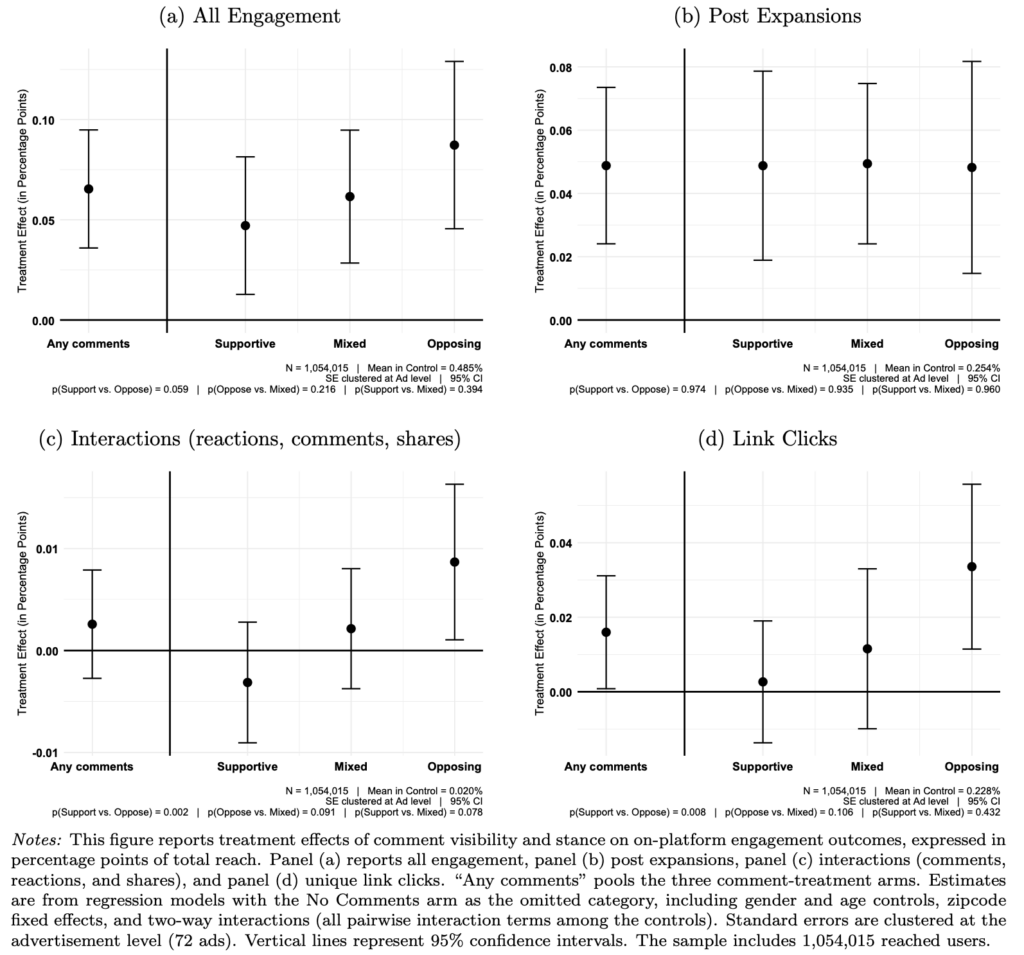
The first result is simple but important: comments attract attention. Relative to posts with no visible comments, the presence of comments increased overall engagement by 13.4% (Figure 1a). Comments also increased the probability that users expanded the post to view the full comment section by 19.3% (Figure 1b). Just having a visible conversation below the post made people pay more attention. But the more important result concerns which comments drive that engagement.
Figure 1: The Impact of the Comment Section on On-platform User Engagement
Opposing views perform better than supporting ones
Comments opposing the post’s content generated much more downstream engagement than supportive ones. Relative to the no-comments control, opposing comments increased reactions, comments, and shares by roughly 45% (Figure 1c). They also increased the clicks on the link embedded in the posts going to the organization’s website by about 15% (Figure 1d). Supportive comments, by contrast, had little effect. The pattern was especially strong among men and in more conservative areas. In those groups, opposing comments produced the clearest increases in clicks and interactions.
That creates an uncomfortable implication for the way success is often measured on platforms. If the goal is to maximize clicks, reactions, or other short-run engagement metrics, comments expressing disagreement with the post show up on the dashboard as a win. They pull people in. They generate visible activity. They can even improve advertising efficiency by lowering the cost per interaction and cost per click. However, that is only part of the story.
More engagement does not mean more persuasion offline
Platform metrics tell us what users do on the platform. They do not tell us what users believe afterward, whether they feel more supportive of the organization behind the message, or whether they are more willing to take meaningful off-platform action.
To study those outcomes, we ran a complementary survey experiment with about 5,000 participants. There, too, comments increased attention. Both supportive and opposing comments made people spend significantly more time looking at the posts by roughly 40% relative to the no-comments condition. So the attention result is robust: comments, regardless of stance, make people stop and look.
But opposing comments did something else as well. They dimmed users’ opinions of the post creator and reduced the likelihood of making an incentivized donation to the organization by 7.3%. They also reduced the average amount donated. Supportive comments did not produce comparable gains. So the comments that worked best on the platform did not work best for the organization’s broader objective. They generated attention and traffic, but they weakened persuasion and financial support.
This is the core trade-off documented in the research: some comment environments raise short-run engagement while undermining off-platform influence.
Why this trade-off matters
This finding matters for at least three reasons. First, it suggests that engagement is not the same thing as endorsement. That point may sound obvious, but social media metrics often blur the distinction. A post that attracts reactions, comments, and link clicks can appear to be succeeding, even if a substantial share of that activity is being driven by disagreement or hostility. For organizations using social media to persuade, mobilize, or raise money, that distinction is crucial.
Second, it helps explain why online discourse can feel more hostile than the underlying audience really is. If a smaller, more oppositional group is more likely to comment, and if those comments are especially good at generating further engagement, then the visible conversation can become systematically more combative than the distribution of underlying views would suggest.
Third, it highlights a potential misalignment between platform incentives and organizational goals. Platforms often reward content that generates engagement. But nonprofits, brands, political groups, and media organizations may care about something else: persuasion, trust, donations, reputation, or long-run support. In our setting, those objectives pointed in different directions.
What may be driving the effects
Our evidence also suggests what mechanisms may be at work that allow comments to draw engagement. One possibility is curiosity: visible disagreement may simply make people want to look more closely. Another is identity congruence: comments may be especially engaging when they resonate with the worldview of the audience reading them. That would help explain why the Facebook effects are stronger in conservative areas and among men.
In the survey experiment, we find evidence suggesting that comments may work partly by changing perceived social norms, or what users think others believe. Among Democrats, opposing comments made progressive views seem less prevalent among other respondents, suggesting that the comments shifted perceptions of how common those views are. But the mechanism is unlikely to be norms alone. The donation effects appear for both Democrats and Republicans, which suggests that persuasion or social learning may also matter. The broader point is that comments do not just add noise. They can change how users interpret the social meaning of a post.
Comment moderation is also a governance question
These findings speak directly to current debates about content moderation and platform governance. Comment moderation is often treated as a narrow issue of brand safety, civility, or toxicity. Those issues matter. But our results suggest something broader: the structure and visibility of the comment section can shape economic and political outcomes even when the comments are organic and not particularly extreme.
That means questions such as which comments are shown first, which comments are left visible, and which comments are tolerated because they generate more engagement are not just operational choices. They are governance choices. They influence what kinds of discourse get amplified and what kinds of outcomes platforms make more likely.
The broader lesson
The main lesson of our paper is not that comments are bad or that platforms should remove them. Comments can create value. They can attract attention, encourage interaction, and make social media feel more participatory. But they also create a democratic tension when the voices that speak loudest are not representative of the public. For organizations trying to influence the public, they also create a strategic tension: the comments that perform best on-platform often work against an organization’s off-platform strategies and goals.
For researchers, this means the comment section deserves to be studied as part of platform design, not as an afterthought. For social media managers, it means comment moderation requires balancing brand safety with engagement goals. And for policymakers, it means platform governance debates should pay more attention to the social influence embedded in comment sections themselves.
On social media, the conversation around a post is often part of the message. And sometimes, the voices that drive the most engagement are the ones that make persuasion harder.
Author’s Disclosures: The authors conducted this research in collaboration with Color of Change and received financial support from the Russell Sage Foundation, the Digital Future Initiative and the Bernstein Center at Columbia Business School, and the Provost Office at Columbia University. The authors report no conflicts of interest. You can read our disclosure policy here.
Articles represent the opinions of their writers, not necessarily those of the University of Chicago, the Booth School of Business, or its faculty.
Subscribe here for ProMarket’s weekly newsletter, Special Interest, to stay up to date on ProMarket’s coverage of the political economy and other content from the Stigler Center.