




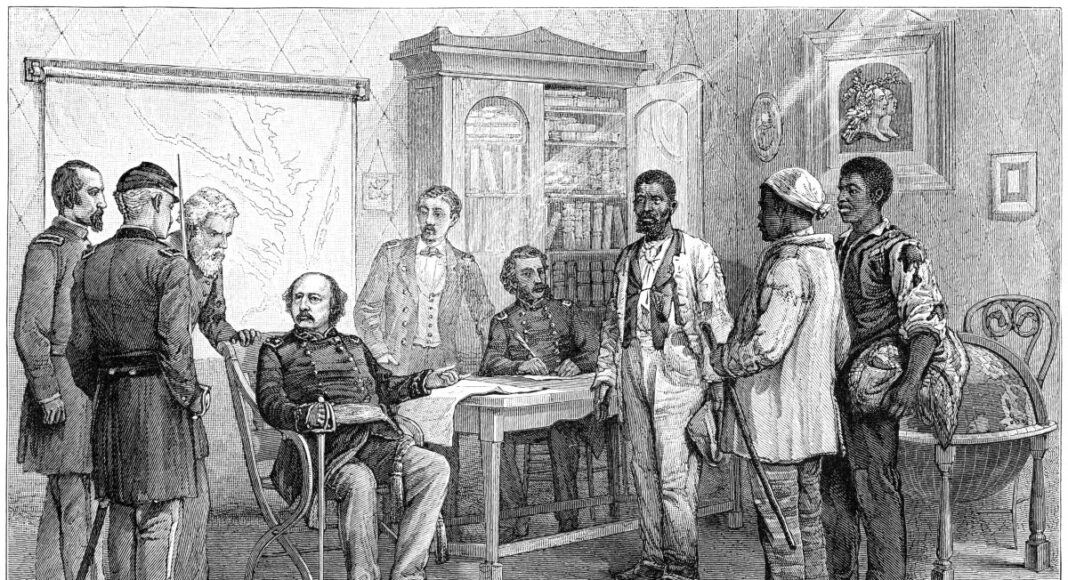



In new research, Luna Bellani, Anselm Hager, and Stephan Maurer examine how the abolition of slavery after the American Civil War affected the political influence of former slaveholders. Despite the blow to their economic standing, former slaveholders maintained their electoral success, and once in office, their influence actually grew.
Abraham Lincoln’s Emancipation Proclamation, the Union victory in the Civil War, and the 13th Amendment to the Constitution together ended slavery in the United States. This process not only set millions free, but in doing so, it also weakened the economic basis of the Southern planter class, opening the region’s politics to disruption. In our new working paper, we examine if abolition weakened the political influence of (former) slave owners, and whether it did so relative to the influence of the economic elite in the North.
It is both intuitive and well-documented that the abolition of slavery reduced the wealth of former slave owners. Among Southerners with equal wealth in 1860, those with more slaves saw a larger decline in wealth by 1870. As a consequence, while overall levels of wealth mobility were similar in the North and South after the war, wealth mobility among the wealthiest was greater in the South. At the same time, even though slavery was gone, the South’s economy remained plantation-based and reliant on cheap labor, giving an important politico-economic role to the owners of former slave plantations. Previous research has already documented a high degree of persistence of former slave owners in political office, both in the Texas legislature and across the whole South. However, it remains unclear what the influence of Southern elites would have been had slavery not been abolished. We thus lack counterfactual evidence on whether abolition caused a meaningful shift in Southern elites’ political influence.
To answer this question, we tracked elected legislators in six state houses and senates between 1850 and 1880. Our dataset covers four slave states—Alabama, Florida, Virginia, and the border state of Kentucky—and two free ones: New York and Wisconsin. The 1850 and 1860 censuses recorded slaveholdings, allowing us to identify which Southern legislators had a slave-owning background. We then compared the share of slave-owning legislators from elite backgrounds in the South to the share of legislators in the North from similar backgrounds, allowing us to see how these shares moved relative to each other over time. We classified a Northern legislator as coming from the socioeconomic elite if his real estate wealth put him among the state’s wealthiest 25% of landowners.
Figure 1. Share of legislators with elite background over time
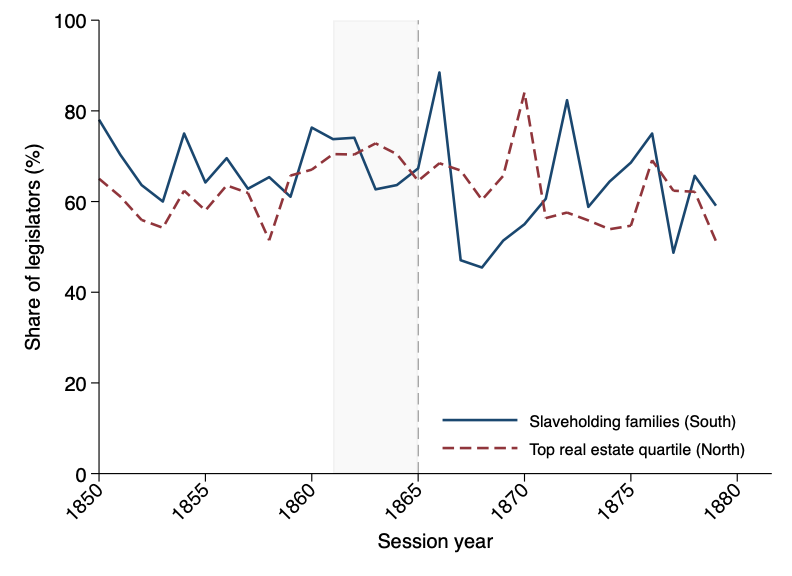
The solid line shows the share of legislators in slave states from slaveholding families. The dashed line shows the share of legislators in non-slave states whose household belongs to the top quartile of the real estate wealth distribution. The shaded area indicates the Civil War (1861–1865). The vertical dashed line marks 1865, the year of abolition.
Figure 1 shows that in both the North and the South, the socioeconomic elite was overrepresented in the legislatures, with typically between 60% and 80% of all legislators coming either from slaveholding families or from the top real estate quartile. Even more importantly, the two time series show very similar patterns, both before and after the Civil War. In 1866, during Presidential Reconstruction, the share of legislators from slaveholding backgrounds in the South even increased. This was then followed by a brief drop during the late 1860s (likely reflecting Congressional Reconstruction), a rebound in the early 1870s and then a similar vacillating trajectory as in the North. This echoes the persistence of (former) slave owners in lawmaking and office, and it adds a comparative perspective: Former slave owners did not lose access to state-level power, neither in absolute terms, nor relative to the Northern socioeconomic elite.
Next, we examined the political influence of legislators based on their socioeconomic backgrounds. We used the number of committees on which a legislator sits to proxy his legislative influence and standing among his peers. We then analyzed whether the Civil War and the abolition of slavery affected the influence of legislators that hailed from the slave-owning elite. To do so, we examined the gap in committee counts between elite and non-elite legislators over time. Figure 2 shows results for the South, where the coefficient on the y-axis measures this gap.
Figure 2. Elite influence in four slave states
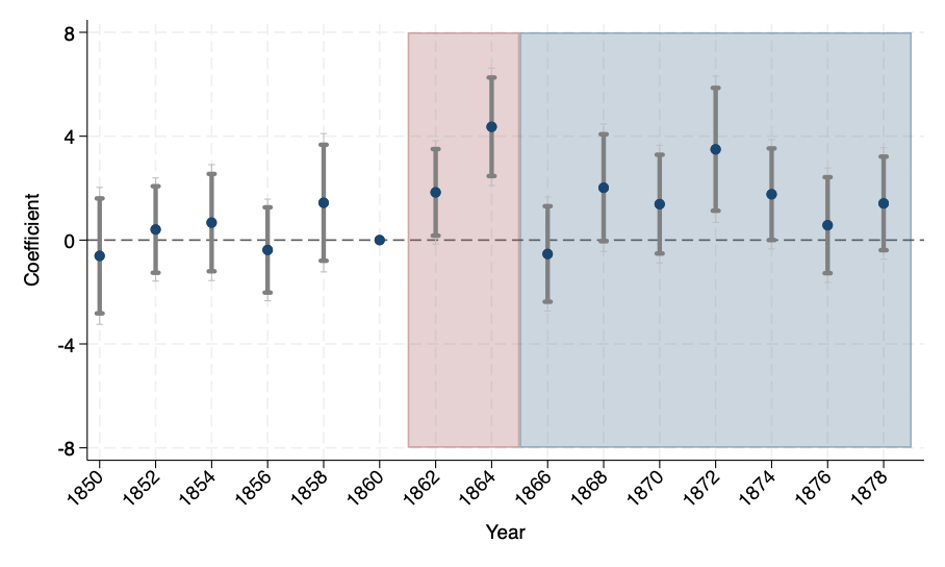
The figure plots the difference in committee counts between elite and non-elite legislators. Elite background is measured by slave ownership. The omitted reference period is 1860–1861.
Before the Civil War, legislators from slave-owning backgrounds had roughly as much legislative influence as their colleagues that did not own slaves. Coefficients before 1860 fluctuate around zero and are never statistically significant. During the Civil War, slave owners then became more influential, and (with the exception of the immediate post-war period) this increased influence persisted until the late 1870s. When we aggregate time periods, we find that the committee gap between elite and non-elite Southern legislators widened by nearly two committees on average during the Civil War, and by more than one committee after abolition.
It is of course conceivable that the pattern of legislative influence in the South was not driven by the Civil War and abolition, but by national trends in elites’ influence. For this reason, we repeated our analysis for the two free states of New York and Wisconsin. Figure 3 shows no comparable increase in elite legislative influence in the North. Both during the Civil War and immediately in its aftermath, coefficients are close to zero and not statistically different from 1860 levels.
Figure 3: Elite influence in two free states
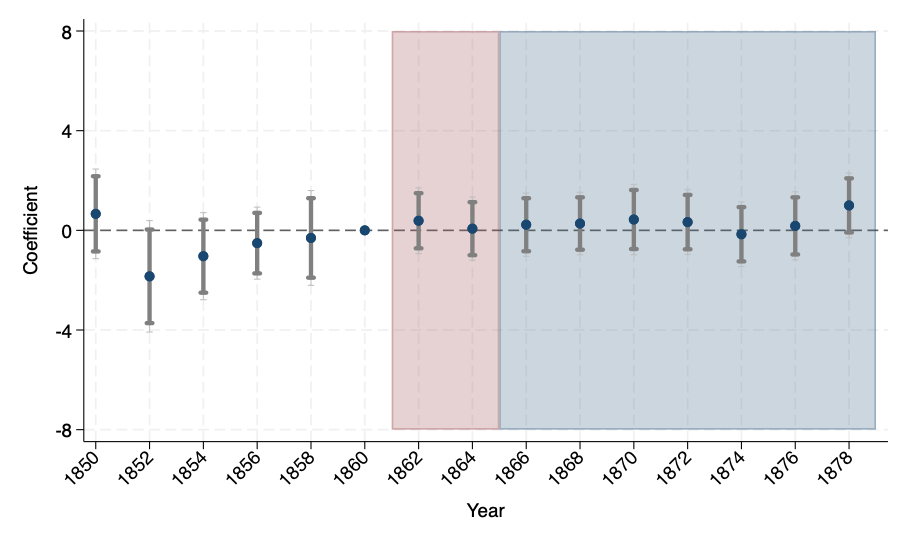
The figure plots event-study coefficients from a two-way fixed effects specification interacting with an indicator for elite background with two-year period indicators. Elite background is measured by top-quartile real estate wealth in non-slave states. The omitted reference period is 1860–1861.
Taken together, our results show a clear picture: The abolition of slavery, while hurting slave owners’ economic position, did not undermine their political influence. They continued to be elected to legislative offices at similar rates as wealthy landowners in the North, with at most a very short-lived divergence during the early years of Congressional Reconstruction. Moreover, once in office, legislators from slave owning families became more influential after the abolition of slavery. Rather than disappearing with the destruction of slavery, elite power adapted and reemerged through political channels.
Our data illustrate how a powerful elite can withstand the destruction of its economic base and reconstitute influence through political channels. Although slavery was dismantled, the planter class preserved its power through deeper political entrenchment. Previous research has shown a backlash against the political participation of freed Blacks: Election losses by the Southern Democrats, increased local taxes, and exposure to field offices of the Freedmen’s Bureau were all found to have increased anti-Black violence in the post-war era. The elite continuity we document was likely related to this backlash. It curtailed the transformative potential of emancipation and set the stage for Jim Crow. Our results thus caution that institutional reforms that target only formal economic arrangements might not be effective. Even transformative shocks such as emancipation may leave underlying political hierarchies largely intact if incumbent elites retain access to political office and institutional power.
Authors’ Disclosures: The authors report no conflicts of interest. You can read our disclosure policy here.
Articles represent the opinions of their writers, not necessarily those of the University of Chicago, the Booth School of Business, or its faculty.
Subscribe here for ProMarket’s weekly newsletter, Special Interest, to stay up to date on ProMarket’s coverage of the political economy and other content from the Stigler Center.