








In new research, David Hall, Benjamin Hansen, and Kyutaro Matsuzawa find that decriminalization efforts in Oregon and Washington reduced the number of drug-related arrests, but also led to additional overdose deaths.
Drug convictions can reduce employment and earnings, deepen racial disparities in the criminal justice system, and deter people from calling emergency services during an overdose. Oregon lawmakers introduced Measure 110 to try and reduce these harms while redirecting people toward treatment. At first glance, drug decriminalization in Oregon achieved one of its central aims: arrests for drug possession collapsed. However, it was also followed by large and sustained increases in overdose mortality relative to comparable states. In our new NBER working paper, we study the effects of decriminalization in Oregon and Washington, which implemented a similar policy to Oregon. We estimate that drug decriminalization was associated with approximately 1,186 additional overdose deaths in Oregon and 1,895 in Washington in about three years. The subsequent question for policymakers is therefore not whether arrests fell—they did—but whether the broader reform improved health and well-being.
Two different paths to decriminalization
Oregon voters approved Measure 110 in November 2020, and it took effect on February 1, 2021. Possession of small amounts of controlled substances for personal use was reduced from a misdemeanor to a violation carrying a $100 fine, which could be waived by completing a health assessment initiated through a statewide hotline. The measure also directed cannabis-tax revenue toward treatment, harm reduction, housing, and recovery services.
Washington arrived at a similar policy through the courts. On February 25, 2021, the state supreme court’s State v. Blake decision invalidated Washington’s previous drug-possession statute, which prosecuted drug possession without proof that that person had knowingly possessed the drugs.. Although possession was temporarily decriminalized, the legislature soon recriminalized possession as a lower-level offense and expanded diversion opportunities to rehabilitation. Reported possession arrests nevertheless remained exceptionally low until late 2023, when a new law increased penalties.
These measures ultimately led to a reduction in drug-related arrests as measured by the Federal Bureau of Investigation’s Uniform Crime Reporting (UCR). Figure 1 shows observed drug-related arrests in red in Oregon (panel a) and Washington (panel B) alongside our estimated counterfactual of each state in blue.
Figure 1: UCR Estimate, Arrests
- Oregon (ATT=-11.86, p-value=0.021)
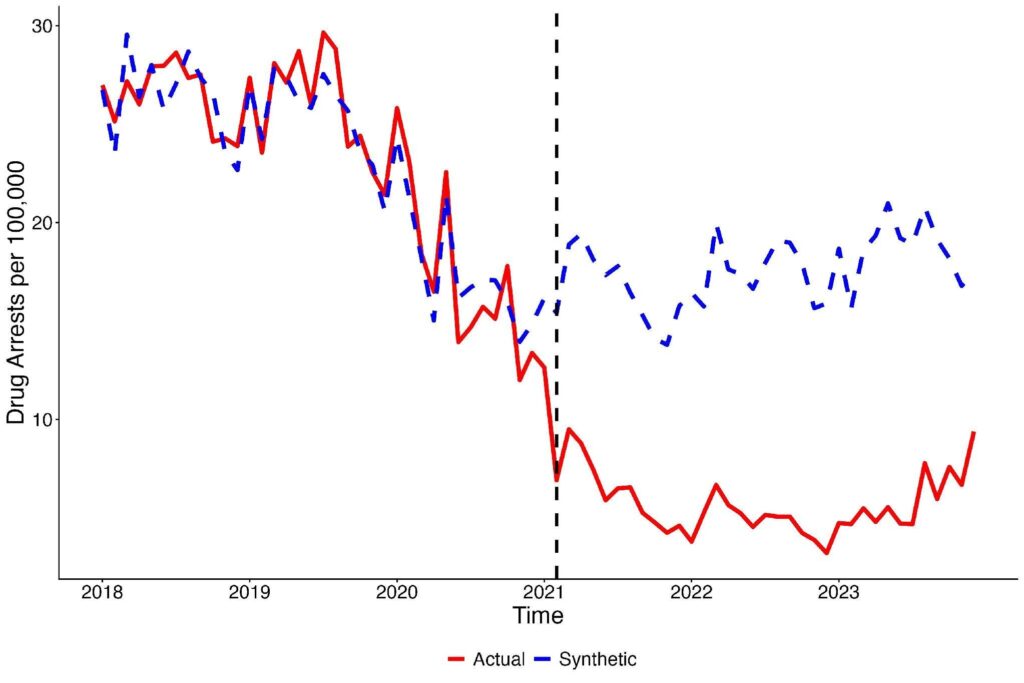
- Washington (ATT=-6.42, p-value=0.021)
Constructing the missing counterfactual
The central empirical challenge is that overdose mortality was already rising during the COVID-19 pandemic. At the same time, fentanyl was spreading from the eastern United States toward western drug markets. Prior work argues that fentanyl reached Oregon relatively late, potentially around the same time Measure 110 took effect. If that timing is correct, estimates could wrongly attribute deaths caused by a coincidental fentanyl supply shock to decriminalization. Our tests do not support an exact coincidence between fentanyl’s arrival and Measure 110, but the concern is important enough to address directly.
We used the synthetic control method (SCM) to isolate the effects of decriminalization from the trend of fentanyl. SCM is particularly useful in case studies like ours, where there is no single obvious comparison state and the choice of counterfactual can strongly affect the estimated policy impact. For each treated state, we constructed a weighted combination of untreated states that closely reproduces its monthly overdose mortality before decriminalization. This weighted combination provides a synthetic estimate of how each state would have looked in the absence of the policy change. We then compared actual mortality with the synthetic counterpart after February 2021 in Oregon and March 2021 in Washington.
The synthetic Oregon and Washington closely track their respective states before decriminalization. Afterward, the paths separate. The gaps emerge in 2021 and widen substantially during 2022 and 2023.
Figure 2: Oregon and Washington Overdoses vs. Synthetic Counterfactuals (a) Oregon (ATT=0.806, p-value=0.02)
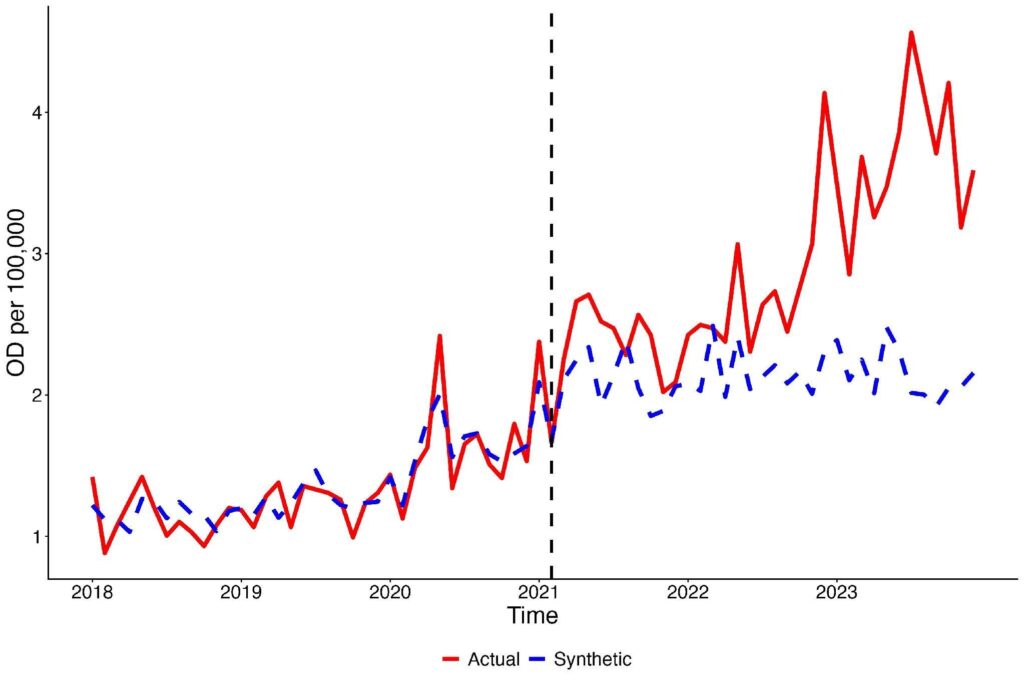
(b) Washington (ATT=0.732, p-value=0.02)
Across the full post-policy period, we estimate that actual overdose mortality increased by 0.806 deaths per 100,000 residents per month in Oregon, which equals about 29.0 percent of all post-Measure 110 overdose deaths. This implies 1,186 excess deaths in Oregon from decriminalization from February 2021 through December 2023. In Washington, the estimated increase was 0.732 deaths per 100,000 residents per month, or about 23.8 percent of all post-Blake overdose deaths, implying 1,895 excess deaths from March 2021 through December 2023. These results hold up even when we vary the parameters of the SCM to use other states as controls or use only pre-pandemic data.
Why fentanyl does not settle the question
Fentanyl is indispensable to understanding the rise in overdose deaths, but accounting for its effect is not straightforward. Fentanyl possession was decriminalized as well, but because of fentanyl’s lethality, enforcement remained high with a larger focus on those selling and those possessing larger quantities. A recent study found that Measure 110’s estimated effect disappeared after controlling for fentanyl’s share of all drug reports in the National Forensic Laboratory Information System (NFLIS). We replicate that result over the same sample period. The difficulty is that fentanyl’s share of drug reports can rise for two reasons: fentanyl reports can increase, or reports involving other drugs can fall.
Laboratory drug reports originate from drugs seized and submitted by law enforcement. After decriminalization, possession arrests and non-fentanyl drug reports fell sharply. Fentanyl’s share of all reports therefore increased partly because there were fewer reported drugs in general. Because decriminalization changed law enforcement behavior, fentanyl’s share of drug reports may have increased without a corresponding increase in fentanyl’s presence in the illicit market.
We therefore test several alternatives, including fentanyl reports per capita, fentanyl’s share of opioid-related reports, and donor pools restricted to states where fentanyl arrived later. The first two alternatives are constructed using the same NFLIS data, but may reflect better the transition from heroin to fentanyl in the third wave of the opioid epidemic and are less likely to be impacted by changes in law enforcement effort from either state’s regime change. The latter allows us to compare states with similar fentanyl outbreak patterns, though the primary specification puts the most weight on states that were hit by fentanyl last regardless. The estimated overdose effects remain positive across these approaches. Moreover, once the analysis is extended through 2023, the estimates are positive even when we use the original fentanyl-share measure. Fentanyl drove overdose mortality throughout the country, but the alternative measures we examine do not fully account for the divergence between Oregon and Washington and their synthetic controls.
What the evidence means for policy
Our estimates capture the net effect of the policy environments that followed decriminalization, but they do not isolate a single mechanism. Mortality could have changed through drug consumption, the composition of the illicit market, enforcement behavior, treatment access, public use, or interactions among these channels. Oregon also paired decriminalization with substantial service funding, although the legal change occurred well before the new treatment system was fully operating. Washington’s institutional response was different. The common pattern was a sharp and prolonged decline in enforcement followed by a growing overdose gap.
The drug-market environment also matters for how these results should travel to other settings. Oregon and Washington changed policy while fentanyl was widespread and overdose mortality was rising nationally. Recent research argues that a disruption in the illicit fentanyl supply beginning in 2023 helped drive the subsequent national decline in overdose deaths as it reduced its purity, although a newer reanalysis concludes that falling national fentanyl purity alone is not a sufficient explanation. Taken together, this evidence suggests that the consequences of decriminalization may differ when the potency, availability, and composition of the illicit drug supply differ. Our estimates apply to the particular 2021–23 policy and drug-market environments we study, not to decriminalization under every possible set of conditions.
A complete welfare evaluation must weigh the mortality increase against the costs that decriminalization was intended to reduce, including arrests, incarceration, criminal records, and barriers to treatment. Our findings address mortality, not every outcome needed for that calculation. They nevertheless show why overdose deaths cannot be treated as an incidental outcome of reform.
Timing also matters. Earlier studies had only about one year of post-policy data and reached different conclusions. Our paper’s appendix replicates and reconciles the two studies’ findings. The estimated gaps became much larger in years two and three. Policymakers should therefore be cautious about drawing conclusions from the first months after Oregon changed course in 2024 or Washington increased possession penalties in 2023. Both states paired these changes with diversion or deflection programs whose implementation varies across localities.
The broader lesson is that decriminalization cannot be evaluated independently of its implementation or the surrounding drug market. Reducing criminal-justice exposure may generate important benefits, but reforms should also be evaluated against overdose mortality, treatment access, enforcement responses, and changes in illicit supply. Our results suggest that decriminalization can carry public-health consequences, while leaving open how those consequences would differ under other policy and drug-market conditions.
Authors’ Disclosures: This research was supported by Grant 24-12072 from Arnold Ventures. The authors report no other conflicts of interest. You can read our disclosure policy here.
Articles represent the opinions of their writers, not necessarily those of the University of Chicago, the Booth School of Business, or its faculty.
Subscribe here for ProMarket’s weekly newsletter, Special Interest, to stay up to date on ProMarket’s coverage of the political economy and other content from the Stigler Center.