


The post-World War II Chicago School of Aaron Director and Milton Friedman reimagined a new (neo) liberalism that treated economic liberties and the free market as the greatest defense of political rights. The government, and democracy, were more often than not barriers to economic liberties. The United States continues to suffer from neoliberalism’s prescriptions, and addressing the concerns of today’s populist movements will mean rediscovering ideas of freedom that the Chicago School denigrated, writes Robert Van Horn.
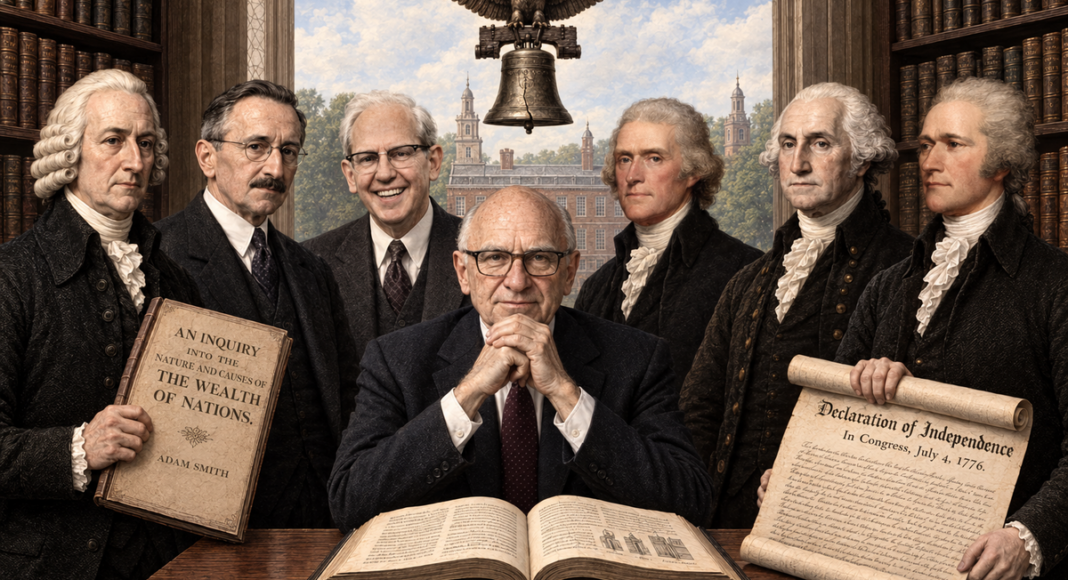
Editor’s note: This year celebrates the 250th anniversaries of the American Declaration of Independence and the publication of Adam Smith’s Wealth of Nations. It is also 50 years since Milton Friedman won the Nobel Prize in economics. This article is part of a symposium revisiting the ideas of freedom and political economy expounded by the American revolutionaries, Adam Smith, and the Chicago School of economics, and how they connect to contemporary concerns about capitalism and democracy. You can read the rest of the articles here as they are published, with contributions from Peter Boettke, David Mitch, Robert Van Horn, Sandra Peart & David Levy, Maha Rafi Atal, Edward Nik-Khah, and Richard John. We welcome responses, which you can send to promarket@chicagobooth.edu.
One of the striking facts about America’s most powerful economics program, housed at the University of Chicago and known colloquially as the Chicago School, is that its greatest exponents advised dictators and in some respects championed authoritarian regimes. For example, the Nobel Prize-winning economist Milton Friedman travelled to Chile in 1975 to advise its dictator about economic policy, and he and his wife wrote about his experience in their exceptional autobiography, Two Lucky People. Significantly, Friedman preferred the authoritarian regime of General Augusto Pinochet to that of Pinochet’s predecessor, whom Pinochet had overthrown in a coup, the Allende regime, because the latter was an overtly Marxist government, though one elected through the legal democratic process.
Why would one of the greatest exponents of the free market take time to support authoritarian regimes? This article takes the position that economics came to support authoritarian regimes because it championed a distinctive form of individual freedom and a distinctive form of the free market that disdained democracy. What mattered was individual freedom from national regulation, particularly for corporations. Indeed, large corporations were a positive feature of the free market representing efficiencies of scale and did not hinder freedom. By adopting economic thinking that championed the free market and supported authoritarian regimes, Friedman and other members of the Chicago School departed from previous generations of economists. Indeed, in their departures from the earlier generations, it is possible to see “where economics went wrong” and the advent of the United States’ contemporary economic and political issues that now spur populism on both the right and left.
The beginnings of neoliberalism
Economics went wrong in the 1950s. Aaron Director, who is often recognized as a leader in establishing the post-war Chicago School and the pioneer in re-orienting antitrust policy towards free-market thinking, said the following about liberalism and freedom in 1955 in “Who Are Today’s Conservatives?”:
The ‘older kind of liberals’ . . . recognize that . . . majority decision involves a substantial amount of coercion; and . . . as a consequence . . . if we are interested in maximizing individual freedom, we must keep those activities which are taken on the majority principle to a bare minimum and leave as much as possible—and to me that includes a great deal—to be decided by the voluntary decisions of individuals.
It is critical to appreciate that after WWII ended, liberalism and its prioritization of the individual was one of the only forms of opposition to collectivism (i.e., socialism, communism, Keynesianism, and institutional reformism). Liberals, such as Director, saw collectivism in all its forms as dangerous and liberalism as its best riposte. However, classical liberalism had always observed a moral obligation of government and economics, and policy was contextual and appropriately a democratic process, as David Colander and Craig Freedman discuss in Where Economics Went Wrong. In the 1950s, Director and other members of the Chicago School reimagined liberalism to abandon many of its moral precepts and social obligations. Director and the Chicago school instead justified liberalism via mathematized economics that applied rigid models maximizing efficiencies and growth. The democratic process, rather than be the method through which to navigate tradeoffs, became a barrier to economic outcomes and individual freedom.
Focusing on Director’s work is one of the clearest ways to see the birth and rise of Chicago new liberalism or neoliberalism. This article focuses on an often-overlooked aspect of the birth of Chicago neoliberalism by examining Director’s thinking about both freedom and democracy. In doing so, it looks at the work of the Nobel Prize-winning economist Friedrich Hayek, who taught at Chicago between 1950 and 1962, and his famous book The Road to Serfdom. Director considered The Road to Serfdom one the greatest works of the middle twentieth century.
How a fear of totalitarianism led to authoritarianism
After the Allies won World War II, Hayek believed another war had to be won. Hayek thought that collectivism (socialism) had been ascendant in Western intellectual circles since the late nineteenth century and had finally triumphed in the Western world during the Great Depression, including in the U.S. with President Franklin Delano Roosevelt’s New Deal. Socialism was inherently totalitarian: hence, the Bolsheviks in Russia and the rise of fascism in Nazi Germany and Italy, the latter which observed their own form of collectivism that brought all aspects of private life under the discretion of the state. A war in the realm of ideas had to be fought to defeat collectivism. The Road to Serfdom argued that government control of markets through central planning inherently risked the slide toward tyranny.
For Director, Road to Serfdom brilliantly explored and attacked the rise of collectivism. Director built upon Hayek’s political theory through his work investigating the legal foundations of capitalism and the “competitive order” for the premier international neoliberal organization, the Mont Pelèrin Society, and in his leadership of the Chicago-based Free Market Study or “Hayek Project,” which ran from 1946-1953. Out of the Free Market Study came research on business monopoly and corporations, particularly that they would eventually always be supplanted by the forces of competition. Director, along with other Chicago School luminaries like Friedman, maintained that concentrations of business power were not a threat to freedom and did not require government intervention because competition would moderate their activity. As such, large corporations and industrial monopolies posed no threat to an individual’s freedom to choose. Government intervention, which gummed up the competition’s invisible hand, did threaten individual freedom, though. This tenet would form the basis of the American “Road to Serfdom” and would define the Chicago School approach to antitrust regulation and the overarching neoliberal philosophy.
With freedom no longer threatened by private power, the ideal took on new significance. Individual freedom naturally provided what was needed to prevent political freedom from degenerating. Collectivism and its limits on individual freedoms were the real dangers to a free society. But so was democracy if the majority of individuals voted for policies that restricted the economic freedoms of other individuals. Thus, with some irony, authoritarian regimes could better affirm the individual rights to unrestrained economic and commercial activity that concerned the Chicago School most.
What was freedom?
In 1953, Director gave a speech at the University Chicago Law School. In it, he stressed that the term “free market” implied that a well-crafted legal system (or legal framework) needed to be in place to preserve effective competition and thereby promote individual freedom. Institutional structures, according to Director, fostered “centers of resistance against the encroaching power of coercive organization.” The competitive order provided an essential foundation for preserving individual freedom and safeguarding it.
Milton Friedman produced the Chicago School’s most famous articulation of freedom in his 1962 book Capitalism and Freedom, published by the University of Chicago Press. The book was the fruit of the Free Market Study, and therein Friedman designated the government’s proper role in market conduct, limited to a steady supply of money and the intervention into rare, technical monopolies. However, Friedman argued, economic rights were the basis of political rights, and thus government limits on commercial activity and private property de facto limited political rights. If economic rights were observed, there would be little need for political discourse. As Friedman wrote, “The wider are the range of activities covered by the market, the fewer are the issues on which explicitly political discussions are required.” To add to that, there was little the free market could not resolve on its own.
The significance of the Chicago neoliberal conception of freedom and democracy can be appreciated by contrasting it with Henry Simons’ 1948 Economic Policy for a Free Society. Simons was a member of the pre-War Chicago School and a classical liberal who helped to define the first Chicago School’s economics tradition. Simons committed suicide in 1946, so he did not witness the abandonment of classical liberalism at Chicago. In his opening chapter, Simons cut right to the chase and discussed the importance of democracy. In Simons’ words: “Democracy…implies, at best, a continuing process of relevant discussions….” Simons said that a democracy allowed extensive discussion to occur and mature consensus to result from this. Simons viewed discussion and mature consensus as vital components of a free society. Simon’s contemporary Frank Knight likewise argued that freedom and democracy went hand-in-hand, and he chose not to direct strong invective toward socialism and communism. When talking about the Chicago School, it’s important to note how much of a break the post-War version of Director and Friedman was from that of the previous generation.
Not, necessarily, democracy
There is perhaps no greater achievements for an American economist than to have one’s book carried by the president of the United States. Ronald Reagan carried Capitalism and Freedom on the campaign trail and close to him during his presidency. While Reagan and his supporters tended to trumpet Friedman and his opposition to big government, Friedman ultimately was about individual freedom and the free market. He was not ultimately about opposing big government and most certainly did not champion democracy. Indeed, the book’s index does not contain a single entry on “democracy.” That is why Friedman’s work appealed to authoritarian countries like China and Chile, and why Friedman himself went to each to spread his neoliberal message and to advise these countries’ regimes.
Friedman travelled to China as the guest of its government. In 1980, he made one of his three visits to China, which had been communist since 1949 and recently begun to expand the role of the free market after the death of Mao Zedong and under his successor, Deng Xiaoping. When Friedman travelled to China in 1980, he knew that “no communist country had ever made a transition to a relatively free society…The only ones that have come close to doing so are countries that had communism forced on them from outside.” He had very little hope that China would be a supporter of economic freedoms even if it expanded the free market. Nevertheless, he offered Xiaoping suggestions on how this might be done.
Friedman had much higher hopes for the Chilean dictatorship of Pinochet.
Relying on Friedman and a cohort of Chilean economists trained at the University of Chicago (known as the Chicago Boys), Pinochet implemented a shock therapy of neoliberal policies to tackle inflation and spur growth, including privatization of industry, deregulation, and austerity. Milton was very complimentary of Pinochet’s efforts while demurring on the regime’s crimes against humanity, which included some 30,000 acts of torture and the execution of over 2,000 Chileans.
Abandoning democracy at home
The Chicago School of Director and Friedman did not celebrate authoritarianism, but the only good political regime was the one that preserved the free market. For Friedman, democracy threatened to slide into the tyranny of the majority.
In the U.S. and abroad, the prescription was to remove the government from market direction as much as possible: deregulation, cutting welfare and the budget, shrinking the government, liberalizing trade barriers and currency exchange. The consequences of the Chicago School’s policy can be seen today as American democracy has been thrown into crisis. This, of course, was of no concern to Milton and Director. However, the consequences of the U.S.’ democratic crisis have not ignored markets. Since the 2008 Financial Crisis that reaped the fruits of financial deregulation, Americans have steadily marched toward populism on both the right and left. President Donald Trump during his first administration usurped the neoliberal trade regime with tariffs. President Joe Biden allocated billions of dollars to industrial policy. Under Biden, the antitrust authorities ramped up attacks on big business. Several of their initiatives against Big Tech started under the first Trump administration.
Perhaps this all supports the Chicago School’s warnings against democracy. Or the turmoil of American politics of the last decade underline that a stable political economy requires a market that supports its democratic institutions and makes space for democratic discourse, as the early Chicago School argued. The first Chicago School found freedom in political engagement. The second found freedom in the minimization of it. As American society navigates continued economic hardships—inequality, attacks on labor via job displacement by artificial intelligence and union-busting, inflation—it will have to remove the separations between economic and political freedoms that the post-WWII Chicago School erected. A healthy economy needs a healthy democracy.
Author’s note: This article draws extensively from Robert Van Horn’s “Why Economics Supported Authoritarian Regimes” in “The Palgrave Handbook of Global Social Problems” (2026, Living Edition) published by Palgrave Press.
Author’s Disclosures: The author reports no conflicts of interest. You can read our disclosure policy here.
Articles represent the opinions of their writers, not necessarily those of the University of Chicago, the Booth School of Business, or its faculty.
Subscribe here for ProMarket’s weekly newsletter, Special Interest, to stay up to date on ProMarket’s coverage of the political economy and other content from the Stigler Center.