










Startups in Africa rely heavily on an equity market dominated by foreign investors and founders who studied or worked outside the continent. In new research, Emanuele Colonnelli, Marcio Cruz, Mariana Pereira-Lopez, Tommaso Porzio and Chun Zhao show that this dynamic exists because local equity is expensive, the pool of local entrepreneurs seeking out funding is small, and local entrepreneurs have limited access to foreign investors.
High-growth entrepreneurship has moved toward the center of the global development agenda. Governments, development finance institutions, and private investors increasingly look to young, technology-minded firms as possible sources of innovation and broader economic transformation. Yet the financing market behind this push remains poorly understood.
Africa offers a particularly important case, and our research takes a first systematic look at the characteristics of the market. We combined a continent-wide survey of 4,444 early-stage startups across 51 countries with an experiment measuring founders’ preferences over financing contracts and investors. We also assembled venture capital (VC) records covering 5,470 firms and 8,751 deals between 2010 and 2024, linked to founders’ education and work histories. Together, these data allow us to study who builds startups, what financing they seek, where capital comes from, and what the resulting allocation may imply for the scale and composition of the sector.
We found that startups seek substantial amounts of outside capital and strongly prefer to raise funds by using equity financing rather than borrowing. But the equity market they face is dominated by investors based outside the continent, and the founders who obtain funding have largely studied or worked abroad. The result is a market that is foreign both in where its capital comes from and in the background of the entrepreneurs who are most likely to reach it.
A concentrated ecosystem with large financing needs
Startup activity in Africa is concentrated in Egypt, Kenya, Nigeria, and South Africa and, within those countries, in a small number of urban hubs. In 2024, these four countries accounted for 72.2% of Africa’s VC deal value while representing 43.5% of its gross domestic product. Among these countries, the cities of Cairo, Nairobi, Lagos, and Cape Town accounted for 46.3% of Africa’s deal value but only about 10% of Africa’s GDP.
In general, startup founders stand out for their high levels of education. The vast majority of founders have some form of college education. Unlike other types of entrepreneurs, startup founders remain highly educated even in the poorest countries where average schooling is low.
Startups in Africa have substantial financing needs. Our average survey respondent sought roughly $730,000 in external capital. Over the preceding three years, respondents secured only 32.1% of the amount they sought, and 78.2% identified ‘access to finance’ as an obstacle to growth.
What do startups in Africa want?
To learn what kind of financing these entrepreneurs preferred, our survey embedded an incentive-compatible experiment where founders rated realistic investment opportunities that vary randomly in financing type, deal terms, investor characteristics, and team composition. This empirical design allowed us to isolate the value entrepreneurs place on various attributes.
The strongest result is a preference for equity financing, where investors buy part of the startup, over debt, which provides immediate cash that must be paid back with interest. Founders value switching from debt to equity financing as much as they would an 11 percentage point reduction in the interest rate on a loan. At the same time, they care about the costs of equity: they prefer lower dilution, which occurs when a startup issues new shares and consequently lowers the ownership of existing shareholders, and react negatively to board-seat requirements. Equity is attractive not because founders ignore ownership and control, but because it provides cash-flow flexibility and gives investors incentives to support the firm’s growth.
Founders also value country and sector expertise, investors’ local experience, and support beyond capital. By contrast, once deal terms and these investor capabilities are held fixed, they place no additional premium on an investor simply because they are foreign.
These findings describe what founders want. We next turn to the financing market that actually emerged.
The capital comes mainly from abroad
VC activity in Africa is low relative to population and GDP, with the largest shortfall on the investor side. African investors supply little capital even relative to the number of startups that receive funding.
Deals involving at least one investor headquartered outside Africa account for about 80% of VC deal value, far more than in other emerging or developed markets. More conservative allocations still place foreign capital at roughly 65% to 75% of African VC financing.
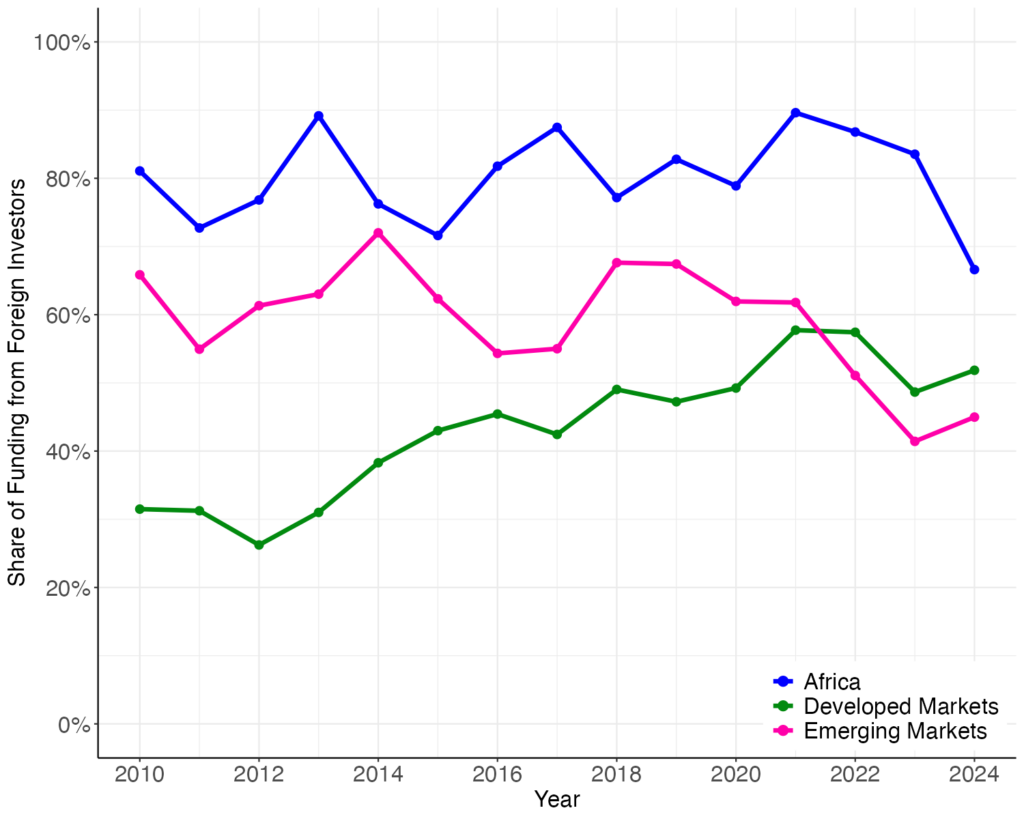
Figure 1. Foreign-investor involvement is unusually high in Africa. Source: Colonnelli et al. (2026).
Most external capital comes from North America and Europe. Intra-African flows remain smaller and geographically concentrated, so the continent’s limited investor base is not offset by a deep and integrated pan-African VC market. Cross-border financing also relies on financial infrastructure outside the continent: 56.2% of African VC deals are denominated in foreign currency, predominantly United States dollars.
This contrast creates a puzzle: founders place no independent premium on foreign investors, yet deals involving them account for the overwhelming majority of venture capital flows to the market.
Foreign exposure shapes who reaches the capital
The international pattern extends to the founder side. Among founders of African startups that successfully raise VC, 46.8% studied outside Africa, 58.4% worked outside Africa, and 67.7% did at least one of the two. We describe these founders as foreign-exposed.
The particular country of exposure matters. A founder’s previous education in an investor country is associated with a 7.7 percentage point higher probability of receiving capital from that country’s investors, compared with an average probability of 2.2%. Founders with previous work experience in the investor’s country also have an advantage of similar magnitude. These correlations show how education and work histories can connect entrepreneurs to the places where capital is available.
This pattern is not explained well by broad performance differences. Once startups with similar characteristics at their first VC deal are compared, differences in exits, acquisitions, bankruptcy, and employment growth between local and foreign-exposed founders are limited. The evidence instead points to access and connections as key parts of the financing market’s infrastructure.
The same forces that make the ecosystem foreign also keep it small
We develop a simple framework to take a first step toward interpreting these patterns. It separates three key characteristics: the relative cost of capital based on investors’ geographic origins; the pool of local and foreign-exposed entrepreneurs who are seeking equity capital; and differences in founders’ access to investors. It also allows for preferences over investor origin and differences in expected returns, explanations that our experimental findings and post-funding outcomes suggest play a smaller role.
Our analysis suggests that local equity is unusually costly relative to capital from North America and Europe in most African regions; the number of entrepreneurs without foreign exposure who are seeking equity financing is relatively thin; and local entrepreneurs have weaker access to the foreign investors that supply most startup capital.
We conducted a number of counterfactual exercises that indicate that these patterns shape both who is financed and how many startups obtain capital. If the cost disadvantage of local equity in Africa were reduced to the corresponding European level, startup activity would grow by 13.0%, the share of local investors would rise from 26% to 42%, and the share of local entrepreneurs would rise from 32% to 41%. Increasing the share of local entrepreneurs in the pool seeking equity financing to the corresponding European level would raise startup activity by 29.0%.
Improving local entrepreneurs’ access to foreign investors also raises startup activity, but shifts financing further toward foreign capital. A market can therefore become more locally founded while remaining, or even becoming, more foreign.
Building a broader startup market
The policy implication is not to choose between local and foreign capital. Foreign investors already supply much of the equity that African startups demand, and wider access to them can support more local entrepreneurship. At the same time, developing domestic and regional equity markets remains a separate and important objective.
Nor is a push for entrepreneurial talent enough on its own. The unusually high education of founders suggests that human capital is central to startup creation, but that talent must be connected to the right (equity) capital. If high-growth entrepreneurship is to play a larger role in development, policy must consider capital, talent, and access together.
Our evidence provides a first view of a market that development policy is increasingly trying to expand. The same forces that make Africa’s startup ecosystem so international also appear to limit its size and shape who can participate. Understanding those forces is therefore central to building a broader startup sector.
Authors’ Disclosures: Emanuele Colonnelli has received compensation as Short-Term Consultant from the World Bank Group. Marcio Cruz has received compensation as an employee of the World Bank Group. Mariana Lopez-Pereira has received compensation as an employee of the World Bank Group. The underlying research was supported by the University of Chicago Booth School of Business; the IFC Economic Research Department in partnership with the Government of Japan; the PEDL-BII Research Initiative; the Templeton World Charity Foundation; the International Growth Centre SGB Initiative; the Nesta Innovation Growth Lab; the Fama-Miller Center and the Polsky Center at the University of Chicago Booth School of Business; and the Becker Friedman Institute. The views expressed are those of the authors and do not necessarily reflect the views of the World Bank Group, its Board, the research partners, or the National Bureau of Economic Research. You can read ProMarket’s disclosure policy here.
Articles represent the opinions of their writers, not necessarily those of the University of Chicago, the Booth School of Business, or its faculty.
Subscribe here for ProMarket’s weekly newsletter, Special Interest, to stay up to date on ProMarket’s coverage of the political economy and other content from the Stigler Center.