









In new research, Annette Alstadsæter, Niels Johannesen, Ségal Le Guern Herry & Gabriel Zucman find that Norwegian households that become wealthy today are much less likely to adopt offshore tax evasion strategies under modern high-transparency standards.
The ability of wealthy households to evade taxes by holding assets in offshore tax havens has long undermined governments’ capacity to tax financial capital. This widespread evasion was made possible by strict banking secrecy in haven countries, which rendered offshore income and wealth nearly invisible to tax authorities and the risk of detection very low.
In response to this challenge, governments have made significant efforts to improve global financial transparency through international cooperation. In 2013, the G20 countries committed to a new mode of cooperation, the automatic exchange of information, under which banks are required to identify all financial accounts beneficially owned by foreigners and share detailed account information with the account owners’ home governments. This new standard is a major breakthrough for enforcing taxes on highly mobile financial capital. By extending third-party reporting—a powerful enforcement tool in the domestic domain—to foreign financial assets and income, it aims at eliminating the possibility for taxpayers to hide wealth and income abroad.
A nascent literature shows that this rise in transparency improved tax compliance on the existing stock of offshore wealth. But the long-run effect of the policy largely depends on whether it also deters new wealth from flowing to tax havens. We tackle this unanswered question in a recent paper examining how financial transparency shapes new wealth flows from the domestic economy to offshore accounts. Focusing on Norway, we find that households becoming wealthy today are much less likely to adopt offshore tax evasion strategies than they were a decade ago when their wealth could hide behind bank secrecy.
Our data are particularly well-suited for studying offshore evasion, a behavior that is notoriously difficult to observe. We combine Norwegian administrative transaction-level data on cross-border bank transfers; annual individual-level data from tax returns on income, wealth, and tax payments; and a comprehensive register of shareholder links between individuals and corporations, spanning 2004–2020. Together, these sources allow us to observe new money flows to secrecy jurisdictions, including flows routed through holding companies, which is a common blind spot in the academic literature.
Wealth accumulation and offshore wealth transfers
Our first exercise asks a simple question: as a household accumulates wealth, how much more likely is it to move some of it to a tax haven? Because we observe the same households over many years, we can identify this relationship from people moving up and down the wealth distribution ladder rather than from comparing different people. This ensures the pattern does not simply reflect fixed differences in tastes or skills between the rich and everyone else. Concretely, we study how the probability of directly transferring more than 100,000 Norwegian kroner (about USD 10,000) to a tax haven in a given year varies with a household’s position in the wealth distribution.
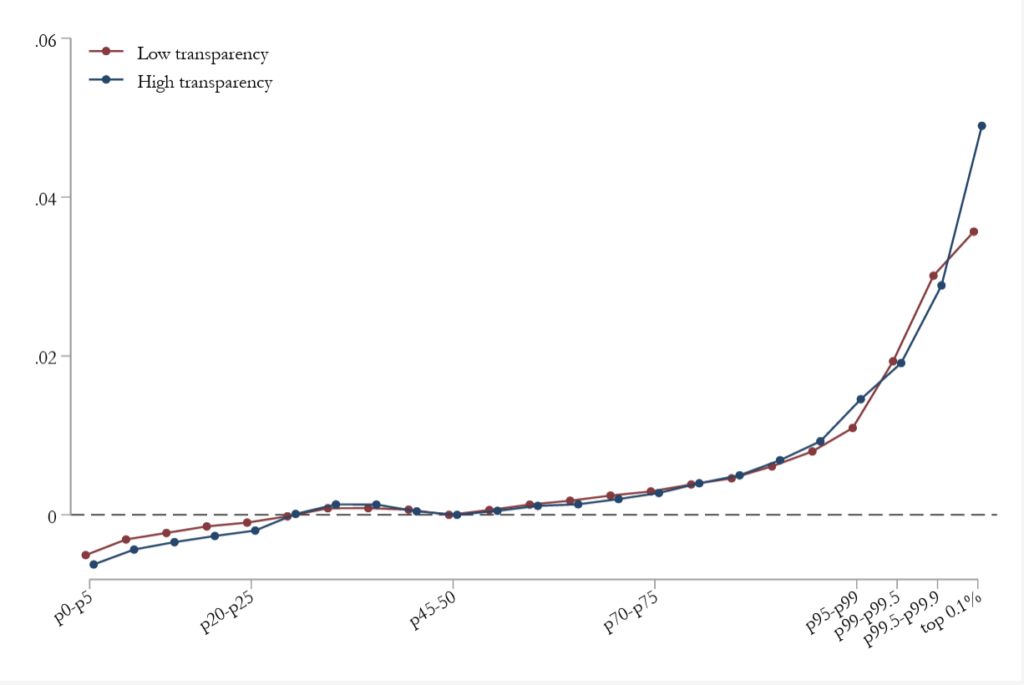
Before 2013, under bank secrecy, households became markedly more likely to make such large transfers as they got richer. As shown by the red line in Figure 1, there is a steep wealth pattern at the top during the low-transparency period: moving from the median level of wealth to the top 0.1% increases the probability of making a large transfer to a tax haven in a given year by almost 0.4 percentage points—approximately a 30-fold increase relative to the baseline at the median. Almost all of this movement comes from households climbing into the top 1%. As shown by the blue line, the pattern is much less steep in the high-transparency period: the same move into the top 1% now raises the probability by only around 0.05 percentage points—approximately a 3-fold increase. These first results suggest a sharp decrease in the propensity to shift newly created wealth to offshore tax havens after the G20 commitment to information exchange.
Figure 1: Wealth flows to tax havens
An obvious consideration is that this change reflects a general retreat from cross-border banking rather than anything specific to tax havens. To rule this out, we show in Figure 2 that when focusing on transfers to non-haven countries, households are as equally likely to transfer money into a cross-border bank before 2013 and after, when the G20 adopted high-transparency standards.
Figure 2: Wealth flows to non-haven countries
Offshore wealth transfers and domestic tax payments
Next, we turn to the tax implications of these wealth transfers under the two tax transparency regimes. We analyze how the tax returns of households sending money to tax havens evolve around the transfer, relative to similar households making no such transactions. To address potential confounders related to international mobility, we exclude highly mobile individuals such as students, individuals with foreign employers, and migrants.
As shown in the top panel of Figure 3, in the low-transparency period, wealth transfers to tax havens are associated with a sharp and persistent drop in tax payments, as shown by the red line. This reflects a larger and equally sharp drop in the financial wealth reported for tax purposes while real capital and salary income barely move. These results are consistent with simple tax evasion: the shifting of financial wealth to undisclosed offshore accounts reduces taxes on capital income and wealth. The results cannot be rationalized as simple portfolio reallocations: Norway taxes households on their global capital income and wealth, implying that tax-compliant transfers to offshore accounts do not reduce reported financial wealth or tax liabilities.
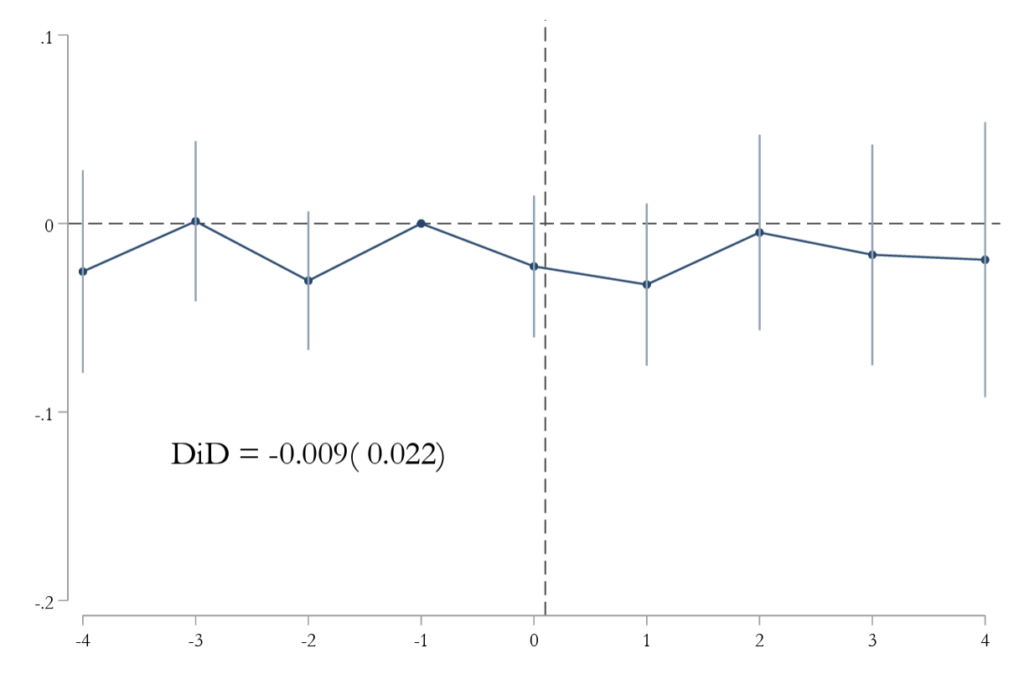
In contrast, the bottom panel of Figure 3 shows that in the high-transparency period, the changes in tax payments around the same event are statistically indistinguishable from zero, as demonstrated by the blue line. The wealth transfers to tax havens that still occur no longer leave any trace on the tax return, suggesting that they are conducted in a tax-compliant manner.
Figure 3: Wealth flows to tax havens and domestic tax payments
Note: In the panels above, the x-axis reflects the years before and after the transfer of wealth to a tax haven. The y-axis shows the change in total tax payments.
The use of holding companies among the wealthy
One may worry that our results merely reflect offshore tax evasion becoming more sophisticated in response to improved financial transparency: tax evaders who used to transfer wealth to tax havens directly from their personal accounts may have set up more elaborate holding structures to conceal these flows. Our final set of results investigates this hypothesis, using the shareholder register to link individual taxpayers to their holding companies and analyzing the cross-border money transfers carried out through these companies.
The evidence is mixed. On the one hand, the propensity of taxpayers to set up holding companies when they become wealthier is more pronounced in the period with high financial transparency, which is consistent with more sophisticated tax planning. On the other hand, the propensity to transfer wealth to tax havens through holding companies is less pronounced in the period with high financial transparency, suggesting that this tax planning is more about legal tax avoidance than about illegal tax evasion through offshore banks.
Overall, our results suggest that the automatic exchange of information, by greatly weakening bank secrecy, has discouraged the formation of new hidden offshore fortunes. In this more transparent tax environment, financial capital may be easier to tax than it was a decade ago, opening the door for governments seeking to raise more revenue or increase tax progressivity.
Author’s Disclosures: The authors report no conflicts of interest. You can read our disclosure policy here.
Articles represent the opinions of their writers, not necessarily those of the University of Chicago, the Booth School of Business, or its faculty.
Subscribe here for ProMarket’s weekly newsletter, Special Interest, to stay up to date on ProMarket’s coverage of the political economy and other content from the Stigler Center.