









In new research, Andrey Simonov, Daniil Mikhailov, Ruben Enikolopov, and Ruben Durante estimate that when a 2016 law pushed Russia’s leading news aggregator Yandex to reduce its references to independent outlets, readers kept following its recommended news stories as before, reducing traffic to the excluded outlets. In response, excluded outlets changed the news they produced.
“We’re not writing news for the readers. We are writing them for Yandex.” This is how one editor at a major Russian news wire described his job and the relationship between news outlets and the main search engine and news aggregator in the country, Yandex News. The Russian news media environment is similar to how American and European outlets rely on digital platforms like Google to publicize their work. Search engines, social media, news aggregators, and, increasingly, artificial intelligence assistants produce no reporting of their own but through algorithmic ranking systems decide which stories get surfaced, in what order, and from which sources.
How much power does that ranking carry over an outlet’s traffic, especially when the ranking system worsens by removing certain politically sensitive content or more independent-minded outlets? One might expect readers to shift demand away from what the ranking offers. When a television channel becomes a tool for propaganda, viewers switch away, for example. If an aggregator adjusts its ranking in a way that doesn’t reflect reader interests, the same logic should follow. Whether they actually do is an empirical question. In a new paper, we answer it using the case of Yandex News, Russia’s largest news aggregator, before and after the government forced it to change its algorithm to suppress certain Russian outlets.
One ranking for millions of readers
The front page of Yandex—one of Russia’s two dominant search engines, alongside Google—has displayed the five most important news stories of the moment directly above the search box for most of the company’s history. These top stories were based on the ranking of news events from Yandex’s news aggregator. Every visitor from around the world, tens of millions of people a day, sees the same five headlines, updated around the clock. Our study covers 2013 to 2017, the years when a click on a headline sent the reader straight to the outlet that published the story, allowing us to measure the impact of news ranking on outlets’ traffic and production decisions.
We reconstructed this ranking history from 29,841 snapshots of Yandex’s front page preserved by the Internet Archive. We then combined it with a dataset of 12.3 million articles published by 50 major Russian news outlets representing the majority of news coverage and with daily traffic data for a subset of them. The design we studied is not unique to Yandex: nearly every major search engine other than Google—Bing, Baidu, Naver, Seznam, and others, together serving roughly 30% of the world’s search activity—curates a similar news block on its homepage. Google itself has started to adopt a similar model: its mobile homepage has carried the algorithmically curated Discover feed since 2018, and in 2025 Discover began reaching the desktop homepage as well.
The traffic value of front-page slots
Yandex’s ranking influence is substantial. Occupying all five slots for a full day raises an outlet’s traffic by roughly 380,000 visitors—about 97,000 for the top slot, falling to 58,000 for the fifth. Stories ranked just below the front page—positions six through ten, which are shown on Yandex News’s page but are not displayed on the homepage—deliver much less traffic with imprecise estimates. This suggests that front-page positioning is what drives the significant proportion of clicks on news links on Yandex, not the newsworthiness of the article behind the link.
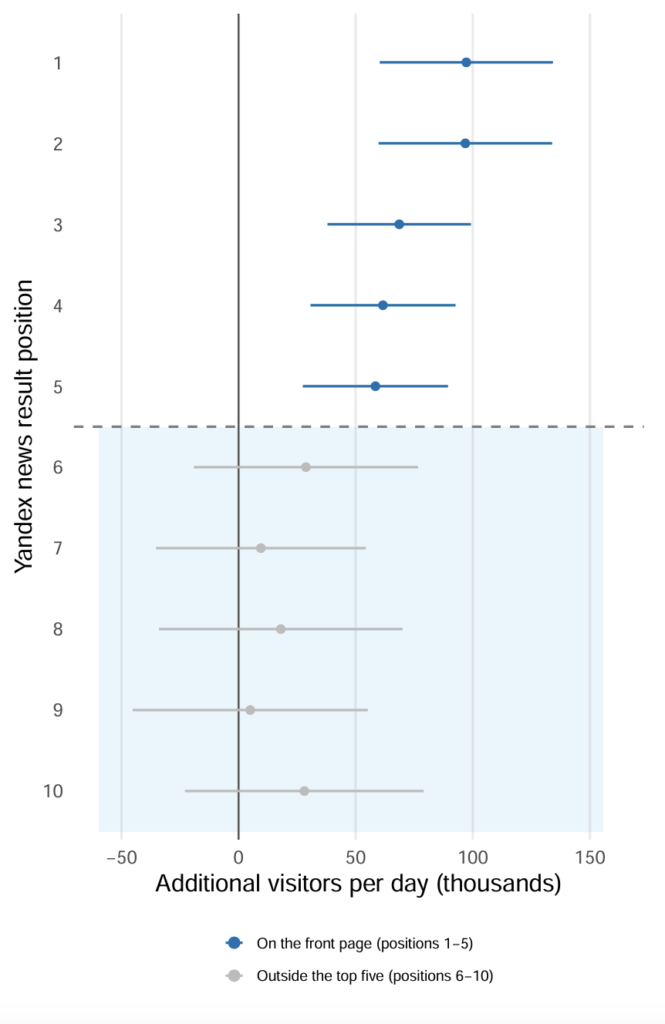
Figure 1: Additional daily visitors from a full day in each of Yandex’s news positions. Positions 1–5 appear on Yandex’s front page; positions 6–10 do not. Error bars are 95% confidence intervals.
Because Yandex’s audience is much larger than that of any outlet, the full set of front page links is worth 26% of daily traffic to the largest outlet in our sample and 1,132% to the smallest. The typical readers who visit news outlets through the Yandex homepage are casual ones: they view 1.8 pages per visit, against roughly four for a dedicated visitor, and they do not convert into loyal readership. The impact on clicks does not vary based on the topic or political sensitivity of the articles. Government-controlled outlets systematically under-report politically sensitive stories, and if anything, Yandex’s influence is stronger among the audience that tends to be older, higher-income, and opposition-leaning.
The algorithm change readers never noticed
On June 23, 2016, President Vladimir Putin signed a law making news aggregators with more than one million daily users liable for the content they cite, unless the source is registered with the state as a media organization. The law covered Yandex but not Google News, whose Russian audience was below the one million user regulatory threshold to be held liable for content.
Yandex’s response was abrupt. Within weeks of the signing—months before the law even took effect—the number of outlets appearing in the top five stories fell from about 24 per week to about 10. Nine outlets were dropped for good, many of them independent: Forbes Russia, TV Rain, and Novaya Gazeta, whose editor Dmitry Muratov would later win the Nobel Peace Prize for defending the right to free expression. The share of independent outlets in the front page slots fell from 20%—equal to roughly the share of independent outlets in all news—to 10%.
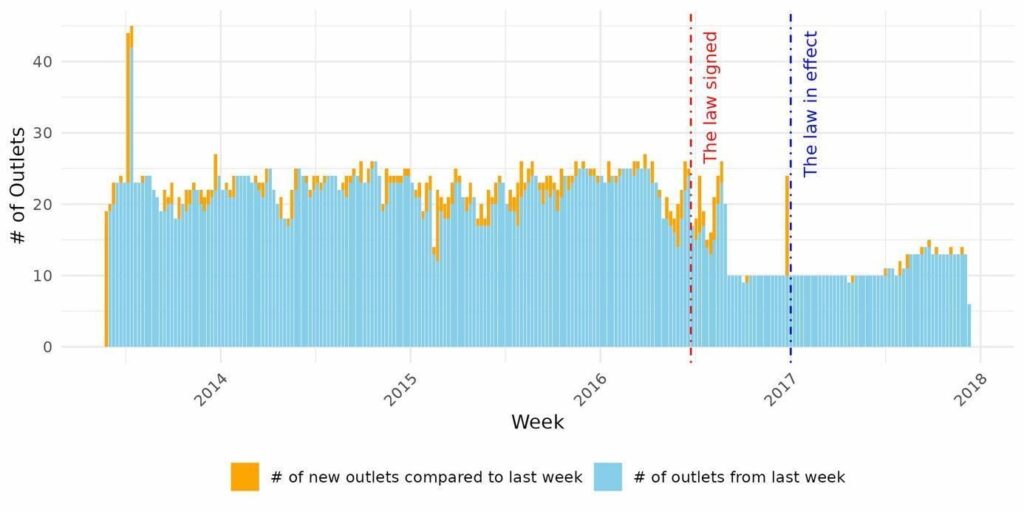
Figure 2: The number of unique outlets cited in Yandex’s top-5 news slots each week. The red line marks the signing of the law on news aggregators (June 23, 2016); the blue line marks its entry into force (January 1, 2017).
Yet the events Yandex covered did not change, and the share of politically sensitive stories in its ranking remained the same before and after the new law. Although some sources fell from the rankings, reporting on news events was widespread among sources. This included government-owned outlets that were still able to publish event-related news under censorship laws at the time and two independent sources, RBC and Vedomosti, which were registered with the government. The algorithm suppressed outlets, not topics, by changing weights of sources in the step where it picks which outlet to cite for each story. This mechanism matches a journalistic investigation (page later removed but the announcement still available on Facebook) of leaked Yandex code, which found a per-source flag controlling front-page eligibility, and reporting that the Putin administration had agreed with Yandex on a list of roughly 15 approved outlets as early as 2015.
While the change in cited outlets was dramatic, readers did not appear to adjust how much they relied on Yandex for news. Both before and after the law went into effect, an outlet that spent a full day in the top five received about 2% of Yandex’s active front-page audience—and the conversion rate is, if anything, slightly higher after the law than before. Yandex’s search market share was flat or rising on both desktop and mobile. Cutting the menu of cited outlets by more than half, including a lot of prominent independent outlets, cost the aggregator nothing.
Writing for the algorithm
The removed outlets, meanwhile, changed what they wrote. Previously, editors knew the algorithm’s tastes—publish early, pack in facts, write short clean headlines, don’t copy the wire—and had optimized their articles to increase the number of Yandex referrals. Once their outlets were excluded, editors stopped writing to appease Yandex’s algorithm. Relative to the outlets Yandex kept, the removed outlets became 20% less likely to write short “spot” news on widely covered events, wrote articles that became 50% longer, and let their headlines grow by seven to eight characters and an extra punctuation mark or two. The adjustment took about ten months, and it reached everyone: a loyal reader of Forbes Russia who never opened Yandex still ended up with a different newspaper.
Capture of media platforms
Research on media capture has generally focused on ownership of newsrooms and its effect on coverage. Our results reflect media capture one layer up: control over the distribution of content that others produce. For a government, this is cheaper and quieter than buying outlets. No newsroom changes hands, no journalist is fired, and—crucially—the manipulation is not directly visible to readers, since algorithms and their parameters are typically not published online. Our back-of-the-envelope calculations suggest this control could move an individual outlet’s traffic by 15% to 270%. The actual 2016 change cost the independent Forbes about 18% of its traffic and handed the pro-government Izvestia a 25% gain.
The obvious caveat is that we study a single dominant aggregator in an autocracy. In more competitive markets, traffic may respond more given that news readers have more options to choose from. But the same design that we study—a non-transparent algorithmic ranking, maintained by a platform that produces no news—now covers Discover on billions of Google Android phones, browser new-tab pages, push notifications, and, increasingly, AI assistants that summarize the news themselves. These channels through which audiences receive news can determine the survival of independent news outlets.
Meanwhile, back in Russia, a draft bill headed to the State Duma would require every large Russian platform to embed a state news widget whose permitted sources are chosen by the authorities. What we study as one company’s discretionary ranking of a single webpage could become a mandatory, state-defined ranking across the entire Russian internet.
Whoever controls the ranking controls the readership. Our evidence says readers will not be the ones to stop them.
Authors’ Disclosures: Andrey Simonov acknowledges financial support from the Chazen Institute for Global Business at Columbia Business School and the Harriman Institute at Columbia University. Ruben Enikolopov acknowledges financial support from the Spanish Ministerio de Ciencia e Innovación (Plan Nacional project PID2023-150768NB-I00) and the Severo Ochoa Programme for Centres of Excellence in R&D (Barcelona School of Economics, CEX2019-000915-S). Ruben Durante acknowledges financial support from the European Research Council (ERC) under the European Union’s Horizon Europe research and innovation program (Grant Agreement No. 101125953). The authors report no conflicts of interest. You can read ProMarket’s disclosure policy here.
Articles represent the opinions of their writers, not necessarily those of the University of Chicago, the Booth School of Business, or its faculty.
Subscribe here for ProMarket’s weekly newsletter, Special Interest, to stay up to date on ProMarket’s coverage of the political economy and other content from the Stigler Center.