



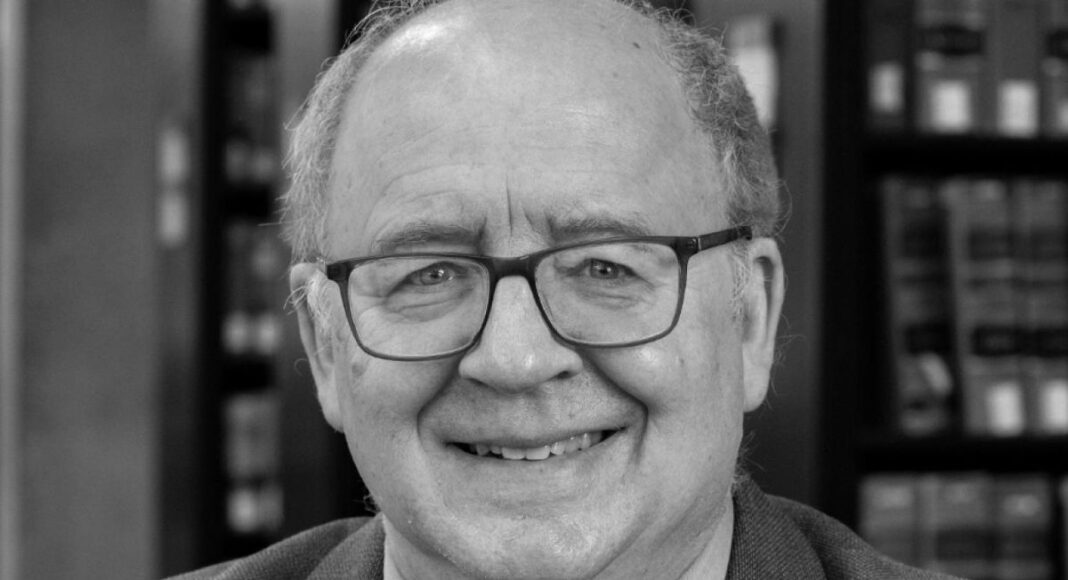
University of Chicago Law School professor Randy Picker passed away this weekend. Georgetown professor Filippo Lancieri pens a tribute to his colleague and former PhD advisor.
This past weekend, professor Randy Picker passed away far too soon.
I met Randy as an incoming UChicago LLM student in 2015. It is impossible to do him justice in words.
First, he was a truly gifted teacher. I am still in awe of how he managed to make antitrust fun and engaging for the more than 100 students who lined up to take his class—they literally had to add more desks to the back of the class to shrink the waitlist. Randy would spend dozens of hours editing his own course materials so students would not have to pay for casebooks. He still makes all of these materials, together with his meticulous slides (all 1,988 of them for his fall 2025 class!), freely available online for anyone to access and download. He taught many other courses—from tech policy to copyright, secured transactions, network industries, and his MOOC on internet giants—and it was always fun and enlightening to take his classes (though I admit all I know about secured transactions is hearsay).
It is also clear from his papers and talks that he was a terrific scholar. An icon of the 2nd generation of the Chicago School of antitrust, Randy certainly shared the “Easterbrook premise” that most markets will self-correct without intervention. That said, he was always open to engaging with new ideas. When the Stigler Center was expanding its antitrust work, it ruffled its fair share of feathers within the University, especially with the older guard. Randy, however, was the person who linked me with the Center (“You should connect and go check the very interesting discussions they are having out there”). Years later, I asked half-jokingly if he regretted that choice, as it helped drift me away from some of his antitrust views. He first responded that the role of any PhD supervisor is to push their students to do good work and find their own voice, no matter what it may be. He then gave a short lecture on why a university is only as strong as its commitment to questioning its core ideas when confronted with new theories and data, and on what a blessing it was to spend most of our time conducting research and advancing knowledge, especially when facing pushback.
True to his teachings, he attended all of our antitrust conferences, and it always gave me joy whenever I received a message on why someone was “totally wrong” about something. Randy went on to chair the 2017 University Committee on Disruptive Conduct, which set boundaries on how to safeguard both a speaker’s right to be heard and a protester’s right to protest. These included the general principles that “debate or deliberation may not be suppressed because the ideas put forth are thought by some or even by most members of the University community to be offensive, unwise, immoral, or wrong-headed” and emphasized that “[d]issent and protest should be affirmatively welcomed, not merely tolerated, by the University.” The boundaries set by the “Picker Report” have never been more important.
Randy and I both sat on the 6th floor of the UChicago law library: he in his office, me in my JSD carrel. Randy was usually there—he walked to the law school no matter how cold it was outside—and his door was always open to anyone stopping by. I still have the recording of the 90-minute (!) voice message with comments he sent on my job talk paper. Every time I am working on a paper, I take deliberate pauses to try and consider “what would Randy tell me?” This exercise inevitably improves whatever I am working on, but no matter how much I tried, it never matched when I talked to him in person or over the phone.
And yes, it is weird to regularly bump into your PhD supervisor in the single-stall, UChicago bathroom. But what people who never interacted with Randy may not know is that he was also a terrific and fun person. He actually took improv comedy classes near UChicago, and certain weekends of the year, we would go out in a group of students to see him perform in Hyde Park. UChicago law has a traditional student musical that pokes fun at teachers, and it is impossible to forget Randy’s unique laughter anytime someone opened a can of Diet Coke on stage to roast him a bit, or while having a drink at Medici, close to his house.
For the past 10 years or so, Randy had been working on his book—The Quest for Next—which examines how antitrust enforcement has historically shaped innovation in technology markets. When everyone was focusing on short-term prices, he focused on ideas and spent years combing through historical newspapers and documents, visiting archives, talking to people, and engaging with such a complex topic with the rigor, open-mindedness, and passion that shaped his career.
The manuscript is mostly ready and is due to be published by Princeton University Press in the near future. Two years ago, we invited Randy to discuss the ideas in his manuscript as the keynote speaker of the 2024 Stigler Center for the Study of the Economy and the State‘s annual antitrust conference (in a conversation with Tim Wu). The keynote is 100% Randy: dozens of thoughtful slides and comments, good jokes, and impeccable timing.
I encourage everyone to listen to Randy’s remarkable lecture. Do so while drinking a can of Diet Coke. I am sure it would make him happy.
May he rest in peace. And may his family find at least some comfort knowing that his legacy lives on through the positive difference he made in the lives of countless students, including mine.
Articles represent the opinions of their writers, not necessarily those of the University of Chicago, the Booth School of Business, or its faculty.
Subscribe here for ProMarket’s weekly newsletter, Special Interest, to stay up to date on ProMarket’s coverage of the political economy and other content from the Stigler Center.