





The federal Buy Clean initiative illustrates how procurement quotas can alter market structure by raising compliance costs and rewarding scale. As states expand their own Buy Clean programs, competition effects deserve the same scrutiny as environmental ones, writes Francesca Chiaradia.
For four years, the United States federal government tried something unusual. It used its own checkbook, more than $650 billion in annual purchasing power, to reshape the market for public building materials, a market it does not regulate directly. Under the Federal Buy Clean Initiative, launched through Executive Order 14057 in 2021, federal agencies were instructed to favor steel, concrete, asphalt, and flat glass with lower embodied carbon, meaning emissions generated before these materials ever reach a construction site.
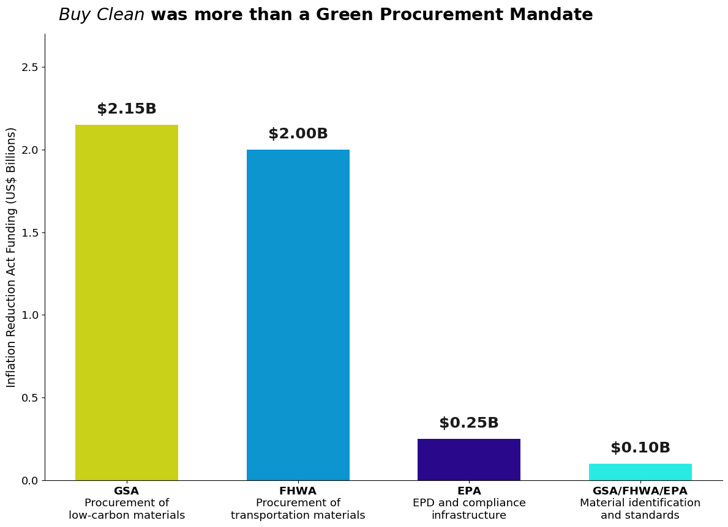
The 2022 Inflation Reduction Act reinforced the proposal with roughly $4.5 billion for the General Services Administration (GSA), the Federal Highway Administration (FHWA), and the Environmental Protection Agency (EPA). The initiative was designed not only to purchase cleaner construction materials, but also to reduce the cost of compliance by financing environmental product declarations (EPDs), effectively nutrition labels for carbon emissions.
Buy Clean combined procurement with compliance subsidies. While most of the funding supported the purchase of lower-carbon inputs, a dedicated share financed the reporting infrastructure needed to certify them. Buy Clean therefore did more than create demand for cleaner products. It also lowered the fixed costs of demonstrating compliance, making it easier for firms to participate in the emerging market for greener alternatives.
On his first day back in office, President Donald Trump rescinded Executive Order 14057. The federal Buy Clean Task Force was dissolved, funding for EPDs was withdrawn, and the broader effort to use federal purchasing power to accelerate the green transition came to an end alongside a wider rollback of clean energy incentives. What remains is a patchwork. California, Colorado, New York, and roughly a dozen other states that participated in the now-defunct Federal-State Buy Clean Partnership are pressing ahead, using state procurement laws and emissions reporting to set carbon standards for public building materials.
This is undoubtedly a climate story, one about the abrupt reversal of an ambitious decarbonization effort. But Buy Clean was never just a climate policy. It was also industrial policy implemented through the government’s role as a buyer rather than a regulator. That distinction matters because procurement changes markets differently from regulation. A procurement quota does not simply change what gets built. It changes who gets to sell to the government, on what terms, and at what scale. As Buy Clean shifts from Washington D.C. to the states, the central question is no longer only whether it reduces emissions. It is whether this shift strengthens competition or quietly reinforces the market position of the largest suppliers.
A buyer’s mandate is still a mandate
Procurement quotas work differently from taxes or emissions caps. A carbon tax raises costs across the board and lets firms decide how to respond. A procurement standard, by contrast, draws a clear line. Firms that meet the emissions benchmark gain access to the country’s largest single source of construction demand. Those that do not are shut out. With public procurement accounting for roughly half of all concrete purchases and one quarter of all steel purchases in the U.S., the race is not simply to reduce emissions. It is to become eligible to supply one of the country’s biggest customers.
Yet, compliance is not only a matter of meeting an emissions threshold. It requires firms to produce EPDs, control their supply chains, and in some cases invest in lower-carbon production processes or inputs. These are costly undertakings, and the costs do not scale down proportionally.
The structure of the industry makes this especially important. Industry analysts describe the U.S. cement market as moderately to highly concentrated, with five integrated producers controlling most domestic production capacity and access to import terminals. By contrast, the downstream ready-mix concrete industry that pours the material remains highly fragmented, consisting of thousands of small regional operators, many with fleets of only a few dozen mixer trucks. When New York developed its own Buy Clean reporting requirements, state officials explicitly sought to ensure that compliance would remain feasible for what one policy adviser called the state’s “mom-and-pop” concrete plants, not only its largest integrated suppliers. The concern was well founded. Producing EPDs and conducting life cycle assessments require specialized expertise and extensive monitoring, costs that a national producer can spread across dozens of projects but that weigh far more heavily on a family-owned regional supplier.
The market’s response since the federal Buy Clean initiative was launched reinforces this point. In the first year alone, the GSA reported that suppliers published more than 23,800 additional EPDs, while 153 companies, including two major steel producers, filed their first-ever declarations. On its face, this is evidence that procurement can accelerate the adoption of cleaner production practices. But it also illustrates how compliance investments reward scale. Building the systems needed to generate EPDs and maintain life cycle data is far easier to justify for firms serving national markets than for those competing for a handful of local contracts.
The federal collapse made the competition problem worse
If a single federal standard raises entry costs for smaller suppliers, a fifty-state patchwork raises them even further. With the federal Buy Clean framework gone, manufacturers increasingly face a growing array of state-specific emissions benchmarks and verification rules. California’s Buy Clean California Act requires a 40 percent reduction in cement-sector emissions by 2035 and net-zero emissions by 2045. Elsewhere, New York has adopted reporting requirements under Executive Order 22, while Colorado, Washington, and several other states continue to coordinate through the U.S. Climate Alliance, a coalition of 24 states formed after Trump withdrew the U.S. from the Paris Agreement during his first term. A multi-state producer can build a single compliance function and spread those costs across every territory it serves. A regional supplier, instead, must either replicate those compliance overheads in each jurisdiction or withdraw from markets where compliance is no longer economically viable.
This is a familiar result in regulatory economics. Fragmented standards tend to favor larger firms, even when each individual standard is relatively modest. Ironically, the federal Buy Clean initiative was designed in part to avoid exactly this outcome by providing a common technical benchmark on which states could build. Removing the federal procurement framework while leaving state mandates in place does not restore a competitive free market for cleaner construction alternatives. Rather, it shifts compliance to a fragmented landscape, where the fixed costs fall most heavily on the firms least able to absorb them.
Who actually benefits from a “clean” quota
None of this means that Buy Clean-style quotas are bad policy, or that concentration in cement and steel is new. The industry has been consolidating for decades, largely for reasons unrelated to eco-standards. But recent deal activity suggests decarbonization compliance is now an active driver of that consolidation, not a bystander. In November 2024, Heidelberg Materials paid roughly $600 million for Giant Cement Holding, adding production and import-terminal capacity. In July 2025, CRH agreed to pay $2.1 billion for Eco Material Technologies, a major supplier of fly ash and other supplementary materials – the key ingredients in the lower-carbon cement that green procurement quotas favor.
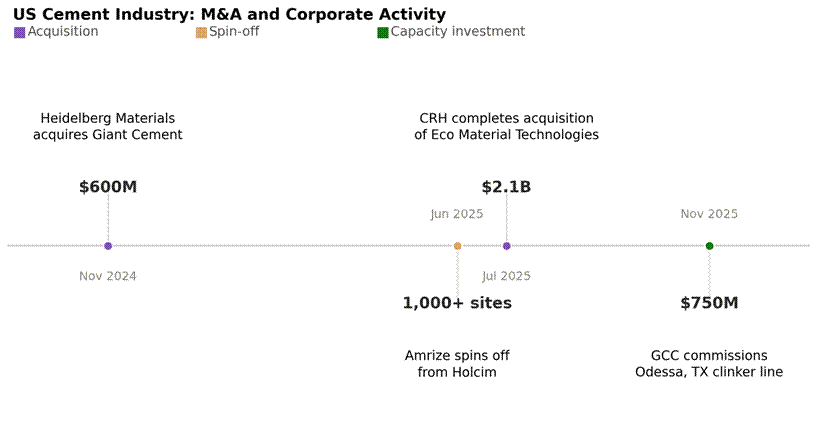
Both acquisitions were explicitly presented by the acquiring firms as investments in expanding low-carbon production capacity. That is exactly the response economic theory would predict. If governments reward compliant products through procurement, acquiring existing low-carbon capacity can be more efficient than developing it internally. Yet, this is also consolidation. Instead of building compliance capabilities from scratch, incumbent firms can acquire them together with market share, further strengthening their position relative to smaller, non-integrated competitors. Industry analysts increasingly describe the sector as becoming more integrated, suggesting that firms with the scale to shoulder the burden are pulling further ahead of the rest of the market.
These competitive effects deserve the same scrutiny that antitrust economists apply to other forms of market intervention. However, the debate over Buy Clean has focused overwhelmingly on its climate benefits rather than its implications for market structure. Far less attention has been paid to whether procurement standards raise barriers to entry, alter competitive dynamics, or disproportionately benefit the largest firms with the resources to document compliance.
These are empirical questions, and now is the ideal time to answer them, while state Buy Clean programs are still developing and their market effects remain observable. Are contracts for low-embodied-carbon materials disproportionately awarded to the same handful of multinational producers that already dominate cement production? Are regional ready-mix suppliers investing in the reporting systems needed to compete, or withdrawing from public procurement altogether? And is EPD generation becoming a market in its own right, with consultancies and software providers lowering compliance costs for smaller firms, or merely creating another layer of overheads that reinforces existing advantages?
The larger pattern
Buy Clean is a small case study in a much bigger phenomenon: governments increasingly turning to procurement rules, rather than legislation, to pursue policy goals that could not pass as regulation. Take, for instance, the case of labor standards (EO 14415), domestic content (Build America Buy America Act), or cybersecurity (NIST 800-171 Rev 3). Procurement is politically easier as it does not require new statutory authority and can be justified on mere financial grounds. But this framing understates its market power. When the buyer is also the largest customer in the country for a given product, its purchasing rules function as de facto market regulation without the procedural scrutiny that actual regulation would require.
The Trump administration justified rescinding Executive Order 14057 on the grounds of cost-effectiveness and reducing federal mandates. While the decision remains deeply contested as climate policy, it also created an unintended natural experiment. It removed the federal coordinating layer while leaving much of the state-level procurement architecture intact. The result, so far, looks less like deregulation than a redistribution of compliance costs. Rather than being subsidized through a federal EPD program, compliance is increasingly financed by manufacturers themselves across a fragmented regulatory landscape, with the greatest burden falling on smaller firms. Buy Clean may yet prove an effective tool for reducing emissions. But if its next chapter unfolds primarily at the state level, policymakers should ask not only whether it lowers carbon emissions, but also whether it reshapes competition in ways they never intended.
Authors’ Disclosures: The author reports no conflicts of interest. You can read our disclosure policy here.
Articles represent the opinions of their writers, not necessarily those of the University of Chicago, the Booth School of Business, or its faculty.
Subscribe here for ProMarket’s weekly newsletter, Special Interest, to stay up to date on ProMarket’s coverage of the political economy and other content from the Stigler Center.