









In new research, Marco Battaglini, Valerio Leone Sciabolazza, Mengwei Lin and Eleonora Patacchini study how the deaths of large donors change candidates’ electoral results and congressional activity in a new measure of donors’ influence in American politics.
How much do large donors really influence a politicians’ electoral success and subsequent legislative activity? These questions have long occupied economists and political scientists, and for good reason. While the amount donors spend per election is large in absolute terms, it does not seem so large when compared with the economic impact of legislative activity. In the most recent United States electoral campaign (2023-2024), candidates and other organizations spent about $22 billion. Yet, annual federal government spending over the same period was more than $6 trillion. It has also been noted that top managers of blue-chip corporations donate less than the amounts they are entitled to contribute under campaign finance legislation. Based solely on the observed amount of money, this could suggest that donors either don’t have a large impact on electoral outcomes, on subsequent legislative activity, or both.
The central difficulty in studying the effect of campaign finance is that it is not enough to establish an empirical link between donation size and the probability that a recipient wins an election or acts in concert with a donor’s interests once in office. Focus on the former question for now. Donations are not random: donors choose which candidates to support, and have the tendency to bet on likely winners. This phenomenon is illustrated in Panel A of Figure 1. Candidates supported by the largest donors systematically perform better than other candidates.
However, this does not tell us if donations actually contribute to the chances that a candidate wins their race or simply rewards a likely winner. In the first case, campaign finance can be compared to leverage. In the latter, it is more like a charity.
Figure 1: Electoral Outcomes and the Loss of Top Donors
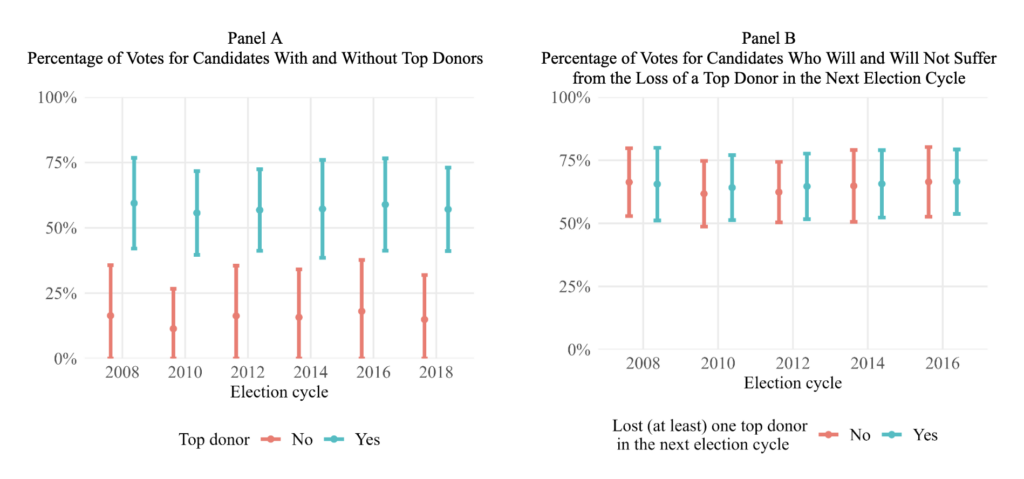
In our paper Unobserved Contributions and Political Influence: Evidence from the Deaths of Top Donors, we address this challenge using the novel strategy of seeing what happens to a congressional candidate’s electoral outcome and legislative activity when one of their top donors dies. We first collect a new dataset on the 1,000 largest donors for each electoral cycle between 2004 to 2018. We use public records to identify the candidates to whom they donate. We then collect information on if the donor dies and when.
Top donors’ deaths are not rare events: in our dataset, we observe hundreds of deaths, affecting about 24% of elections. Panel B of Figure 1 compares the electoral performance of candidates who lose a top donor in the next election cycle with that of candidates who do not. The figure mirrors the structure of Panel A. However, unlike the earlier comparison between the vote share of candidates with and without support from top donors, we find no statistically significant difference in vote shares between those who will lose a top donor in the next electoral cycle and those who do not. This finding suggests that the death of a top donor is not systematically associated with candidate quality, which alleviates what economists call the “selection problem.” Thus, if a candidate’s electoral fortunes worsen after the death of a top donor, we can more credibly attribute the decline to the loss of that donor’s support rather than to the possibility that stronger candidates are more likely to lose a donor.
The effect of losing a top donor
So, what is the impact of top donors’ support on politicians? We distinguish between an immediate electoral effect reflected in the probability of winning elections and a longer-term legislative effect, defined by how politicians behave once they reach Congress.
With respect to the immediate effect, we find clear evidence that top donors matter for winning elections. When a candidate loses a major donor, the probability of winning declines by about 2.8 percentage points. The effect is even larger in close contests, where margins are tight. In these settings, the loss of a donor can be decisive, suggesting that major donors play a particularly important role at the margin of electoral competition. Losing a top donor reduces vote share by only 0.3 percentage points on average, but by about 1.2 percentage points in competitive contests. While these percentages may seem small, they are large enough to flip a significant number of close seats in a typical election cycle. We estimate that, in tight races, the death of a top donor may reduce the probability of winning by up to 9.5 percentage points. Importantly, these effects persist even after controlling for all observable campaign spending.
The influence of top donors does not end on Election Day. The methodological challenge to studying how a donor influences legislative activity is that there are thousands of top donors, each with their own, unique combination of policy preferences, making it difficult to match any given donor to a specific legislative goal. For this reason, we focus on two outcome measures that can be quantified precisely and capture donor influence without requiring full knowledge of donor intentions. First, we study the effect of a top donor’s death on the breadth of a Congress member’s legislative activity, as measured by the randomness or dispersion of topics in the bills the member sponsors, in what is called Shannon entropy. We find that after the death of a top donor, a legislator’s Shannon entropy falls significantly, by about 8% of its standard deviation, suggesting that donors broaden a politician’s agenda by introducing idiosyncratic concerns. This interpretation is confirmed by our second exercise. We study the effect of the death of a top donor on the ideological distance between a legislator and the median member of the same party, as measured by their respective voting behavior. We find that legislators who experience the death of a top donor align more closely with their party’s position, suggesting that they are freer to follow the party line.
Alternative methods of donor influence
The previous analysis highlights the effect of top donors’ support on candidates. But if top donors’ direct contributions to any given candidate are often too small to explain these effects on their own, what is the relevant mechanism? Our analysis points to a broader view of donor influence, in which major donors provide both nonmonetary resources and access to financial support not fully captured by their reported giving.
The first possible mechanism is signaling and coordination. A contribution from a prominent donor can serve as a visible endorsement. It may signal to other donors, consultants, outside organizations, and party actors that a candidate is serious, viable, and worth supporting. In this sense, the direct contribution may matter less for its dollar value than for the information it conveys. This interpretation is consistent with our finding that the electoral impact of a donor’s death is not closely tied to the donor’s own direct contributions. Instead, direct giving appears to function mainly as a signal of a broader relationship. We find evidence of this by examining what happens to other forms of support after a donor dies. Candidates who lose a top donor also experience declines in contributions from other donors. They also lose support in the form of political advertising from political action committees (PACs and Super PACs). By contrast, we do not observe a similar decline in advertisements financed directly by the candidate. This pattern is hard to reconcile with the view that donors matter only through the checks they write. It fits more naturally with the idea that prominent donors help mobilize a wider financial coalition around a candidate.
A second mechanism is donor prominence itself. Not all top donors are equally influential. We find that the effects of donor death are substantially stronger for especially prominent donors, including those in the top quartile of total contributions and those listed in the Forbes 400, even after controlling for their contributions. This suggests that what matters is not only how much a donor gives, but also who the donor is. Reputation, status, and network centrality appear to amplify political influence. Two donors with similar observable contributions may have very different effects if one brings greater visibility and stronger connections.
A broader perspective on political influence
These findings suggest that top donors exert significant influence on a legislator’s chance of being elected and on their legislative activity after being elected. More broadly, however, they suggest that political influence is best understood not as a purely financial phenomenon, but as a network phenomenon. Donors do not simply provide funds. They are nodes in a larger system linking candidates to other donors, interest groups, information, expertise, and public visibility. Their influence critically depends on these networks, more than on just the money they give.
This has implications for how campaign finance legislation should be reformed or, from the courts’ perspective, interpreted. Much existing policy focuses on the disclosure or limitation of direct monetary contributions. These tools remain important, but our findings suggest they are incomplete if the most consequential forms of donor influence operate through broader networks and indirect channels. Even when direct contributions are disclosed in detail, the broader relationships that make them politically valuable may remain hard to observe. Current regulation in the U.S. imposes strict limits on direct monetary contributions, but relatively weak disclosure requirements on political networking. For instance, the Honest Leadership and Open Government Act of 2007 requires campaigns to disclose lobbyist bundlers who raise more than minimal amounts, but only when the bundler is a registered lobbyist. Our findings suggest that greater attention to the disclosure of network-based support is needed if voters are to assess who truly has power over candidates.
Author Disclosure: The author reports no conflicts of interest. You can read our disclosure policy here.
Articles represent the opinions of their writers, not necessarily those of the University of Chicago, the Booth School of Business, or its faculty.
Subscribe here for ProMarket’s weekly newsletter, Special Interest, to stay up to date on ProMarket’s coverage of the political economy and other content from the Stigler Center.