







In new research, Daniel Lobo and Ryan Brutger theorize that American concepts of fairness are shaped by race and lived experiences. In a national survey experiment, they confirm that white and Black Americans view differently what constitutes “fair” trade policy.
Public debates about globalization often revolve around how trade will affect economic growth, jobs, and wages. Beneath these material considerations lies another fundamental dimension: a moral question about what constitutes fairness in the global economy.
Fairness is a central concept in political economy, shaping attitudes toward taxation, redistribution, welfare, and market outcomes. But fairness is not interpreted uniformly. Behavioral economists have long shown that individuals care not only about their own outcomes, but also about how those outcomes compare to others. This is the foundation of inequality aversion, which includes two distinct categories: advantageous inequality aversion (discomfort when one is better off than others) and disadvantageous inequality aversion (discomfort when others are better off than oneself).
Prior research finds that Americans tend to be especially sensitive to disadvantageous inequality, meaning they dislike being behind more than they dislike being ahead. Scholars have coined the term “asymmetric fairness” to show how strongly this sensitivity to disadvantageous inequality shapes trade attitudes. But this earlier work evaluates fairness without assessing the additional effects of race. Our research asks: do all Americans share this asymmetric fairness orientation?
We argue that Americans do not share a single, universal understanding of fairness. Instead, perceptions of fairness are deeply shaped by race, history, and lived experience. Drawing on critical race theory, cognitive psychology, and social identity theory, we theorize that white and Black Americans have been socialized to understand fairness in distinct ways. Using a national survey experiment, we find strong evidence that these divergent fairness frameworks lead white and Black Americans to respond differently to the same trade policies.
White Americans and the fear of falling behind
For white Americans, concerns about “falling behind” are not simply economic anxieties. They are tied to a long history of racial privilege protected by law, politics, and social norms.
Critical race theorists, such as Derrick Bell and Kimberlé Crenshaw, have shown that American legal and political institutions were built to preserve the advantage of white Americans. Across the eras of chattel slavery and Jim Crow the political and legal systems preserved white Americans’ historically dominant position in the social hierarchy. This dominance has been reinforced through what Bell calls “racial realism”—the idea that the law tends to protect white interests—and “interest convergence”—the notion that racial progress occurs only when it aligns with the self‑interest of white Americans. Such protections endure in ostensibly race-neutral policies today, from zoning laws that concentrate wealth in predominantly white neighborhoods to credit rating systems that institutionalize the economic disadvantages produced by prior racial discrimination.
This history shapes contemporary social psychology. White Americans have been socialized to expect a certain level of social, economic, and political privilege. As a result, policies that appear to reduce the United States’ relative standing, even in the context of international trade, can feel like a threat to that position. This is consistent with disadvantageous inequality aversion: losses loom larger than gains, especially when they threaten a historically privileged status.
In this context, asymmetric fairness becomes a natural lens to evaluate global economics. When a trade agreement benefits another country more than the U.S., white Americans are more likely to view it as unfair.
Black Americans and the experience of structural disadvantage
Black Americans, by contrast, have not been the primary beneficiaries of the American system. From slavery and segregation to ongoing racial disparities in wealth, health, and political representation, Black Americans have been systematically disadvantaged by the very institutions that protected white privilege. For example, Adams-Schoen demonstrates that American single-family zoning emerged directly from the explicitly race-based ordinances of the Jim Crow era, and that the same residential-use taxonomy continues to produce chronic underinvestment in communities of color while concentrating amenities in predominantly white neighborhoods. Norris similarly shows that cities with larger Black populations receive systematically lower credit ratings than cities with larger white populations. When this disparity is “explained away” by median family income—itself a product of historical racial discrimination—the mechanism functions as what he calls an epistemic maneuver that allows racial inequality to evade identification and become institutionalized as seemingly objective market criteria.
This history shapes expectations. Rather than expecting to be ahead, Black Americans have been socialized to expect that the system will place them behind. As a result, policies that leave the U.S. “behind” another country do not represent a meaningful loss relative to the status quo expectations. They simply reflect a continuation of longstanding inequalities.
Cognitive psychology reinforces this logic. Reference‑dependent theory suggests that individuals evaluate outcomes relative to their baseline expectations. For many Black Americans, the baseline is one of structural disadvantage. Falling behind is not new, it is the norm.
At the same time, Black political thought has long emphasized collective uplift, equality, and solidarity. Scholars from sociologist W.E.B. Du Bois to contemporary political scientists have documented the ways Black communities cultivate a shared memory of racial injustice and a commitment to egalitarian principles. This produces what we call principled fairness: whereby the idea of fairness is applied equally to both parties regardless of whether oneself or the other is benefiting more or less.
Segregated social worlds reinforce divergent fairness norms
These fairness frameworks are not only historical; they are reproduced through contemporary social environments.
White and Black Americans live in profoundly different social worlds. White Americans’ social networks are overwhelmingly white; three‑quarters of white Americans have entirely white networks. Black Americans, by contrast, live in communities where most of their social contacts are also Black.
These segregated networks shape political attitudes. White communities tend to reinforce colorblind ideologies, meritocratic narratives, and beliefs that the status quo is fair. Black communities maintain a collective awareness of racial injustice and a skepticism toward claims that existing institutions are neutral.
These environments cultivate different moral intuitions about fairness—intuitions that extend beyond domestic policy into the realm of international trade.
A national survey experiment
To test our theory that white and Black Americans view trade fairness differently, we re-analyzed data from Brutger and Rathbun’s national survey experiment. Given our focus on racial differences, we subset their data to only the 2,674 white and Black respondents. In the experiment, participants were presented with hypothetical trade agreements that randomly varied the tariff concessions made by the home and foreign country. The relative tariff concessions were either Equal, Favorable, or Unfavorable. In the equal treatment, both parties make the same concessions. In the favorable treatment, the other country makes a larger concession than the U.S., whereas in the unfavorable treatment, the U.S. makes a larger concession than the other country.
We then asked respondents to evaluate the fairness of each agreement, which was measured on a five-point scale from “very unfair” to “very fair.”
The results were striking, as shown in the figure below, which is reproduced from our paper:
● White Americans exhibited strong asymmetric fairness. They viewed agreements that left the U.S. behind as especially unfair, even when the U.S. still benefited overall.
● Black Americans did not exhibit asymmetric fairness. Their fairness evaluations did not hinge on whether the U.S. was ahead or behind.
● White and Black Americans thought it was most fair when trade flows or concessions were equal.
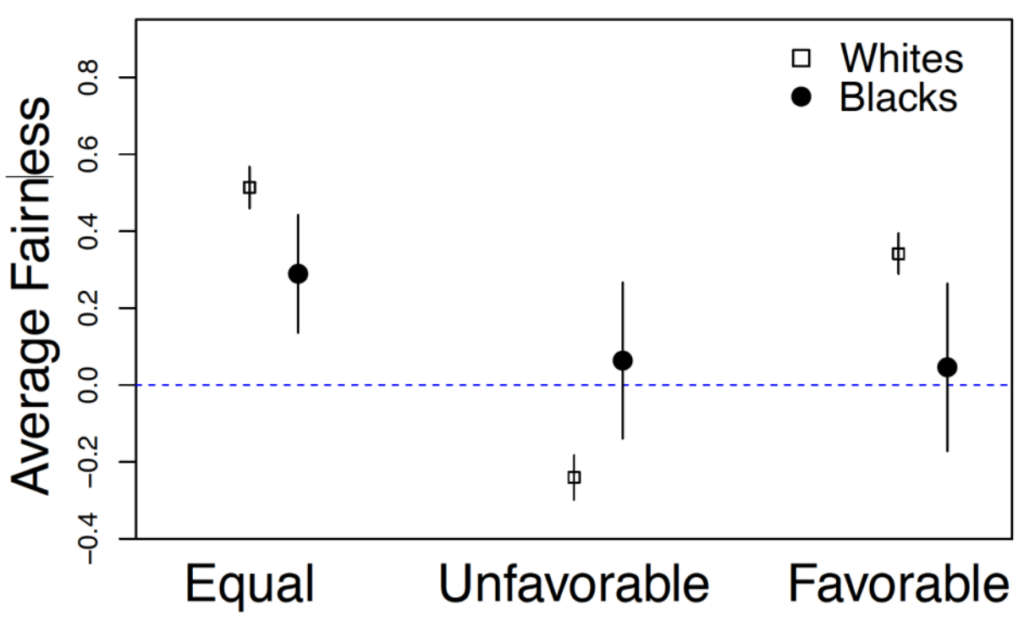
Note: The figure displays the average fairness score by treatment type, measured from -2 (Very Unfair) to 2 (Very Fair), with 95 percent confidence intervals. Higher values represent greater perceived fairness of the trade agreement. The results are divided based on whether respondents identified as White or Black.
While both white and Black Americans believe it is most fair when the parties to a trade agreement benefit equally or make equal concessions, that is where the similarities end. The principled fairness approach, adopted by Black respondents in our study, applies fairness symmetrically to the U.S. and the trading partner, resulting in nearly identical beliefs about (un)fairness when trade negotiations are uneven, regardless of whether the home or foreign country is benefiting more. However, when a trade agreement allows a foreign country to increase its trade by a larger share than the U.S., or to make smaller concessions in a negotiation, white respondents think this is especially unfair. When comparing white and Black respondents’ fairness evaluations of the unfavorable agreement, white respondents think it is significantly more unfair (−0.304, p < 0.02) than Black respondents.
These differences persisted even after controlling for partisanship, ideology, income, education, and national attachment. In other words, racial differences in fairness perceptions cannot be explained away by political or socioeconomic factors. These differences are not simply abstract moral preferences. They are rooted in centuries of racial hierarchy, unequal access to political and economic power, and the distinct social worlds in which white and Black Americans are embedded, and they have real consequences.
Implications for trade policy and political communication
These findings have important implications for policymakers, political strategists, and scholars of international political economy.
1. Trade messaging resonates differently across racial groups. Appeals to “America First” or warnings about the U.S. “falling behind” may resonate strongly with white Americans but not with Black Americans. Conversely, messages emphasizing equal benefit resonate among both white and Black Americans.
2. Racial fairness frameworks shape broader foreign policy attitudes. If fairness perceptions differ across racial groups, then racial identity may influence not only trade attitudes but also views on foreign aid, immigration, climate agreements, and foreign direct investment, among other policies.
3. Economic models of trade preferences ought to incorporate race. Traditional models assume individuals evaluate trade based on material self‑interest or national economic outcomes. Our findings suggest that moral frameworks, shaped by race and history, play a central role.
4. Understanding racialized fairness perceptions can improve policy design. Policymakers seeking broad support for trade agreements must recognize that different communities evaluate fairness differently. A one‑size‑fits‑all narrative is unlikely to succeed in a polarized political climate.
These findings challenge the assumption that Americans share a common baseline for evaluating fairness in global markets. They also highlight the importance of incorporating race, and the historical and psychological forces that shape racialized perceptions, into the study of international political economy.
Conclusion
Fairness is not a universal concept. It is shaped by history, socialization, and lived experience. In the U.S., centuries of racial hierarchy have produced divergent fairness frameworks among white and Black Americans—frameworks that extend into how individuals evaluate international trade.
White Americans, socialized into a position of historical privilege, tend to view trade through an asymmetric fairness lens, emphasizing relative advantage and fearing losses. Black Americans, shaped by a history of structural disadvantage and collective struggle, approach trade through a principled fairness lens, applying the concept of fairness equally to both the foreign and home country, regardless of who is benefiting more or less.
These differences matter. They shape public opinion, influence political debates, and challenge long‑standing assumptions about how Americans think about globalization. As policymakers navigate an era of rising protectionism and geopolitical competition, understanding these divergent fairness frameworks is essential for crafting trade policies that resonate across the full spectrum of American society.
The other authors report no conflicts of interest. You can read our disclosure policy here.
Articles represent the opinions of their writers, not necessarily those of the University of Chicago, the Booth School of Business, or its faculty.
Subscribe here for ProMarket’s weekly newsletter, Special Interest, to stay up to date on ProMarket’s coverage of the political economy and other content from the Stigler Center.