






In new research, Janka Deli analyzes the relationship between the decline in the rule of law and trade. Contrary to democratic and developmental theory, she finds that declines in the rule of law, as seen in Hungary, Poland, and Czechia, do not lead to timely reductions in trade with other EU partners.
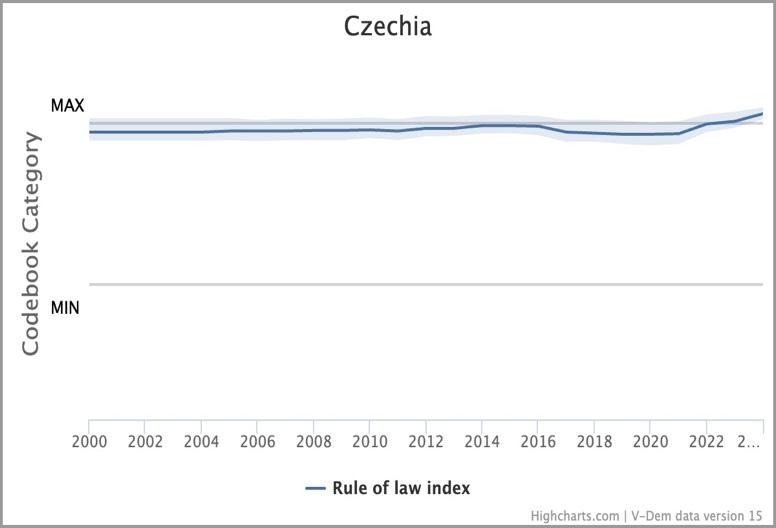
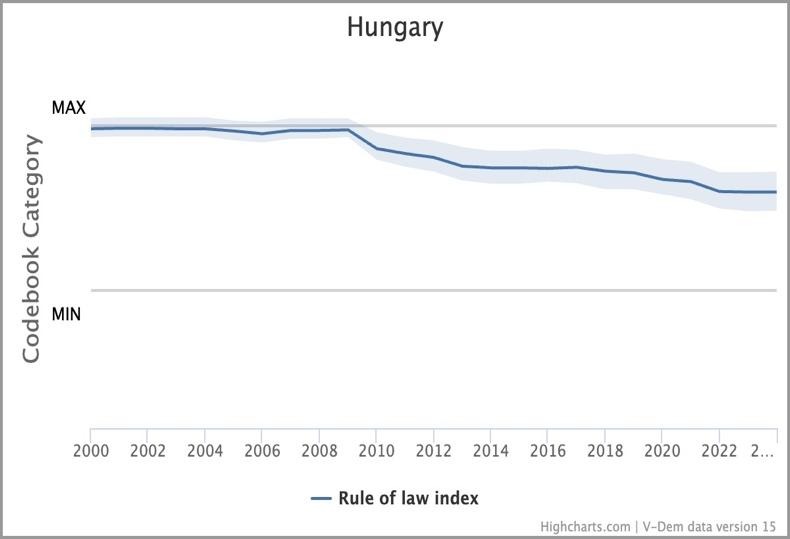
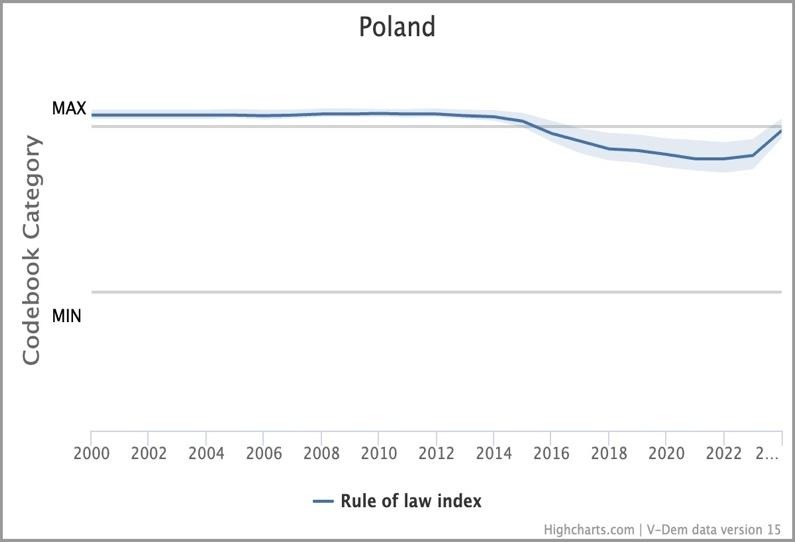
In 2010, Hungary’s Viktor Orbán nationalized private pension funds—forcing nearly three million Hungarians to forfeit their retirement savings—and then forced 274 judges into early retirement while hollowing out the Constitutional Court’s authority in an attempt to reduce restraints on the governing Fidesz-KDNP coalition. Similarly, after winning the presidency and a majority of parliamentary seats in 2015, Poland’s right-wing populist Law and Justice party systematically attacked judicial independence, brought under its control the public media, prosecutor’s office, and ombudsman’s office, and deployed arbitrary regulatory measures.
For decades, economic theory has posited that the rule of law, which holds people and the government legally accountable for their actions, drives economic growth through clear causal channels: better property rights protection, contract enforcement, and reduced transaction costs. Conventional wisdom would suggest that in the cases of Hungary and Poland, trading partners would respond to these declines in the rule of law by shifting trade and investment to countries with stronger property rights and legal predictability.
But between 2004 and 2019, as Czechia, Hungary, and Poland systematically violated international investment agreements across multiple industries, their exports in those very same sectors showed no contraction. Within these countries’ own trade, affected industries outperformed unaffected ones by roughly 23% in the short run. This finding casts doubt on assumptions about trade’s role in disciplining governments that undermine the rule of law. If this assumption is wrong—especially in the European Union, where commitment to democracy and the rule of law is at its strongest—the implications for democratic governance worldwide are profound.
Testing the most difficult case
The EU represents the ideal setting to test whether declines in the rule of law produce negative trade consequences. The EU’s foundational commitment to rule of law as a core value suggests member states should be highly sensitive to institutional violations. Meanwhile, the absence of tariffs and relatively low switching costs within the single market means importers can easily shift to alternative suppliers if institutional quality deteriorates.
In research methodology, this is called a “most difficult case”—if a decline in the rule of law does not reduce trade here, it is unlikely to do so anywhere. Yet, if offsetting mechanisms prove powerful enough to generate positive economic effects even in this context, they are likely stronger in less integrated markets with higher trade barriers.
To measure the decline in the rule of law, I developed an events-based approach that sidesteps the conceptual and measurement problems plaguing traditional rule of law indices. Instead of relying on expert surveys or aggregated scores, I identified systematic institutional deterioration through recurring rule of law-related breaches of international investment agreements across multiple industries, confirmed by independent international tribunals.
This cross-industry recurrence criterion distinguishes genuine rule of law decline from isolated policy disputes. Spain, for instance, faced dozens of investor claims related to renewable energy subsidies—but these were concentrated in a single sector over 16 years, reflecting a specific policy reversal rather than systemic institutional erosion. By contrast, Hungary committed breaches across industries, including bakery products, agriculture, electricity, and business services, Czechia did so in the construction services, financial services, and raw and refined sugar and sugar crops production industries, while Poland’s violations touched financial services, trade related services, pharmaceuticals, and heritage and recreational services industries.
Figure 1: Varieties of Democracy Rule of Law Index (2000–2024)
Exports proved resilient despite rule of law decline
Using bilateral trade data from 2004–2019 and structural gravity estimation (a standard model for estimating bilateral trade flows), the analysis reveals several striking patterns.
First, the short-term resilience is specific to systematic violators. When I expanded the analysis to include all countries with isolated breaches, the results reversed: exports in affected industries declined roughly 38% in the short run. This suggests that something fundamentally different happens when institutional decline becomes systematic rather than sporadic.
Second, short-term effects do not vary based on trading partners’ democratic traditions. Both “senior” EU members with long democratic histories, such as Germany and France, and “junior” post-communist states that joined in 2004, like Slovakia and Lithuania, maintained or increased imports from backsliding countries. The short-term resilience extends across both categories, suggesting that offsetting mechanisms operate independently of importers’ institutional maturity.
Third, the mining and energy sector—where confirmed cases cluster in electricity production—stands out as a critical exception. The immediate negative consequences of confirmed breaches are concentrated in this sector: excluding it from the analysis, even the pooled sample that includes isolated breaches shows no short-term contraction. The sector’s unique characteristics—massive capital investments with decades-long payback periods, exceptional regulatory complexity, and strategic national importance—create conditions where conventional negative effects dominate offsetting factors.
Why trade relationships persist despite backsliding
Multiple mechanisms likely contribute to these results, operating across different timeframes and affecting both supply and demand.
Economic inertia provides the most immediate force. Luxembourg maintained and even increased financial services imports from Poland by 14% between 2011 and 2017, despite two investor claims based on the same breach. Transaction costs, relationship-specific investments, and status quo bias create substantial barriers to switching suppliers—even when institutional conditions deteriorate.
Alternative governance schemes can emerge to replace the predictability and trust that the rule of law would guarantee. Hungary’s 99 strategic partnership agreements with multinational corporations since 2010 illustrate this pattern. These arrangements provide regulatory predictability through bilateral deals rather than consistent rule of law, allowing governments to maintain economic performance while continuing institutional erosion. Many participating firms are major exporters, directly preserving trade capacity despite declining institutional quality.
Investment-trade substitution may also play a role. Hungary’s foreign direct investment collapsed after 2010 due to institutional concerns and did not recover toto pre-financial crisis levels until 2019. Meanwhile, trade flows remained robust. When institutional quality deteriorates, firms rationally prefer arms-length trade transactions over asset-specific investments vulnerable to expropriation.
What this means for development theory
These findings call into question core assumptions in law and development scholarship. Economists have presumed for decades that the rule of law is a prerequisite for trade and economic growth, guaranteeing the enforcement of contracts and property rights, while offering lower transaction costs. This relationship has been demonstrated convincingly in cross–country studies.
But this study reveals that the economic effects of rule of law decline are far more complex than assumed, challenging the presumption that they produce strong incentives to uphold the rule of law. Bilateral trade appears neither to clearly incentivize upholding the rule of law nor to facilitate the theorized positive feedback loop between institutions and growth.
Most significantly, if offsetting mechanisms dominate even in the EU—where institutional sensitivity to the rule of law is highest and switching costs to trade lowest given the common market—they are likely even stronger in less integrated contexts. This suggests that one of the presumed automatic stabilizers of liberal democratic governance may be weaker than democratic theory assumes. Economic integration, rather than constraining backsliding through market discipline, may inadvertently provide cover for it.
The policy challenge
For EU policymakers, these findings suggest that alternative instruments may be more critical to preserving democracy and the rule of law than previously assumed. Article 7 procedures allow the EU to suspend member state voting rights for serious rule of law violations, but require unanimous approval from other member states, creating a deadlock when Hungary and Poland shielded each other from sanctions. The Rule of Law Framework, established in 2014, provides a structured dialogue process to identify systemic threats before they escalate, but came too late to prevent Hungary’s institutional erosion. Budget conditionality mechanisms—which tie EU funding to rule of law compliance—have proven most effective: Hungary permanently forfeited over one billion euros in EU aid in January 2026 after failing to implement required reforms, while approximately 18 billion euros remain frozen as of mid-2025 due to continued non-compliance with anti-corruption and judicial independence standards.
The evidence supports stronger ex-ante institutional safeguards with built-in economic incentives rather than relying on ex-post market-based discipline. Budget conditionality represents exactly this kind of deliberate institutional design. Unlike trade relationships, which these findings suggest won’t naturally discipline backsliding, budget conditionality creates explicit economic incentives aligned with institutional quality. The question is whether such mechanisms can be calibrated strongly enough to counteract the insulation that economic integration apparently provides.
The broader lesson extends beyond Europe. If trade fails to constrain backsliding in the EU, it is unlikely to do so in less integrated and democratic markets. If economic integration is not protective for the rule of law, preserving democratic governance requires more deliberate institutional design than conventional wisdom assumes. Market-based discipline through trade may simply be too weak—or too slow—to counteract the political incentives driving institutional backsliding.
When Hungary’s Viktor Orbán or Poland’s Law and Justice party dismantled judicial independence and undermined constitutional checks, they weren’t just betting that voters would tolerate these changes. They were also wagering that economic integration would shield them from market-based consequences. The data suggests—at least through trade channels during this period—they were right.
Author Disclosure: The author reports no conflicts of interest. You can read our disclosure policy here.
Articles represent the opinions of their writers, not necessarily those of the University of Chicago, the Booth School of Business, or its faculty.
Subscribe here for ProMarket’s weekly newsletter, Special Interest, to stay up to date on ProMarket’s coverage of the political economy and other content from the Stigler Center.