




In new research, Raymond Fisman, Aron Malatinszky, and Eyüb Yegen find that states with higher levels of corruption are more likely to delay or reject requests for government data required by freedom of information laws in the leadup to elections.
Transparency, it has long been argued, is a basic principle upon which government accountability rests. It can limit rent-seeking, improve bureaucratic performance, and bolster the legitimacy of government. Information on government performance may even help citizens assess whether to reelect a politician or to vote them out of office. These potential benefits from government openness and accountability led the United States government to pass the Freedom of Information Act (FOIA) in 1966. Many states also passed additional sunshine laws to offer more transparency at the state level, modeled after federal legislation. Collectively, these laws give the public the right to request access to U.S. government agency records, such as FBI interview reports, government contracts, or emails sent by government employees, at the municipal, state, and federal levels.
Very often, however, transparency requires the cooperation of precisely the same officials who will be subjected to greater scrutiny as a result. While technically requests are to be fulfilled within a prespecified time, officials may have discretion to delay responding to requests for sensitive material or to deny the request outright based on FOIA exemptions. This discretion can lead to a wide gap between the stringency of written laws and their enforcement in practice, as rules on the books are only as effective as the officials responsible for implementing them. As the Washington Post put it in a 2021 article on police accountability, “[n]ationwide…exemptions are carved into state public records laws, empowering police departments to deny the public access to vast amounts of information.” Officials may be less inclined to respond to requests when transparency is most valuable to citizens and most harmful to their reputations. This may be the case in the run-up to elections, when officials may wish to avoid the release of information which could be politically damaging.
For example, under Mayor Rahm Emanuel, Chicago’s police department initially rejected, and then delayed through prolonged litigation, the release of politically contentious dashcam footage related to the 2014 shooting death of 17-year-old Laquan McDonald. The initial request was made in January 2015, one month before the mayoral election on February 24, but the requested materials were not released until November after a lengthy court case. It subsequently became clear that the forcefulness with which the FOIA request was rebuffed reflected a concerted effort by the mayor’s office to suppress details of the case, at least until after the closely contested mayoral race.
In our paper, we assess the extent to which FOIA discretion is exploited by public officials to suppress politically costly disclosures in the run-up to state and municipal elections. We analyze how, in general, discretion may be utilized differently before versus after municipal- and state-level elections, using what we call a “revealed transparency” measure to capture government openness and accountability. We build this measure from an initial sample of nearly 100,000 FOIA requests filed between 2010 and 2024 via MuckRock.com, a website that facilitates FOIA request submission. The MuckRock Application Programming Interface makes it easy to submit large batches of FOIA requests, and many users—especially journalists—take full advantage of this feature by submitting comparable requests across many agencies. This allows us to take a “matched-request” approach to our analysis, comparing the outcomes of identical FOIA requests made by the same submitter on the same date to, say, police departments in Arkansas, Alaska, Vermont, and Wyoming. Crucially for our purposes, some officials potentially implicated by the requests may be up for election at the time of filing while officials in other states may not be, owing to differences across cities and states in election cycles. By comparing how the same request is treated in jurisdictions with and without an upcoming election, we are able to assess how electoral pressures affect responsiveness, holding other aspects of the request constant.
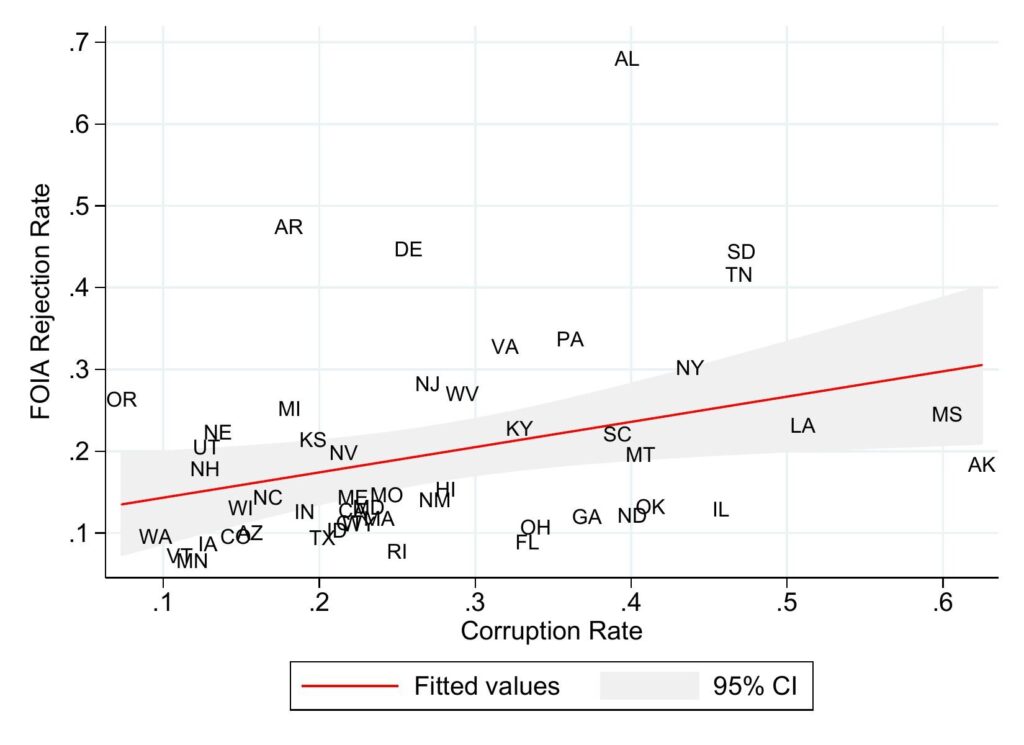
Before getting to our election results, we first look at whether FOIA rejections are predicted by state-level corruption. Officials in more corrupt states may desire less openness because greater transparency could expose misconduct, and also because the lack of transparency in such states may facilitate misconduct. We find a strong statistical relationship, as illustrated in Figure 1 below: in states like Louisiana and Illinois (where relatively many public officials are prosecuted for abuse of public office), rejection rates are considerably higher than in states like Utah and Washington (which have few corruption prosecutions). This is the case even when we compare response rates to requests for identical material, so the higher rejection rates in more corrupt states can’t be attributed to different types of requests. Perhaps surprisingly, states with stronger FOIA laws on the books are not systematically less corrupt. Transparency in practice appears to matter more than transparency on paper.
Figure 1: Relationship between state-level corruption and FOIA rejection rates
When we shift to studying how FOIA compliance changes around municipal and state elections, we first observe that the overall incentives are ambiguous. Most obviously, officials may wish to avoid the release of damaging information before an election—as in the case of the Laquan McDonald dashcam footage. Alternatively, a well-intentioned public servant may be particularly motivated to provide timely disclosures in advance of elections. And failure to comply with a request may itself be the source of campaign fodder. (The relationship is further complicated by the fact that those tasked with filling FOIA requests and those targeted by them may not be the same person and indeed may not even be politically aligned.)
In our statistical analysis, we find no impact of election timing on FOIA responsiveness—whether defined by delay or rejection—on average. This apparent non-result reflects the offsetting incentives described above. However, when we introduce state-level corruption as a variable, we find that pre-election responses are relatively slow and more likely to result in rejection in high-corruption states. For states in the highest quartile of corruption, the probability that a request is either rejected or delayed until after the election rises by roughly 11 percentage points—about a 30 percent increase relative to the baseline (non-election) rate.
Freedom of information laws are intended to make governments more transparent. Our findings suggest that their efficacy depends less on what the law requires than on how public officials exercise the discretion those laws inevitably leave them.
And this raises something of a policy conundrum: those with more to hide are least apt to be transparent. One implication is that FOIA management should be insulated from state and local politics, to separate the job of holding elected officials accountable from politicians themselves. This is easier said than done. Individual agencies usually handle their own FOIA requests. Even if, for example, the person responding to FOIA requests at the Chicago police department doesn’t report directly to the mayor, he’s still working in an office where those around him report to the police superintendent, who is appointed by the mayor. FOIA responses could be done centrally, managed in Washington D.C. along with the rest of the federal bureaucracy. But that hardly works to make FOIA officers responsive to the people of Chicago. Another approach to insulating FOIA decisions from political pressure is to make them less discretionary. But that’s a fool’s errand, as not every government document should be aired in public. Difficult policy tradeoffs are required, and as our research shows, many city and state governments will, for the right and wrong reasons, err toward secrecy.
Authors’ Disclosures: The authors report no conflicts of interest. You can read our disclosure policy here.
Articles represent the opinions of their writers, not necessarily those of the University of Chicago, the Booth School of Business, or its faculty.
Subscribe here for ProMarket’s weekly newsletter, Special Interest, to stay up to date on ProMarket’s coverage of the political economy and other content from the Stigler Center.