









Prizewinning research in most science-related academic fields has become less concentrated among institutions. However, as Richard B. Freeman, Danxia Xie, Hanzhe Zhang, and Hanzhang Zhou discuss in new research, prizewinners in economics continue to come from a narrow set of American institutions.
Take every economist who has won a major research prize and add up all the years of their working lives. Half of those years were spent at just eight American universities: Harvard, the University of Chicago, MIT, Stanford, Princeton, Yale, Berkeley, and Columbia.
That may not be surprising. Talented people end up at famous places. What surprised us, when we set economics next to the rest of science, is that in every other discipline we examined, this pattern is growing weaker. In economics, however, it is getting stronger.
In a new paper, we trace the careers of nearly 6,000 winners of 171 major prizes in 18 fields. Among those fields are physics, chemistry, medicine, mathematics, several branches of engineering, and the social sciences. We look at prizewinners because they shape the direction of research in their fields. For each field, we asked how concentrated prizewinners are across academic institutions, expecting concentration to have fallen as science has become more global. That is what we find in 17 of the 18 fields. However, in economics, concentration is the highest of any field, and it is the only field where concentration is rising.
Science has spread out
Sixty years ago, prizewinning research in most fields came from a small number of universities in a few developed countries. Since then, the number of universities in the world has grown more than fivefold. Research has spread to more institutions, both within developed countries and in developing countries that have built up their own research capacity.
In 17 fields related to science, prizewinners have spread across more institutions—and countries—over time, consistent with the globalization of science. This holds for large fields such as physics and chemistry and for small ones such as astronomy and materials engineering. It also holds for social sciences such as sociology, political science, and education.
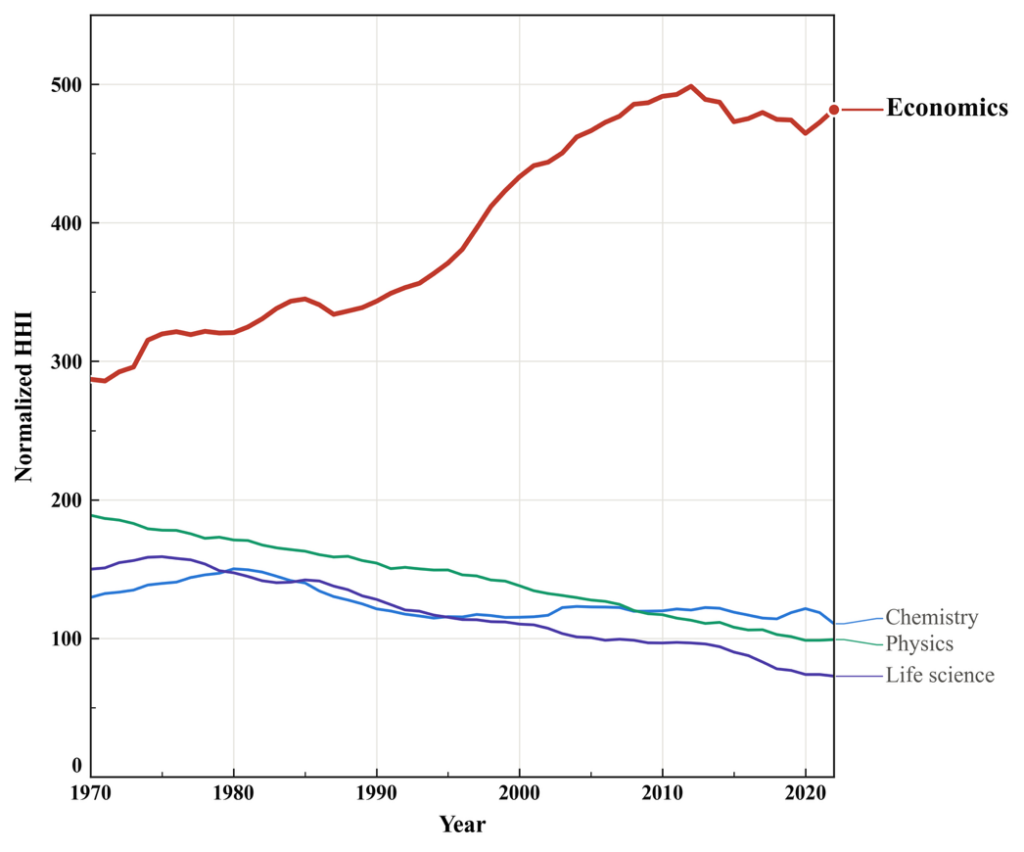
Economics is the exception. In 1960, it ranked ninth of the 18 fields in concentration, but its prizewinners have since gathered in fewer places, and it is now the most concentrated (Figure 1). The pattern is the same if we focus on Nobel laureates in economics, physics, chemistry, and medicine (Figure 2).
Figure 1. Institutional concentration of prizewinners by field, 1970 to 2022.
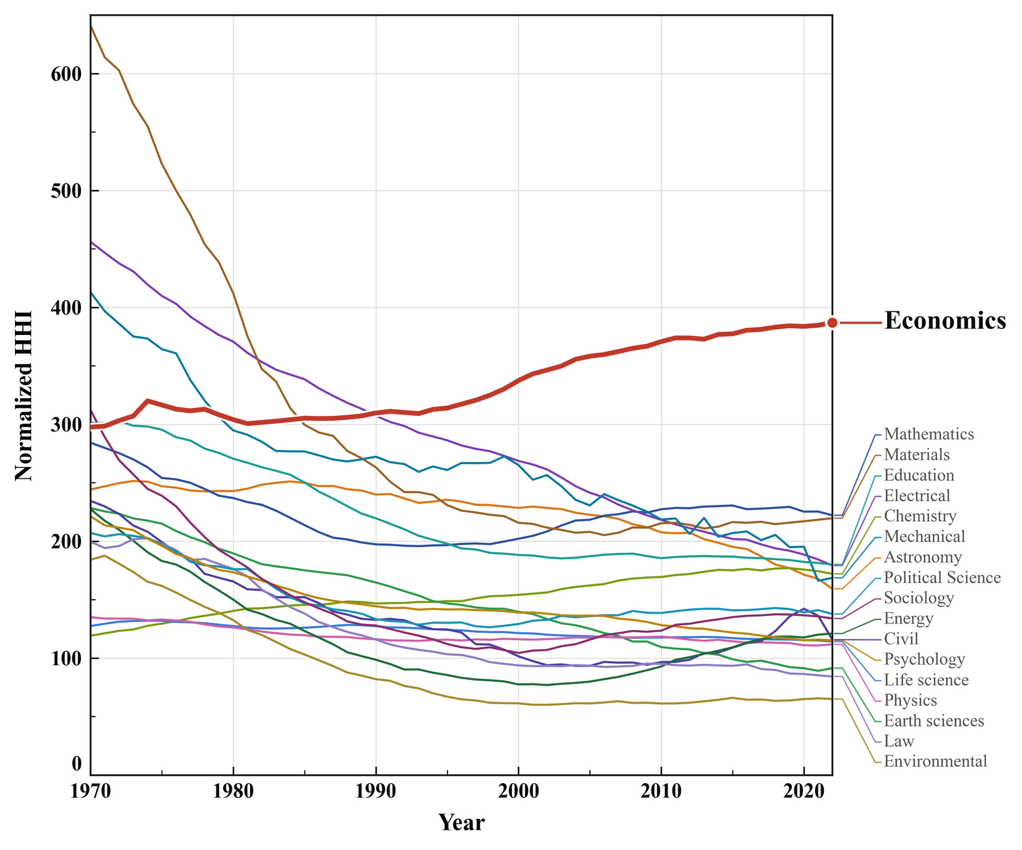
Figure 2. Institutional concentration of Nobel laureates by field, 1970 to 2022.
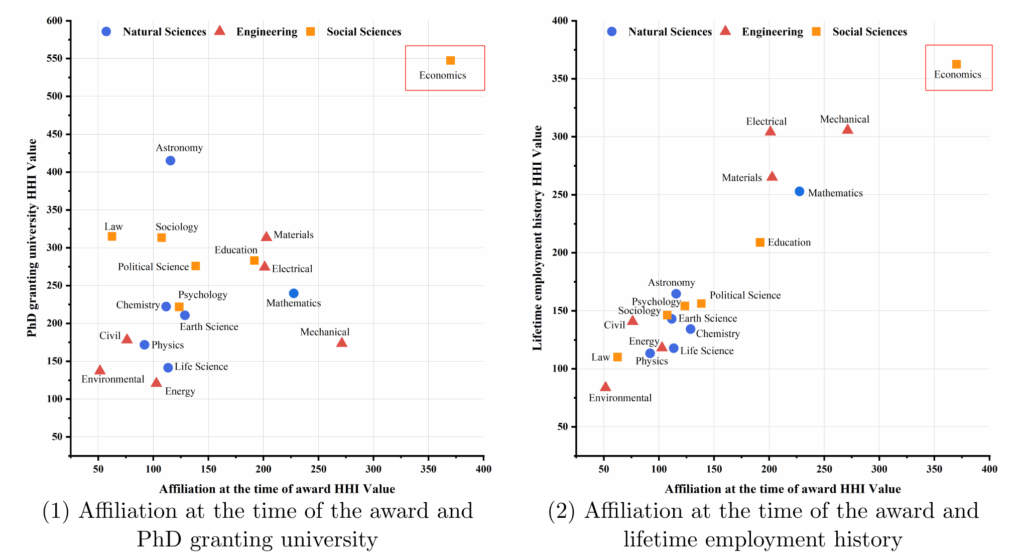
The highest institutional concentration of economics also holds if we count where prizewinners worked when they won or where they earned their PhDs (Figure 3) or if we use lists of the most-cited researchers in place of prizes. Economics is an unusually American field: about three quarters of its prizewinners worked in the United States, against about half in physics. But that does not explain the pattern either, because this concentration remains when we look only at universities within the U.S.
Figure 3. Concentration of each field’s prizewinners measured three ways: by where they worked when they won (horizontal axis), by where they earned their PhD (left panel), and over their whole careers (right panel). Economics is the most concentrated on every measure.
Three things set economics apart
We examine three factors associated with the high institutional concentration of awards in economics.
One is the role of institutional prestige. Prizewinning economists earned their PhDs at higher-ranked universities and went on to work at higher-ranked universities than prizewinners in any other field. On the U.S. News ranking, the average ranking of universities where prizewinning economists earned their PhDs was 13th and the ones where they worked averaged 15th. In most other fields, those averages fell between 20th and 40th. Hiring at the top looks the same. Using records on nearly 300,000 American professors, we found that the leading economics departments recruit from a smaller circle of PhD programs than the leading departments in any other field.
Another is the role of physical capital. In much of the natural sciences and engineering, research is tied to equipment that is expensive and hard to move, and no university can afford to house everything. This encourages scientists and engineers to disperse to a greater diversity of universities and nonacademic institutions, each with a unique specialty and specialized facilities. Most economists, however, can do extensive research with a laptop and a whiteboard, which makes star economists easy to hire away and collect in one place. In our data, star economists move to different universities more often than star researchers in any other field, at about 7% a year. When prizewinning economists moved in the years before their prize, it was often to a higher-ranked university. The same holds for economists who didn’t earn top prizes: among people with American PhDs who work at universities, economists have the highest mobility rates, at 4.7% a year against an average of 3.6%.
The third is the nature of evidence in each field. In much of science, results can be relatively easily validated through experimental measurements or mathematical proofs, which either succeed or fail unequivocally, supporting or overturning what most experts previously believed. In economics, however, theoretical contributions are not recognized for their incontrovertible discoveries but rather for their productive reframing of data and evidence that leads to new ways of conceptualizing economic activity. Success is based on expert consensus, not namely empirical testing or mathematical logic, and the merit of a theory depends more on signals, which can include the prestige of one’s university appointment.
In most scientific fields, prizewinners could be people working outside of their chosen field or struggling in their careers who then make a startling discovery and are ultimately given an award when their finding is validated.. For example, Yitang Zhang had worked as an accountant and in a sandwich shop and was a lecturer at the University of New Hampshire when he made a major advance on a famous problem about prime numbers in 2013. By the next year, he had won five major awards, including a MacArthur “genius” fellowship. Barry Marshall and Robin Warren were little-known Australian doctors with no university backing or fame when they provided evidence that bacteria caused stomach ulcers in the 1980s; they were eventually awarded a Nobel Prize once experimental validation supported their result. Katalin Karikó experienced repeated career setbacks in the 1980s and 1990s, including demotion and lack of funding, before her work with Drew Weissman on mRNA therapy received broad recognition and a Nobel Prize in 2023. In each case, the prizes came for validated findings irrespective of the researcher’s standing.
Economics rarely works this way. Few of its claims can be settled by one experiment or proof, so a major contribution is usually a research program: an idea developed across many papers over decades and judged by the profession rather than by a decisive test. Since 1969, 55% of the laureates in economics have been honored for a sustained research agenda rather than a single finding, against 20% in physics, 40% in chemistry, and 6% in medicine (Table 1). Paul Samuelson’s 1970 prize was “for the scientific work through which he has developed static and dynamic economic theory,” and Richard Thaler’s 2017 prize was “for his contributions to behavioral economics.” Each honored a body of work built over decades. In the natural sciences, the citations point to a specific discovery: Barry Marshall and Robin Warren won “for their discovery of the bacterium Helicobacter pylori and its role in gastritis and peptic ulcer disease,” Emmanuelle Charpentier and Jennifer Doudna “for the development of a method for genome editing,” and Rainer Weiss, Barry Barish, and Kip Thorne “for decisive contributions to the LIGO detector and the observation of gravitational waves.” Where awards recognize a broad body of work, as in economics, recognition depends on how the field assesses a scholar’s contributions over time rather than on a single decisive result, and institutional affiliation is one of the signals that assessment draws on.
Table 1. What the Nobel Prizes were awarded for, 1969 to 2022
| Field | Research agenda, top-10 institution | Research agenda, other institution | Single finding, top-10 institution | Single finding, other institution |
|---|---|---|---|---|
| Economics | 36 (39%) | 15 (16%) | 18 (20%) | 23 (25%) |
| Physics | 10 (8%) | 17 (13%) | 28 (21%) | 78 (59%) |
| Chemistry | 13 (11%) | 33 (29%) | 12 (10%) | 57 (50%) |
| Medicine | 4 (3%) | 4 (3%) | 30 (24%) | 89 (70%) |
Note: Number of laureates, with the share of the field’s laureates in parentheses. The top 10 are the ten institutions with the most prizewinners in each field. Each prize is classified from the prizewinning work and the wording of the citation.
Economics also differs from the other social sciences
Physical capital and the nature of evidence can explain why economics differs from the natural sciences and engineering. They cannot explain why it differs from the other social sciences. Those fields require no more specialized equipment than economics, and their findings do not depend on decisive experiments, but their prizewinners have become less concentrated over time.
We hypothesize that economists agree, far more than their neighbors do, on how research should be done and where it should be published.
First, economics has a stronger field paradigm. It shares a common framework for analyzing behavior. That framework takes, at least as a first step, the assumption that workers, firms, and government regulators seek to optimize reasonably well-defined objectives in a market setting, where the key variables are prices and quantities in goods markets, and wages and employment in labor markets. Consistent with its more unified paradigm, economics has a much greater preference for within-field collaboration and a higher rate of self-citation than other social sciences. In a survey of American professors, 42% of the economists agreed that knowledge drawn from several disciplines is better than knowledge from one. Among sociologists it was 73%, and among psychologists 79%.
Second, economics has narrower methods for recognizing quality work. Sociology and political science place considerable weight on books, and both award major prizes for them. In economics, what counts most for getting tenure at a leading department is publishing in the “top five” journals. Those five, out of 433 economics journals, collect 28.5% of all citations. Two of the five are edited at Harvard and UChicago. Between 2000 and 2016, Harvard authors wrote about 25% of the articles in Harvard’s Quarterly Journal of Economics, and UChicago authors wrote about 14% of those in UChicago’s Journal of Political Economy.
The costs and benefits of concentration
We compared the summaries of nearly four million recent journal articles across six social sciences. Economics has the highest method cohesion of the six fields and the lowest topic cohesion. Its papers use the same techniques more uniformly than those of any other social science, and they cover the widest range of questions.
This uniformity has benefits. When economists working on different subjects use the same techniques, their results can be compared and built upon, allowing readers to judge work well outside their own area. Because that toolkit travels across subdisciplines, economics has extended beyond its traditional concerns with markets and prices into crime, family structure, discrimination, and institutions.
But there is an alternative, less favorable view. If the institutions producing most of the field’s recognized work also set its methodological standard, then meeting that standard becomes the condition of entering the field and its higher echelons and publishing. On this view, work using an unfamiliar approach is hard to place or recognize, and findings that disagree with the main tenets of the field are rejected rather than studied as special cases that may yield new knowledge. For example, George Akerlof’s “The Market for Lemons,” which brought asymmetric information into economics and earned him the 2001 Nobel, was rejected by the American Economic Review and the Review of Economic Studies as trivial, and by the Journal of Political Economy as wrong, before the Quarterly Journal of Economics accepted it four years after his first submission. Akerlof later wrote that editors “were afraid that if ‘information’ was brought into economics, it would lose all rigor.” It also means that because the top universities maintain their status through setting the guidelines for publishing in the top journals, the top economists, according to the top institutions’ standards, are constantly funneled to those institutions.
The difference between economics and other social sciences lies in what is missing from the published record: the papers that were never written or never accepted because they did not fit the standard, and the findings that were published but ignored. Those gaps are hard to measure. One piece of indirect evidence comes from an earlier study, which found that the productivity boost an economist once got from working at an elite university had largely vanished by the 1990s, as cheaper communication made it easy to work with good colleagues anywhere.If working alongside other stars no longer makes an economist more productive, the benefits of proximity are a less convincing explanation for why the stars keep gathering in the same few departments.
A concentrated market for ideas
Governments turn to economists when they set interest rates, write tax rules, or decide whether a merger is beneficial. If the field’s most influential economists come from a handful of departments that share one way of working, the public may hear a narrower range of ideas than it otherwise would.
Economists study what happens when a few firms come to dominate an industry, and antitrust authorities track such concentration with the same Herfindahl–Hirschman index we use here. Usually, concentration leads to undesirable effects.
Over sixty years, 17 fields of research have decentralized while economics has become more centralized. We cannot say whether the costs of this concentration outweigh its benefits, but it is a pattern that would draw economists’ attention in any other market, and we think it deserves the same attention in our own profession.
Author’s Disclosures: Hanzhe Zhang acknowledges financial support for this research from Amazon Science, the National Science Foundation, and the Michigan State University Honors College and Provost Undergraduate Research Initiative. Richard Freeman is affiliated with Harvard University and Hanzhang Zhou with MIT, and Danxia Xie and Hanzhe Zhang graduated from the University of Chicago, three institutions with the largest shares of prizewinning economists in the data. You can read our disclosure policy here.
Articles represent the opinions of their writers, not necessarily those of the University of Chicago, the Booth School of Business, or its faculty.
Subscribe here for ProMarket’s weekly newsletter, Special Interest, to stay up to date on ProMarket’s coverage of the political economy and other content from the Stigler Center.