




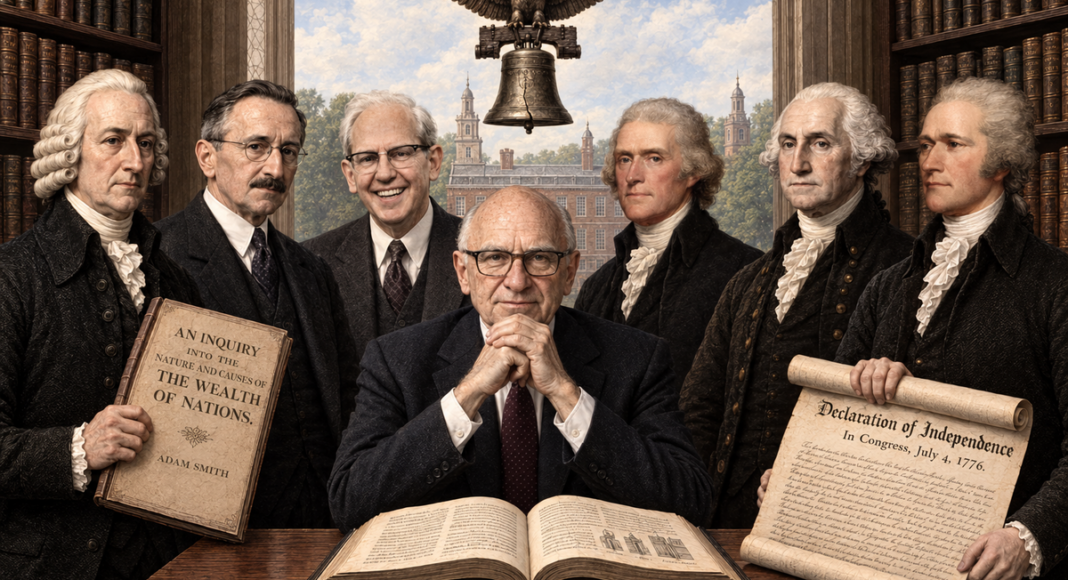

Jolted by the Great Depression of the 1930s, Thurman Arnold devised an anti-monopoly industrial policy for the United States Justice Department that breathed fresh life into a then-moribund Sherman Anti-Trust Act. Arnold’s jurisprudence built on Adam Smith’s discovery that market-making could promote national security and forestall civil unrest. Smith’s insights had informed the industrial policy of Alexander Hamilton, who laid the groundwork in the 1790s for the country’s economic development. Edward H. Levi brought Arnold’s pragmatic anti-monopolism to the University of Chicago. Here, ironically, Arnoldian jurisprudence would be transmogrified into the doctrinaire company-over-country market fundamentalism of the Chicago School of Economics. Today, writes Richard R. John, as we envision for the 21st century a new pro-market, pro-freedom, pro-national security industrial policy, it is worth recalling how U. S. economic development took the form that it did, why the Chicago School repudiated the enduring wisdom of Adam Smith, and what this portends for the world of today.
Editor’s note: This year celebrates the 250th anniversaries of the American Declaration of Independence and the publication of Adam Smith’s Wealth of Nations. It is also 50 years since Milton Friedman won the Nobel Prize in economics. This article is part of a symposium revisiting the ideas of freedom and political economy expounded by the American revolutionaries, Adam Smith, and the Chicago School of economics, and how they connect to contemporary concerns about capitalism and democracy. You can read the rest of the articles here as they are published, with contributions from Peter Boettke, David Mitch, Robert Van Horn, Sandra Peart & David Levy, Maha Rafi Atal, Edward Nik-Khah, and Richard R. John. We welcome responses, which you can send to promarket@chicagobooth.edu.
In 1776, the British Empire was in turmoil. For moral philosopher Adam Smith, a pernicious “mercantile system,” a phrase Smith popularized, stunted overseas trade and legitimized monopolistic globe-spanning corporations like the East India Company. For a restive cabal of patriotic colonists an ocean away in Philadelphia, a diabolical British conspiracy was underway to enslave a liberty-loving people.
Two hundred and fifty years later, much has changed. Yet the twin threats that British and colonial statesmen confronted in 1776—political corruption and imperial overreach—continue to haunt the moral imagination of thoughtful Americans today.
Of the many responses to these threats, two prioritized a mode of inquiry that contemporaries would have understood as anti-monopoly, or what we today might call pro-market. The first was the establishment by the first secretary of the United States Treasury Department, Alexander Hamilton, of a treaty-worthy fiscal-military state that could go head-to-head with the British Crown overseas while encouraging insurgents to combat incumbents at home. Hamilton’s achievement lay not only in the creation of a fiscal apparatus that would enable the fledgling commercial republic to hold its own in a world of hostile rivals, but also in his vision of an industrial policy that would hasten the transformation of a commercial republic into an industrial nation. This achievement would be realized in the half-century following the Union victory in the U.S. Civil War.
The second was the rise of the Chicago School of Economics. That the Chicago School has an anti-monopoly pedigree may surprise those who identify it with the pro-monopoly market fundamentalism of Milton Friedman—who, a half century ago this year, received the Nobel Prize in economics. Like Facebook in the 2010s, the Chicago School in the 1970s favored company over country. In so doing, it turned its back on the anti-monopoly jurisprudence that had hastened its rise, much of which, ironically, had originated at the University of Chicago.
The arc from Hamilton to Friedman was long and, notwithstanding its anti-monopoly origins and industrial policy pedigree, it repudiated Smithian common sense moral philosophy for the doctrinaire universalism of market fundamentalism. To understand this surprising turn of events, it can be useful to return to Smith, whose landmark policy brief, The Wealth of Nations, hit the bookshops in March 1776—four months before the Continental Congress adopted the Declaration of Independence. As it happens, both Hamilton in the 1790s and the Chicago School in the 1950s built on what they presumed to be Smithian orthodoxy to popularize then-novel conceptions of economic development.
Smith had mixed views about the colonial uprising that had erupted in British North America known today as the American War of Independence. Like Edmund Burke—a statesman Smith knew well, and whose anti-monopoly agenda Smith wholeheartedly endorsed—Smith doubted the efficacy of the commercial monopoly that the British Parliament imposed on colonial North America’s overseas trade. To fill the coffers of the British treasury, British customs officers tried to channel goods shipped overseas through British ports, even if these goods had neither originated in nor been destined for the mother country.
Smith’s opposition to Britain’s North American trade policy is often misunderstood. He opposed trade restrictions not as a free-trade absolutist—which he was not—but because they had proved unenforceable. The British government had for over a hundred years presumed that it possessed a “great empire on the west side of the Atlantic,” Smith sardonically observed. Yet this empire existed “in imagination only.” The cost of pursuing this project had proved to be immense “without being likely to bring in any profit”: “for the effects of the monopoly of the colony trade…are, to the great body of the people, mere loss instead of profit.”
The title of Smith’s masterpiece underscored his priorities. The goal of constructive statecraft was the wealth of the nation. The flourishing of the market was a means to this end. Smith deplored monopoly because it weakened Britain’s economy by crippling the “invisible hand” of its manufacturers. The “invisible hand” metaphor, which can be found only once in The Wealth of Nations—and which was almost never lifted up by commentators as a key to Smith’s oeuvre before the Second World War—referred not to the impersonal market, as legions of commentators have mistakenly assumed, but to the relentless Protestant work-ethic of Britain’s artisans and industrialists.
Smith’s pragmatic nation-centrism would be adopted by Hamilton in the 1790s only to be rejected in the mid twentieth century by the Chicago School, whose market fundamentalism prioritized profit maximization over national security and economic development. To drive his point home, Smith lifted up Britain’s Navigation Acts, a holdover from England’s seventeenth-century maritime rivalry with the Dutch Republic, as “perhaps, the wisest of all the commercial regulations of England.” By filling the government’s coffers and shielding Britain’s merchant marine from foreign competition, these laws protected the homeland from attack while emboldening the British navy to project its power overseas.
Smith’s praise for the Navigation Acts can be squared with his critique of Britain’s North American trade policy by recalling that Smith opposed the latter not as economically unsound but as politically inexpedient. For similar reasons he derided as an abomination the monopoly grants that undergirded Britain’s East India Company, one of the world’s oldest and most rapacious multinationals and the lineal ancestor of the raft of digital platform monopolies that encircle the planet today. In both instances, pro-monopoly trade laws fostered the kind of endemic political corruption derided by a later generation of commentators as the regulatory capture of the administrative state.
Smith deplored regulatory capture. Yet the principle that the Navigation Acts enshrined—that a maritime empire had a paramount obligation to maintain an industrial policy to protect its national security—was for him sacrosanct.
No eighteenth-century U.S. statesman could have been confident—and many were not—that the nascent political confederation that would come into being a few short months before the patriots’ 1781 victory at Yorktown ended the military phase of the American War of Independence would remain intact for the foreseeable future, let alone that it would eventually morph into the global powerhouse that it has become today. Smith himself ventured the prediction in the 1784 edition of The Wealth of Nations that, should the coercive power of the mother country be “entirely taken away” from Britain’s North American possessions, the factions that had divided them before the war would be “ten times more virulent” and “soon break out into open violence and bloodshed.”
Adam Smith crosses the Atlantic
Enter Alexander Hamilton. With the calm self-assurance of a battle-tested statesman whose wartime record compared favorably with that of Thomas Jefferson, George Mason, or any the other leaders of the patriot cause—excluding only Hamilton’s patron, mentor, and second father George Washington—Hamilton grasped the vulnerability of Britain’s former colonies not only to recolonization, but also to civil war, and planned accordingly. As the keenest student of Smith among the founders of the U.S. republic (Hamilton quoted liberally from Smith’s Wealth of Nations in his landmark 1791 “Report on Manufactures”), Hamilton intuitively understood the symbiosis of statecraft and economic development. The fiscal apparatus Hamilton built included a low-tariff regime for most goods to boost the credibility of U.S. government bonds in overseas markets; a central bank to facilitate commercial exchange and stabilize the currency; and the assumption by the federal government of the war debt held by the individual states. These institutional arrangements would remain a cornerstone of the U.S. fiscal-military state from the 1790s until the ratification of the Sixteenth Amendment legalized the imposition of a federal income tax in 1914.
Consider a counterfactual. Had George Mason or Thomas Jefferson successfully imposed their political-economic agenda on the fledgling republic, its future might have been quite different. Mason’s revulsion toward New England merchants was so deeply engrained that—to the consternation of many of his contemporaries, including his Virginia neighbor George Washington—he brazenly opposed the ratification of the U.S. Constitution.
Mason’s objection centered on the refusal of the framers to include in the Constitution a clause that would have required a congressional supermajority for the promulgation of navigation acts in the new nation comparable to the Navigation Acts of Great Britain. Mason was actually more fearful of having his tobacco transported overseas in ships hailing from Salem or Boston than from London or Glasgow, a reactionary, and implicitly anti-Smithian, neo-colonial orthodoxy that prefigured the doctrinaire universalism of the University of Chicago’s economics department, as well as that of its ideological satellite campus in Virginia that today bears Mason’s name.
Meanwhile, Jefferson’s hatred of cities, manufacturing, and public finance was so pathological that, had he dismantled Hamilton’s fiscal apparatus during his presidency—which he wisely did not—the U.S. might well have found itself no less vulnerable to the “informal empire” of British commercial domination than Argentina, Brazil, or Chile. Had Hamilton’s innovations been repudiated, it is hard to imagine that Napoleon Bonaparte would have judged the new republic to be sufficiently creditworthy to unload on it France’s vast North American holdings. No Hamiltonian fiscal apparatus, no Louisiana Purchase, a crowning achievement of Jefferson’s presidency.
That the U.S. might have remained long after 1776 an agrarian republic on the global periphery, as its southern and western hinterland would remain until the twentieth century, was by no means far-fetched. In our own age, we have come to deride as “banana republics” nations whose leading sector was an agricultural staple. That the U.S. avoided this fate is a tribute to the merchants, manufacturers, farmers, and workers who transformed a commercial republic into an industrial nation. Yet they did not, and could not have, done it on their own. In the absence of the supportive institutional arrangements that Hamilton’s vision of an industrial nation prefigured—including, in addition to its fiscal apparatus, its protective tariffs to nurture “infant industries” and its lean yet formidable military—who can say with confidence that an export-staple-based political economy might not have become even more firmly entrenched? The establishment of a strong state would prove indispensable not only to industrialization, but also to the preservation of the Union from enemies at home and abroad. It was not Jefferson, but Hamilton, who laid the foundation for the institutional arrangements upon which the political economy of the modern U.S. would be built.
The Chicago School rejects anti-monopoly
Fast forward to the twentieth century. The U.S. would emerge in the 1920s as the world’s largest creditor. Yet danger loomed ahead. The stock market crash in 1929 and the economic collapse that followed shortly thereafter diminished faith in competitive markets and led in 1933 to a brief experiment in the cartelization by Hugh S. Johnson’s National Recovery Administration (NRA) of leading sectors of the U.S. industrial economy. According to Johnson, a West Point veteran much impressed by the U.S. military mobilization during the Great War, the 1890 Sherman Anti-Trust Act was responsible not only for stifling U.S. economic development, but also for the Great Depression.
For Thurman Arnold and his colleagues in the Antitrust Division of the Justice Department, over which Arnold presided between 1938 and 1943, Johnson could not have been more mistaken. From their point of view, the NRA’s price controls bore a far-from-superficial resemblance to the economically backward and politically dangerous cartelization of Germany’s heavy industry by Adolf Hitler’s fascistic regime, a pro-monopoly scheme in which many large and powerful U. S. corporations were complicit. Cartelization, whether at home or abroad, had become a powerful catalyst for political corruption and imperial overreach.
Arnold was no market fundamentalist. Yet, like Louis Brandeis, the doyen of the post 2008-financial crisis anti-monopoly movement, or, for that matter, Friedrich Hayek, the torchbearer for the Chicago School, he was determined to prosecute under the Sherman Act restraints of trade in business, labor, and professions. So bracing was Arnold’s anti-monopoly vision that, for Chicago School economist Henry C. Simons, writing in 1940, Arnold’s Bottlenecks of Business, which Arnold had published during his tenure in the Antitrust Division, “may be the important political tract of its time. Broadly interpreted, it is an earnest plea for restoration of free markets in the United States—for preserving our democratic way of life and preserving free internal trade as the basis of our political liberty.” Arnold’s anti-monopoly campaign, Simons underscored, had become the nation’s single most effective weapon against the scourge of fascism both at home and abroad. “What I make out of Arnold,” Simons elaborated, “is that monopoly prosecutions should be a kind of perpetual witchhunt, tormenting and dislodging people who make too much money selling things or spend too much producing them.”
Arnold’s anti-monopoly vision built on his then-novel pragmatic conception of U.S. law. InThe Folklore of Capitalism, which Arnold published shortly before joining the Justice Department, Arnold had analyzed the symbols that shaped U.S. industrial policy. Public opinion, in his view, lauded competition, efficiency, service, and what he would enthusiastically praise as “free enterprise.” To be effective, antitrust policy should build on this intellectual heritage. Bad business, rather than big business, should be its primary target.
Among Arnold’s admirers was Edward H. Levi, a recent law school graduate (University of Chicago JD ‘35). Intrigued by the bracing iconoclasm of Arnold’s Folklore, Levi published a 1938 law review essay in which, somewhat improbably, he harnessed Arnold’s irreverent pragmatism to the sacrosanct orthodoxy of medieval natural law. Impressed by Levi’s erudition and intrigued, without being entirely persuaded, by his exegesis, Arnold recruited Levi for his anti-monopoly campaign.
Levi’s tenure in Arnold’s Justice Department solidified a friendship between the two men that is well documented in Levi’s personal papers at the University of Chicago. Arnold—reflected Levi in 1970, in a fulsome tribute to his former boss that Levi published six months after Arnold’s death—had the “capacity and the necessity” to “free himself” from the special pleading endemic to his craft: “In the joining of skill, purpose and responsiveness, he became one of the great lawyers and human beings of his time.” Levi’s own writings were suffused with Arnoldian insights. “The problem of political economy in this day,” declared Levi in an unpublished paper that he probably wrote around 1964, was to “join effective political action with freedom…In this country, individualism has been a fighting faith…Those who value a competitive order must not only expose the underlying issues of power and authority. They must also develop a set of symbols which will capture the imagination of men.” Arnold could not have put it any better.
Arnold would go on to a long and distinguished private-sector career following the Second World War as a founding partner of Arnold and Porter, a Washington, D.C., law firm still in business today. Levi, in turn, rose through the ranks at the University of Chicago as law professor, law school dean (1950-1962), university provost (1962-1968), and university president (1968-1975). It was here, and in ways that no one in the 1930s could have predicted, that Levi’s jurisprudence would graft onto Arnoldian pragmatism the doctrinaire market fundamentalism for which the Chicago School of Economics would come to be identified, lauded, and reviled.
Levi was a lawyer and not an economist. For this reason, he is rarely counted among the founders of the Chicago School. Yet it was during Levi’s tenure as law school dean that the Chicago School’s market fundamentalism became entrenched. While surprising, this turn of events by no means took place behind Levi’s back. For several years in the 1950s, for example, Levi cotaught with Aaron Director (Milton Friedman’s brother-in-law) a famous seminar on antitrust law in which Levi analyzed antitrust jurisprudence from the standpoint of a lawyer, and Director responded in kind from the standpoint of an economist. For a rising generation of jurists, including Robert Bork–who credited Director with his conversion to market fundamentalism–the Levi-Director seminar was a life-changing event. Though the seminar ran its course, it would become institutionalized in the Chicago-School-friendly Journal of Law and Economics, which began publication in 1958. The journal’s first editor, Director, had been hand-picked by Levi; Director, in turn, would help install in 1964 his successor, the famed Chicago School economist R. H. Coase.
The Arnold-Levi-Chicago School lineage scrambles the conventional genealogy of U.S. anti-monopoly thought. Arnold created modern antitrust jurisprudence to combat fascism at home and abroad. University of Chicago economists and jurists, beginning in in the 1930s with Simons and Levi, gave Arnoldian pragmatism academic credibility. Yet it would not be until a rising generation of market fundamentalists inspired by Director and Friedman reconfigured its pragmatic nation-centrism as a dogmatic universalism, drawing in part on a then-pervasive misreading of the Smithian corpus, that it would become an influential current in public policy and social thought.
By the 1970s, Chicago School orthodoxy would become more-or-less synonymous with the market fundamentalism of Robert Bork, a Director-inspired Chicago School acolyte who was a longtime law professor at Yale. In his 1978 Antitrust Paradox, which built on a series of influential articles that he had published over the course of many years, Bork invested with an almost talismanic power the concept of “consumer welfare,” which he equated with the neoclassical economic concept of allocative efficiency—presuming, with a stunning disregard for the most rudimentary canons of historical inquiry, that the twentieth-century economistic understanding of this concept had informed U. S. congressional thought in the run up to the enactment of the 1890 Sherman Act. In so doing, Bork broke decisively with Adam Smith, who had prioritized what we would today call national security over “opulence,” an eighteenth-century synonym for consumer welfare. Bork’s repudiation of Smith would go so far as to indict the entire administrative state as politically corrupt and morally decadent, a critique that Bork would elaborate with increasing fervor following the refusal in 1987 of the U.S. Senate to confirm his appointment as a Supreme Court justice. In a small library of increasingly apocalyptic post-1987 books, Bork openly questioned the legitimacy not only of the liberal social legislation that he had long covertly opposed—with legalized abortion as his bête noire—but also the pragmatic nation-centric anti-monopoly jurisprudence of Arnold and Levi. Other members of the Chicago School, including Friedman and his fellow Nobel laureate George Stigler, would challenge other bulwarks of the administrative state, extending far and wide the Chicago School’s anti-regulatory, anti-statist, pro-monopoly policy agenda.
How could the Chicago School’s market fundamentalism have so successfully swamped the anti-monopoly jurisprudence of Arnold and Levi? One answer can be found in the extraordinarily favorable position enjoyed by U.S. business in the decades immediately following the Second World War. Having defeated Germany and Japan—and with Great Britain, France, and the rest of Europe reeling from wartime devastation—the U.S. emerged in 1945 as the world’s only superpower. Market fundamentalism was an ideological cri de coeur for an age in which the terms of trade decisively favored U.S. business, U.S. consumers, and U.S. workers. The Soviet menace dominated geopolitics. Yet for the Chicago School, the monopoly power wielded by U.S. firms that had so terrified Henry C. Simons had suddenly come to seem perversely overblown if not altogether illusory. For Alexander Hamilton, the existential peril of imperial overreach originated in London and Paris. For Arnold, it was coeval with the cartelization of heavy industry by the Nazis. For Bork and the Chicago School, in contrast, monopoly power had crossed the Atlantic and entrenched itself within the bowels of the administrative state, not excluding even the upper ranks of the Antitrust Division of the Justice Department. For Hamilton and Arnold, the monopoly monster remained overseas. For Bork, it had become the enemy within.
While the Chicago School often prevailed in the courts, it had a hard time making its case for the history books. The reason was not hard to fathom. For as historians now agree, it was not the absence of a strong state, but its structuring presence that facilitated the transformation of the U.S. from a commercial republic into an industrial nation. And among the founders it had been Hamilton—rather than, say, Jefferson or Mason—who had done the most to lay the groundwork for this epochal transformation.
How a nation—or a planet—can strike a balance between ethics, national security, freedom, and economic development is one of the most enduring problems of statecraft. The market fundamentalism of the Chicago School dissolved into the ephemeral calculus of transaction costs the perennial challenge of political corruption and imperial overreach. It so doing, it marked the revenge of the doctrinaire universalism of Thomas Jefferson and George Mason over the pragmatic nation-centrism of Alexander Hamilton and Adam Smith.
“The antitrust laws were the answer of a democracy to the concentration of wealth,” Arnold declared in The Folklore of Capitalism: “An antitrust case is not supposed to produce lasting economic results. It is a morality play about political problems.” In a year in which we celebrate the two-hundred-and-fiftieth anniversaries of the Declaration of Independence and Wealth of Nations and the fiftieth anniversary of Milton Friedman’s Nobel Prize in economics, it is worth recalling that this morality play was once regarded as enormously consequential not only for statesmen, but also for economists, jurists, journalists, and the countless merchants, manufacturers, professionals, and service providers who found themselves in the thrall of monopoly power, and to reflect on the social circumstances at home and abroad under which it might become consequential again.
Author’s Disclosure: The author reports no conflicts of interest. You can read our disclosure policy here.
Articles represent the opinions of their writers, not necessarily those of the University of Chicago, the Booth School of Business, or its faculty.
Subscribe here for ProMarket’s weekly newsletter, Special Interest, to stay up to date on ProMarket’s coverage of the political economy and other content from the Stigler Center.