








In new research, Markus Eberhardt, Giovanni Facchini, and Valeria Rueda find that a growing share of PhD graduates from top U.S. economics programs are leaving academia, looking beyond North America, and moving into the private sector, especially towards the tech industry.
The economics profession regularly makes the news, but not always for the right reasons. The discipline is accused of being elitist and detached from reality. Critics point out that many of the most influential economists come from a handful of developed countries, work for a very narrow set of institutions in the United States, and build careers on work published in the top five journals, which are often criticized for rewarding methodological sophistication over the breadth and real-world relevance of the questions studied.
PhD programs in technical disciplines such as economics train experts for research and innovation in a broad set of sectors: academia, but also public policy, and the private sector. If economics PhDs were acquiring expertise disconnected from the outside world, few employers beyond academia would want them and, presumably, the demand for this type of training would also decrease. The pool of graduates has, in fact, grown substantially. According to the Survey of Earned Doctorates, there were 950 new PhDs in economics 2000; by 2022, that number had risen to 1,287. What are the job market options for these new economists?
To investigate these matters, in a recent paper, we collected data on all PhD graduates from the top 33 U.S. economics programs since 1998 and traced their placement after they entered the job market. We find that these paths substantially diversified over time, and that more graduates are exiting academia, leaving the U.S., and entering the tech industry, which recruits irrespective of gender, ethnicity, or program prestige.
However, the rapid expansion of tech employment may be more fragile than it first appears. Hiring is highly concentrated, with Amazon alone accounting for more than 40% of tech placements. The profession may be opening up to opportunities outside academia, but unevenly, and perhaps not irreversibly.
Academic placement is declining and globalizing
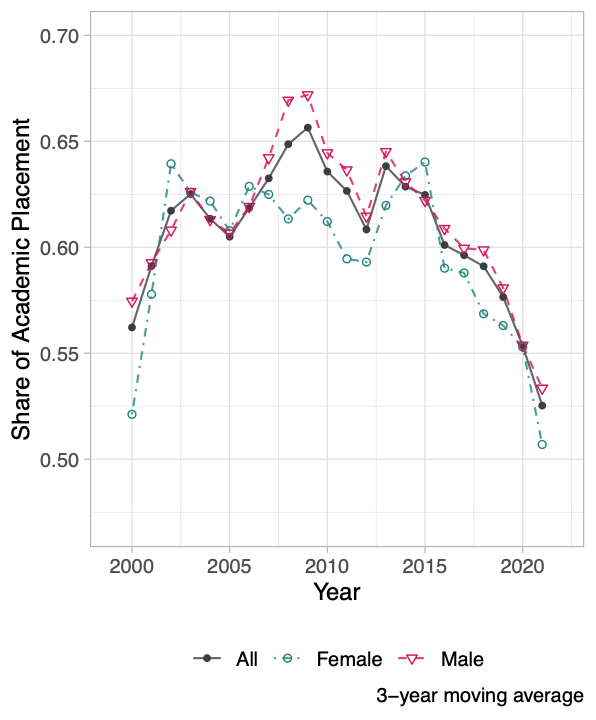
In 2009, around two thirds of PhD graduates in our sample took an academic job, but that share has since fallen to roughly half (Figure 1). This decline is visible among both men and women, and across programs of all ranks, although it set in later at the higher-ranked programs. Take a Californian example. At Stanford and UC Berkeley, academic placement climbed from around 55% in 2000 to a peak near 75% in 2014, before pulling back to around 65%. At UCLA, UC San Diego and UC Davis, a more marked pattern emerges. Placement rose from about 50% to a peak near 65% in 2007, then eased down to around 55% over the following decade.
Figure 1: Share of PHD graduates who take an academic job.
Among those who enter academia, a declining share takes up positions at North American institutions (Figure 2). In the early 2000s, roughly 75% of graduates landed an academic job in the U.S. or Canada. That share is now roughly 50%. Instead, European and East Asian institutions are becoming increasingly attractive destinations for these graduates. This globalized dispersal misses large swathes of the globe, though. For example, institutions in India recruited just 34 of the 11,625 candidates in our sample, while African institutions recruited only seven.
Figure 2: Share of PhD graduates who take academic jobs by geographic destination
Tech fuels private placement
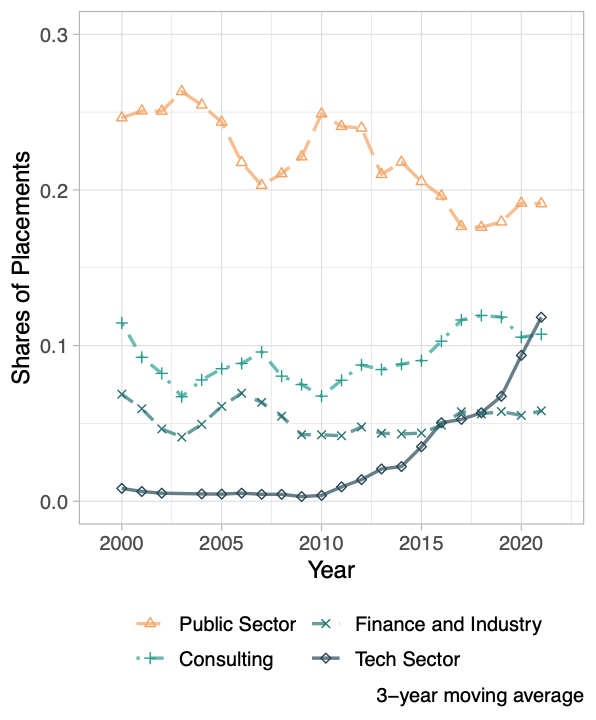
Where do the growing number of graduates leaving academia go? Traditionally, economists have joined the ranks of public institutions. International organizations such as the International Monetary Fund and the World Bank, as well as central banks and finance ministries around the world have long demanded highly skilled economic expertise. While the public sector remains the most common destination outside academia (20% in the 2020s), its relative importance is declining. Increasingly, economics PhDs opt instead for jobs in the private sector: in consulting, finance, and tech. The tech sector has expanded particularly fast, growing from just 1% of placements in the 2010s to 12% in the 2020s (Figure 3).
Figure 3: Share of PhD graduates taking jobs in different sectors
Competition for economists varies dramatically across industries. In finance, placements are spread across a broad range of firms. The biggest recruiters emerge in consulting and the public sector: the IMF, the World Bank, and the U.S. Federal Reserve absorb much of public-sector hiring, while Analysis Group and Cornerstone lead in consulting. The tech sector’s rise is largely in response to Amazon, which accounts for over 40% of recruitments into the sector. No other employer comes close.
Can we predict the placement outcomes of PhD economists?
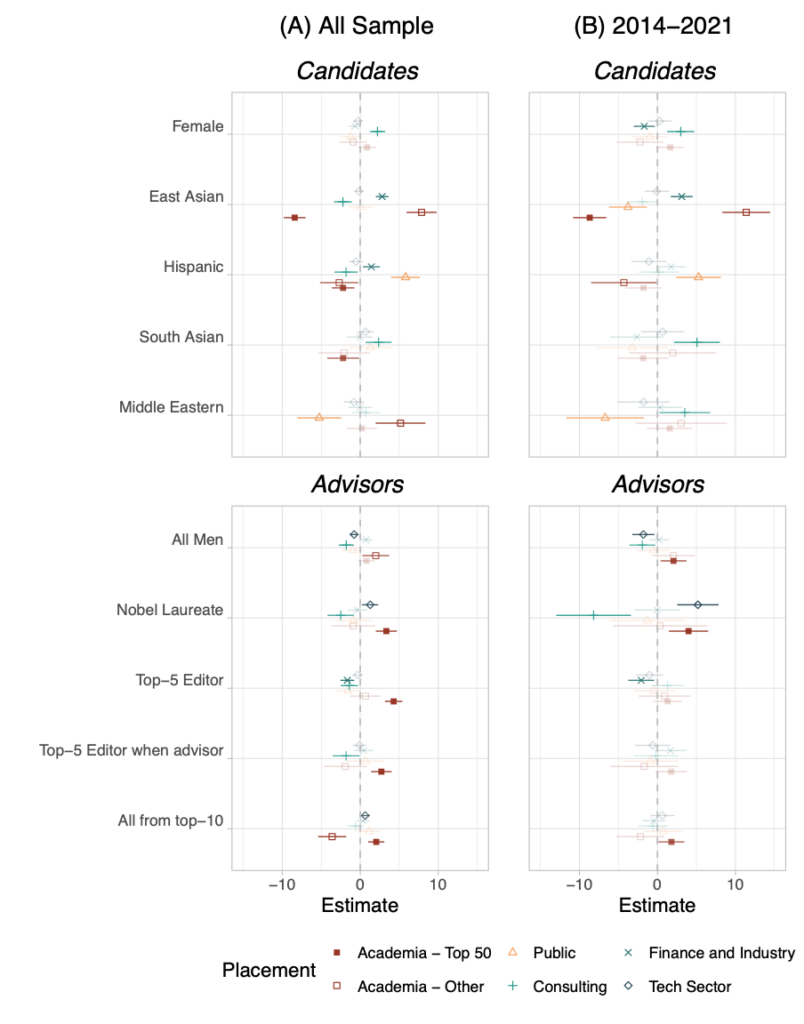
Among those PhDs who secure an academic position in a top U.S. university, we identify a number of characteristics (marginal effects reported in Figure 4). Advisors are a significant predictor of placement: Students of Nobel laureates or top-five journal editors are more likely to join leading universities. Similarly, candidates whose advisors have stronger academic networks, measured by top-10 institutional backgrounds and co-authorship connections, are more likely to secure top academic positions even after conditioning for the academic prestige of advisors. Taken together, these results echo concerns about the lack of diversity at the very top of the economics profession.
Among candidates’ characteristics, gender bears little relation to the placement: 28% of the candidates in our sample are women, and women made up 27% of all academic placements. This result contrasts with the growing evidence of barriers faced by women in other aspects of the profession, including recommendation letters and work environment. More pronounced gaps emerge along ethnic lines. Black candidates are substantially underrepresented (less than 1% in our sample). East Asian candidates, who are the largest ethnic minority (28%), are less likely to place at top-50 institutions and more likely to join lower-ranked ones, not only in China but also elsewhere. These gaps have become larger in the more recent period, while academic placement gaps seem to be smaller for South Asians and Hispanics. One particularly notable result is that tech is the only industry in which placement outcomes appear unrelated to any of the candidate characteristics we consider.
Figure 4: Candidate and Advisor characteristics help predict placement
Conclusions
Top economics PhDs are looking at employment opportunities outside the top U.S. programs, but this evolution has been uneven, and it is unclear whether this trend will persist. Recent cohorts are more likely to leave academia, more likely to work outside the U.S., and are increasingly absorbed by a tech sector that recruits without regard to gender, ethnicity, or academic prestige. It is possible some of this is due to race or network barriers to entering the top PhD programs. East Asian candidates face a substantial placement penalty, while elite advisor networks still confer significant advantages.
This evolution may also prove fragile. The expansion of tech hiring has been driven disproportionately by a single firm. How the artificial intelligence boom will reshape the demand for economists in the sector and whether tech will continue to provide an important alternative to traditional academic careers remains uncertain. Much may depend on whether the market diversifies beyond Amazon.
Author’s Disclosures: The authors report no conflicts of interest. You can read our disclosure policy here.
Articles represent the opinions of their writers, not necessarily those of the University of Chicago, the Booth School of Business, or its faculty.
Subscribe here for ProMarket’s weekly newsletter, Special Interest, to stay up to date on ProMarket’s coverage of the political economy and other content from the Stigler Center.