






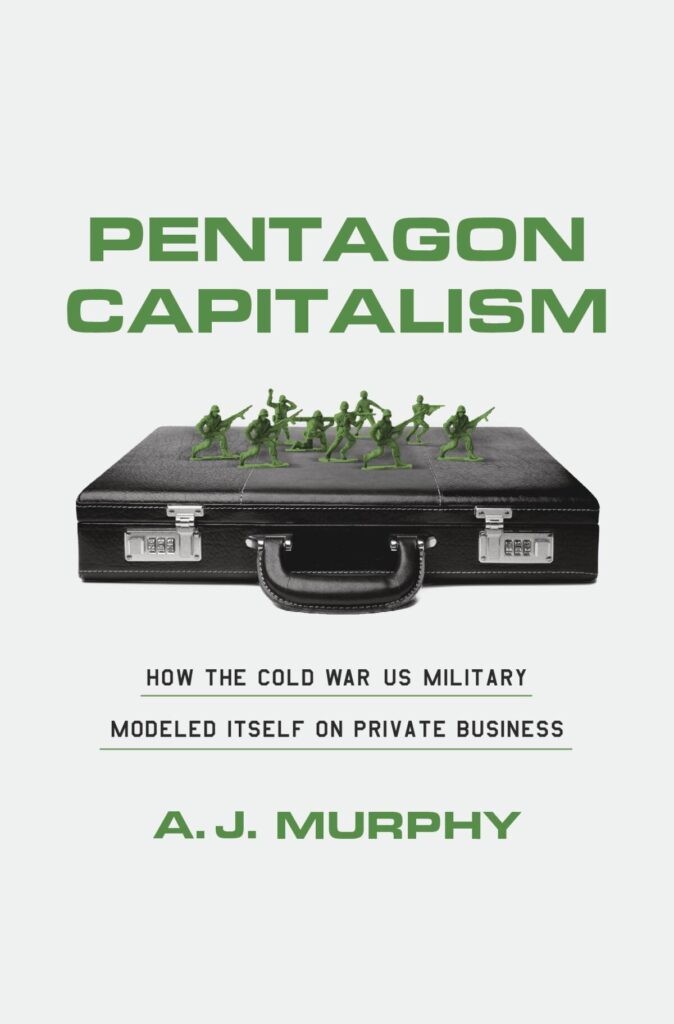
The following is an excerpt from Pentagon Capitalism: How the Cold War US Military Modeled Itself on Private Business by A. J. Murphy, now out at Harvard University Press.
While civilians often think of the military as a separate world of weapons, warfare, and boot camp, the reality of military life also involves a vast array of mundane economic and social activities. Apart from direct combat, the military engages in manufacturing, engineering, and industrial projects but also includes administrative bureaucracies that provide everyday services to millions of personnel and manage a vast real estate portfolio. With the beginning of World War II, the US military became—and remains—one of the biggest employers in the world, employing millions of people performing a wide array of jobs spread across many distant locations. Military workers were always ultimately preparing for war, but they did so by typing reports and memos, running hospitals and housing projects, processing millions of pay vouchers, manufacturing clothing, overseeing massive high-tech engineering projects, and doing laundry, among countless other tasks.
Surveying these myriad functions, many Cold War defense reformers came to believe that the military shared much in common with businesses, specifically a particular kind ascendant at the time: the large, multidivisional, industrial corporation with millions of dollars of investment and revenue, tens of thousands of employees organized in formal hierarchies, and multiple physical facilities performing a broad array of functions. The industrial corporation stood at the center of the economic landscape envisioned by a consolidating field of civilian management professionals who developed methods to control it, including time study, industrial psychology, executive development, profit center accounting, decentralization, statistical and economic analysis, and management by objectives. When defense reformers called on these civilian experts and their methods, they expressed their conviction in the fundamental similarity of the military establishment and corporate enterprise. Military officers, civilian career employees, consultants, and elected and appointed officials often drew comparisons between business and government more broadly to argue that the defense apparatus could and should be organized around business-derived mechanisms that maximized efficiency. In the estimate of one consultant in public administration, 90 percent of the characteristics of executive management in government were “identical” with private management.
At the same time, of course, the military was not a business—and could never succeed at becoming one. While the military oversaw an extensive assortment of banal activities, its ultimate purpose was to generate the capacity to destroy enemy capital, infrastructure, and combatants—a function it carried out at sites around the world, even in the absence of the ultimate frontal confrontation with the Soviet Union that planners braced for. Its raison d’être was to prepare for and prosecute wars, not to produce commodities for a market or generate returns for investors. Beyond its monopoly on organized violence, the military diverged from the businesses it emulated in that it was embedded within the state itself. Even as business-inspired reformers sought to impose commercial logics on the military, it remained a government organization subject to congressional control over the public funds—not private capital—that fueled its operations. As politicians and defense officials would sometimes acknowledge with disdain, a better comparison than business for such a massive, centralized military apparatus might have been an entire socialist planned economy. Indeed, scale supports this alternative analogy: Since World War II, annual US military spending has rivaled the national incomes of some of the world’s largest economies. By 1960, spending on the staggering array of resources and labor encompassed in the US defense apparatus approximated the GDP of the seventh-largest national economy in the world—placing it just behind China and ahead of Japan, Canada, Italy, and India.
So why did the military—a state institution that doesn’t produce a profit—nonetheless embrace techniques considered emblematic of American capitalism? Even in the absence of direct market forces, postwar military managers experienced downward pressure on their budgets imposed by Congress. Belt-tightening prompted a search for systems that would help officers control and conserve resources. Military management methods—reformers’ deliberate invocation of business and market models—were the medium through which they apprehended and controlled the defense establishment and represented it to the outside world. Defense leaders could have drawn on internal resources to address these challenges: the military possessed robust traditions of bureaucratic organization, communication, and hierarchies of authority that preceded the widespread adoption of the corporate form in industry. But by embracing business practices and managerial rhetoric, defense leaders spoke in a language that they hoped Congress—and a wider public—would find persuasive and politically palatable. Downplaying its resemblance to a centrally planned economy, reformers presented the military’s conversion to a corporate model as an appropriate and ideal way to harness the strengths of American enterprise in the war against global communism. Business efficiency and market virtue was the language through which even the most sensitive critics of government expenditure and bureaucratic power came to accept and support Cold War military expansion.
While defense reformers had cynical reasons for invoking business authority, their analogies nevertheless reveal genuine affinities between military and corporate operations—affinities that complicate dominant narratives of American economic history and the military’s place within it. Scholars recognize World War II as a pivotal break in the economic history of the US—one that allowed the country to manufacture itself out of a deep depression. The conflict endowed the federal government with a degree of economic oversight that exceeded the peacetime interventions of the New Deal, cast by friends and foes alike as revolutionary. While the economic significance of World War II is widely acknowledged, the military often recedes into the background of accounts of economic change in the decades that followed. It is a striking omission: While we recognize its profound impact on politics and culture, the military remains curiously sidelined in the mainstream economic narrative of the Cold War period. As the story goes, the two decades after World War II marked a “golden age of capitalism,” characterized by rapid economic growth, a marked decline in wealth inequality, and rising standards of living and consumer comforts for white Americans—all of which was underwritten by the stabilization of a bureaucratized industrial relations regime and the development of a limited but expanded welfare state. Around 1970, however, this order began to unravel, giving way to ascendant antistate, pro-business politics that defined the neoliberal era. Beginning in the 1970s, economic policy and practice pivoted toward social disinvestment (accompanied by intensified policing and mass incarceration), financialization, deregulation, offshoring, deindustrialization, and the rise of a service- and tech-oriented economy defined by increasingly casualized labor.
While the military is often relegated to the background in survey-level views of Cold War political economy, a new generation of scholarship has brought the military’s startling economic influence to the fore. By several measures, military investment was in fact one of the defining economic features of the Cold War era—accounting for 8 to 14 percent of the country’s GDP from 1950 to 1970. At home, the military functioned as a shadow welfare state for millions of servicemembers, employees, contractors, and their families, if often a grossly inadequate one. Military spending stimulated domestic industries and propped up local economies in defense-dependent regions. As a workplace, the military served as a key battleground for civil rights activism and antiracist struggles for economic justice. As this literature has made abundantly clear, the Cold War military had an immense impact on the political economy of the US—shaping industrialization, urban and suburban development, migration, and the making of nuclear and other militarized landscapes. The same could be said of the US military’s impact on countless places beyond the nation’s borders. Whether they call it “international empire,” “liberal empire,” “empire by invitation,” “market empire,” “informal empire,” “empire without colonies,” “pointillist empire,” or “hegemony,” most historians consider the years after World War II to be a new era of US imperial strategy that departed from past periods of direct colonial rule and Good Neighbor policy. Marked by American state and business power over other nations’ political and economic circumstances through means other than direct territorial control, this new order relied heavily on international agreements and defense treaties that conveyed financial, industrial, and technological aid, most famously the Marshall Plan. While these civilian development-oriented projects were a defining feature of the new imperialism, the military continued to play an important role in projecting US power, even when it wasn’t using its signature capabilities of physical force. Overseas, US military occupation reconfigured local economies in its guises as a civil government, infrastructure builder, and direct employer. Wherever the military expanded its empire of bases it also exported American culture, consumer goods, and people, who in turn brought increased demand for supplies and services. The presence of US bases generated local industrial development, racialized labor systems, and sex work economies that frequently inspired occupied populations to political revolt. As historian Paul Kramer has suggested, the US military’s influence in economic, institutional, political, and social terms since World War II has been so immense both domestically and internationally that “the search for a distinctly ‘civilian’ American capitalism is elusive, if not quixotic.”
These insights about the military’s central role in shaping economic life have yet to be fully integrated into the standard narrative of American capitalism in the Cold War period. Alongside the familiar labels of neoliberalism, financialization, and globalization, this period might just as fluently be called the age of Pentagon capitalism, to borrow the term economist Seymour Melman coined in 1970. Warning about the social costs of permanent war, Melman argued that so much of the country’s production and employment—its economic way of life—was controlled by the military that it constituted a form of state capitalism. Today, the defense establishment continues to command an enormous amount of our collective resources. Compared to other countries, the US spends by far the most on its military, representing an estimated 37 percent of the military spending of the entire world in 2024—more than China, Russia, and the next seven countries combined.
Scholarship on the military-industrial complex and military Keynesianism has continued to refine our understandings of the military’s economic power and its entanglement with political and corporate forces since World War II. Analyses of the military-industrial complex have documented the mutually beneficial alliance of defense contractors, the armed services, and policymakers in sustaining defense spending. Scholars of military Keynesianism have extended this critique, highlighting the macroeconomic role of military expenditure as a stabilizing force and a substitute for social investment. This study shifts attention to an underappreciated dimension of Pentagon capitalism: the way the military itself was modeled on the for-profit firm. To move beyond abstract discussions of scale and structure, this book opens the black box of the military, tracing its economic evolution through its often fraught attempts to remake itself in the image of business.
The corporatization of the military was both a symptom of and response to the contradictions of the Cold War. Aligning national defense with capitalist principles, the translation of military governance into a business idiom helped disarm accusations of creeping socialism. Management expertise greased the gears that kept the military-industrial complex running, while reconciling its very existence to a dominant political culture increasingly defined by opposition to big government. Identifying the military’s economic functions with business prowess and market efficiency appeased anxieties about the profusion of state-funded economic activity centered under its control. In this way, business management in the military served to both facilitate and hide an empire that spanned the military’s global network of bases and the myriad bureaucratic and private institutions that sustained it. Business expertise supported defense leaders seeking to sustain and expand the military sector of the state under the banner of American free enterprise, all in the name of keeping the world safe from socialism.
This article is excerpted from “Pentagon Capitalism: How the Cold War US Military Modeled Itself on Private Business,” by A.J. Murphy, published by Harvard University Press. Copyright © 2025 by the President and Fellows of Harvard College. Used by permission. All rights reserved.
Articles represent the opinions of their writers, not necessarily those of the University of Chicago, the Booth School of Business, or its faculty.
Subscribe here for ProMarket‘s weekly newsletter, Special Interest, to stay up to date on ProMarket‘s coverage of the political economy and other content from the Stigler Center.