



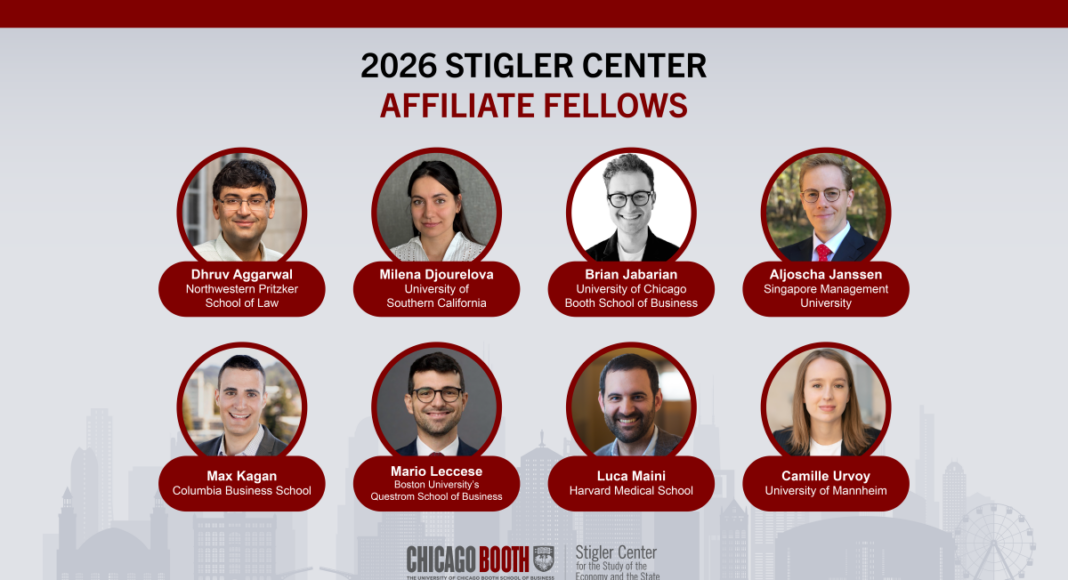

The 2026 Stigler Center Affiliate Fellows at the Stigler Center at Chicago Booth are a multidisciplinary group of economists, business scholars, lawyers, and political scientists.
The Stigler Center at Chicago Booth, of which ProMarket is a part, is happy to announce the fifth cohort of its Affiliate Fellows program.
This non-resident, 3-year appointment is designed to support the research of up-and-coming academics and strengthen and cultivate a community of scholars worldwide working on political economy, regulatory capture, and competitive markets. The Affiliate Fellows cohort is a multidisciplinary group, composed of economists, business scholars, lawyers, and political scientists from multiple different backgrounds and jurisdictions. The fellows will also contribute articles about their research to ProMarket.
Dhruv Aggarwal — Assistant Professor, Northwestern University
Dhruv Aggarwal is a law and finance scholar primarily interested in the economic analysis of corporate and securities law. His work has appeared or is forthcoming in law and social science journals, including the Journal of Financial Economics, the Journal of Law and Economics, the Journal of Law, Economics, and Organization, the Journal of Empirical Legal Studies, the Michigan Law Review, the Northwestern University Law Review, the Southern California Law Review, the Wisconsin Law Review, and the Harvard Business Law Review. He has presented his work at venues including the Harvard/Yale/Stanford Junior Faculty Forum and the annual meetings of the American Law and Economics Association and Conference on Empirical Legal Studies. Aggarwal received a BA in economics, PhD in financial economics, and JD from Yale University.
Milena Djourelova — Assistant Professor, University of Southern California

Milena Djourelova is an Assistant Professor of Economics at the University of Southern California. She is an applied microeconomist working on questions in political economy, with a focus on information, media, and elections. Her research examines how political communication and electoral institutions shape beliefs, policy preferences, and participation. Before joining USC, she was an Assistant Professor at Cornell University and a Postdoctoral Fellow at the University of Chicago. She received her PhD in Economics from Universitat Pompeu Fabra in 2021.
Brian Jabarian — Howard and Nancy Marks Fellow, University of Chicago School of Business

Brian is an economist studying how frontier AI systems automate an increasing share of real-world work, and the implications for markets, organizations, and welfare. His research combines large-scale experiments, simulations, and prediction markets in partnership with organizations deploying these systems.
Brian is currently the Howard and Nancy Marks Fellow at the University of Chicago Booth School of Business and will join Carnegie Mellon University as a tenure-track Assistant Professor in the Heinz College of Information Systems and Public Policy, and as a faculty member by courtesy in the School of Computer Science. He is also an inaugural Google AI & Economy Researcher. Brian received his Ph.D. in economics from the Paris School of Economics and his Ph.D. in philosophy from the Sorbonne, both in 2023. Brian’s work has been supported by Google, Schmidt Sciences, the Swiss National Science Foundation, Becker-Friedman Institute, The Kenneth C. Griffin Applied Economics Incubator and The Roman Family Center for Decision Research and Center for Applied AI at the University of Chicago Booth School of Business, and has been featured in The Wall Street Journal, NPR Planet Money, Bloomberg, Fast Company, Business Insider, Financial Times, and The Information.
Aljoscha Janssen — Assistant Professor, Singapore Management University
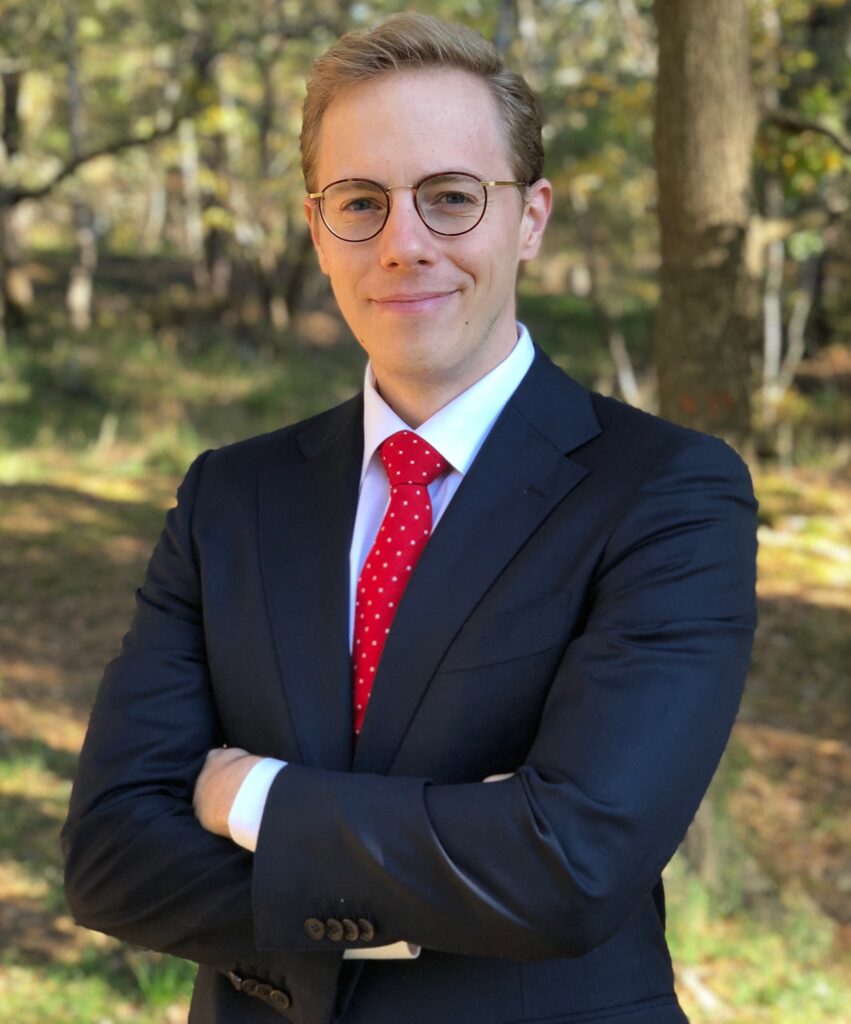
Aljoscha Janssen is an Assistant Professor of Economics at Singapore Management University and a Lee Kong Chian Fellow. His research lies at the intersection of industrial organization, quantitative marketing, and health economics. He studies how firms and consumers behave in markets shaped by pricing frictions, information problems, switching costs, advertising, and regulation. His work uses causal inference, structural econometrics, and machine learning to examine topics such as pharmaceutical pricing, generic substitution, retail pharmacies, opioid markets, shrinkflation, mutual fund search costs, alcohol consumption, and advertising. His research has been published in leading journals including the American Economic Review, The Economic Journal, Marketing Science, Journal of Industrial Economics, and Quantitative Marketing and Economics.
Max Kagan — Postdoctoral Research Scholar, Columbia Business School
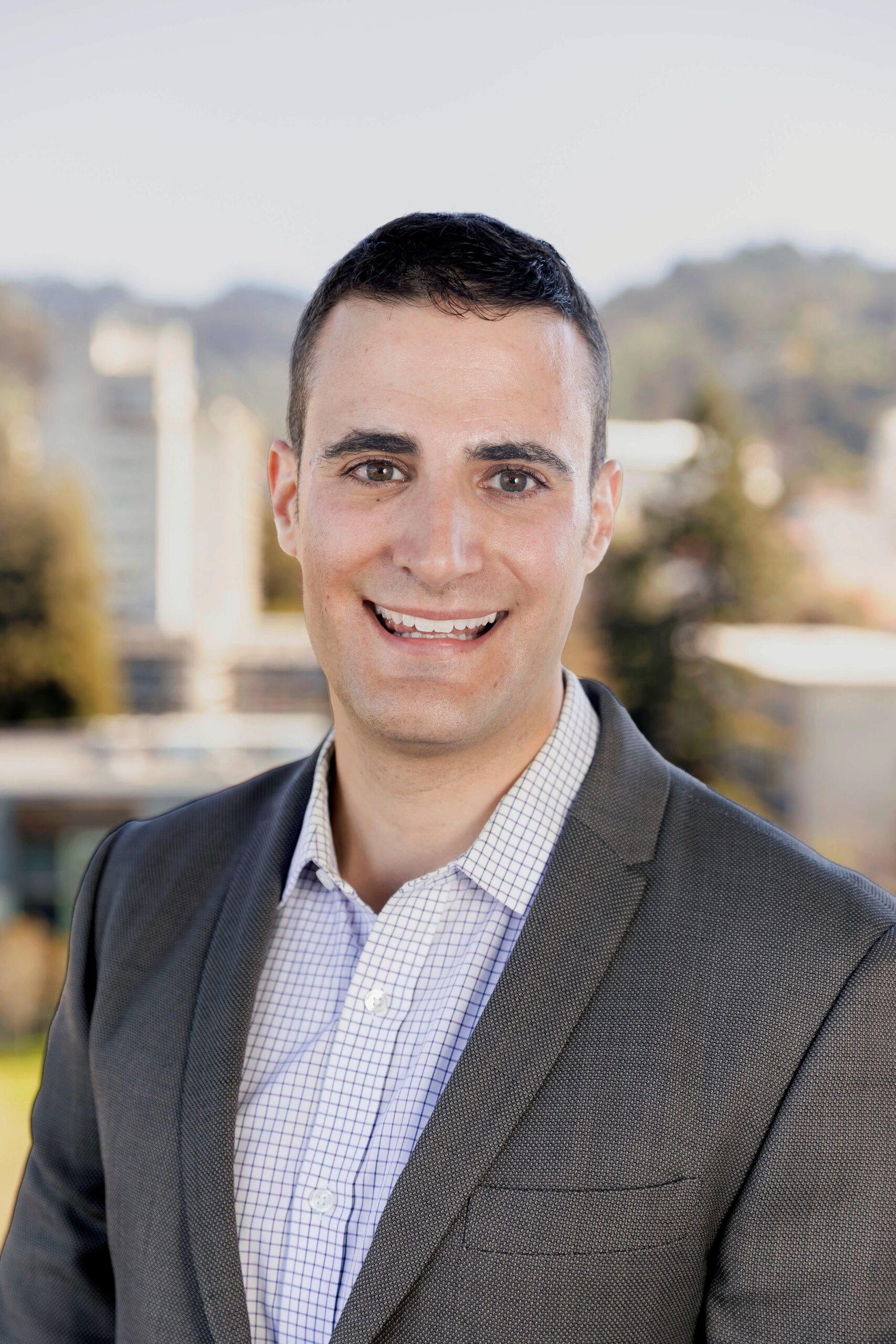
Max Kagan is a Postdoctoral Research Scholar in the Management Division at Columbia Business School. His research examines how political identities and behavior affect the careers of workers, the performance and strategic choices of organizations, and the overall well-being of democratic society. Topics his research has explored include the extent of partisan segregation in the workplace, how consumers and employees respond to firms that adopt public political stances, and how the firm-employee relationship shapes workers’ voting behavior. Max is a co-lead of Politics in the U.S. Workplace, an open data initiative that uses large-scale administrative records to better understand the effects of politics on work. His research has been published in journals including Organization Science and Nature Human Behaviour, and has been supported by the U.S. National Science Foundation. He received his PhD in Political Science from the University of California, Berkeley. Prior to graduate school, he worked at McKinsey & Company, in private equity, and at the Good Jobs Institute.
Mario Leccese — Assistant Professor, Boston University’s Questrom School of Business
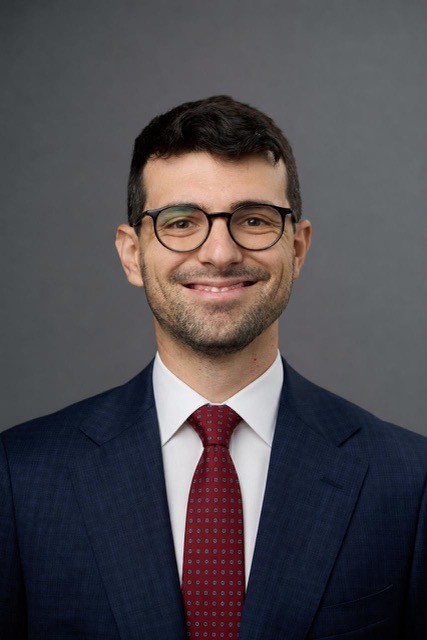
Mario Leccese is an Assistant Professor of Strategy and Innovation at Boston University’s Questrom School of Business. His research lies at the intersection of industrial organization and corporate strategy. He studies how mergers, acquisitions, and minority investments by incumbents and financial intermediaries affect market structure, innovation incentives, and entrepreneurial dynamics. A central focus of Mario’s work is understanding how antitrust and related public policies influence these outcomes, with particular attention to digital and technology-driven markets. Mario received his PhD in Economics from the University of Maryland in 2024. He also holds bachelor’s and master’s degrees in Economics from Bocconi University.
Luca Maini — Assistant Professor, Harvard Medical School
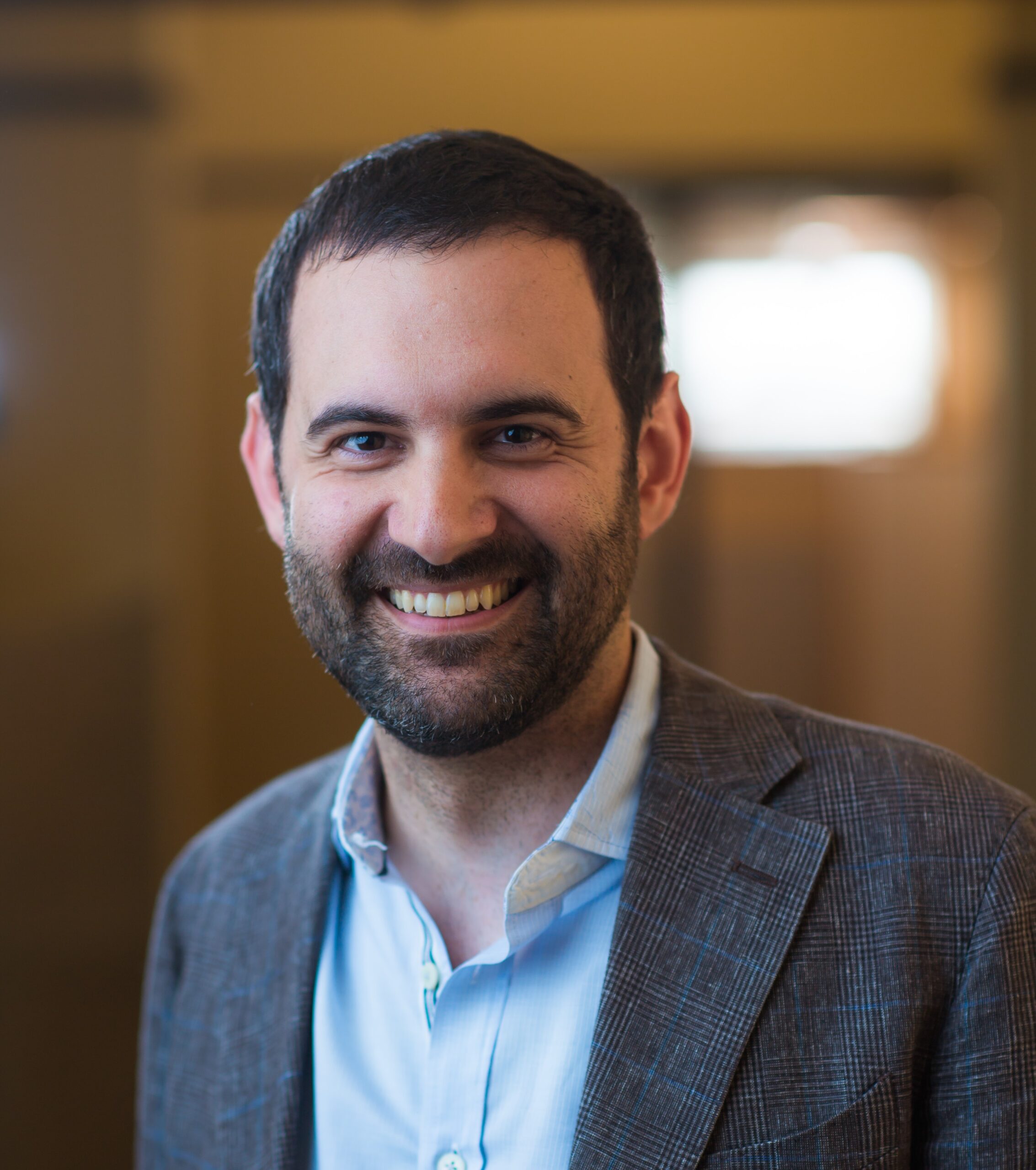
Luca Maini is an Assistant Professor in the Department of Health Care Policy at Harvard Medical School. His research examines competition and regulation in healthcare markets, with a particular focus on the pharmaceutical industry. Combining structural and reduced-form empirical methods with detailed industry data, Professor Maini studies how policies such as reference pricing, Medicaid rebate rules, and insurance benefit design shape drug prices, market entry, and patient access. His work also investigates the strategic behavior of pharmaceutical manufacturers, pharmacy benefit managers, and the consequences of mergers and acquisitions among drug makers.
Professor Maini’s research has been published in leading economics and health policy journals, including AEJ: Economic Policy, AEJ: Microeconomics, Management Science, NEJM, JAMA, and Health Affairs, and has been covered in outlets such as The Economist, Chicago Booth Review, and STAT News. His work has been supported by grants from the NIH, Arnold Ventures, the Washington Center for Equitable Growth, and the NIHCM Foundation. Before joining Harvard Medical School, Professor Maini was an Assistant Professor of Economics at the University of North Carolina at Chapel Hill. He received his PhD in Economics from Harvard University.
Camille Urvoy — Assistant Professor, University of Mannheim
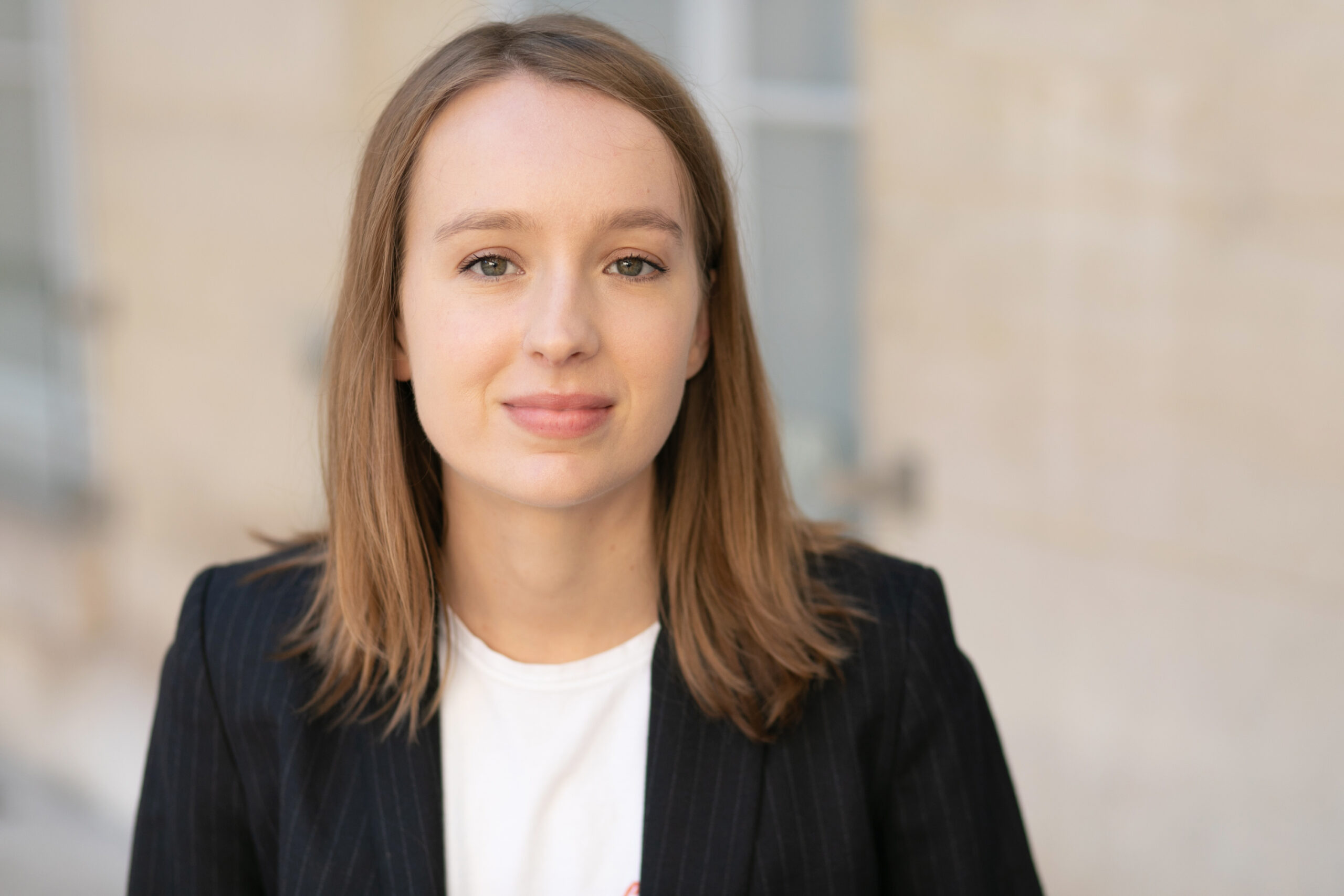
Camille Urvoy is an Assistant Professor of Economics at the University of Mannheim, where she holds a tenure-track position and leads a project on platform markets within the Collaborative Research Center TR 224 (EPoS). She is also a Research Network Affiliate at CESifo and a member of the CEPR Media Plurality Research Policy Network. She received her Ph.D. in Economics from Sciences Po Paris.
Her research lies at the intersection of media economics, political economy, and public economics. She studies how market structure, funding models, and ownership structure shape information production, editorial independence, and democratic accountability. Her work has been published in the American Economic Review and the Journal of Public Economics. Her current work examines how journalist mobility and ownership shocks drive media bias in French broadcasting, and considers the allocation of public funding to civil society organizations.
Subscribe here for ProMarket‘s weekly newsletter, Special Interest, to stay up to date on ProMarket‘s coverage of the political economy and other content from the Stigler Center.