








In new research, Jongkwan Lee, Giovanni Peri, and Hee-Seung Yang assess the effects of a sudden reduction in immigrant workers in South Korea. They find that migrant workers were not easily replaceable by natives, resulting in operational disruptions and firm closures.
Debates on immigration’s impact on local employment often start from a simple premise: if fewer immigrant workers enter a country, native workers should benefit. With fewer foreign workers competing for jobs, wages should rise and employment opportunities for natives should expand.
However, there are also reasons to think that immigration can benefit local employment. Many low-skilled manufacturing jobs are physically demanding and relatively low-paid. Firms often struggle to recruit native workers willing to take these positions. Immigration can fill necessary roles that native workers will not take.
Another reason is that production processes inside firms often rely on a division of labor between different types of workers. Migrant workers frequently perform routine and manual tasks that support the work of more experienced employees. Their presence allows native workers to focus on tasks such as machine operation, supervision, quality control, or coordination. In this case, immigration can support and complement native worker employment.
Our research investigates this debate by studying what happens to local employment and business trends when a supply of low-skilled migrant workers suddenly drops. Using a natural experiment created by COVID-19 border restrictions in South Korea, we examine how firms responded when their access to migrant labor abruptly declined. The evidence suggests that firms could not replace migrant workers with natives, so many struggled to maintain operations at the same level, causing them to reduce production and, in some cases, to shut down entirely.
These findings suggest that low-skilled migrant workers complement native workers in production. Removing or reducing them can disrupt production in ways that affect not only firms but also native workers and local economies.
A sudden stop in unskilled immigrant labor
South Korea provides an unusually clear setting to study the consequences of a significant and sudden decline in unskilled immigrant workers. Like many advanced economies, such as Japan, Italy, and Germany, Korea faces severe demographic decline. The country has one of the world’s lowest fertility rates and a rapidly aging population. As younger cohorts entering the labor market become smaller and more educated, fewer workers are willing to take physically demanding entry-level jobs in manufacturing, construction, and agriculture.
To address such low supply and difficulties in hiring, Korea introduced the Employment Permit System (EPS) in 2004. The program allows small and medium-sized firms to hire foreign workers for low-skilled jobs that are difficult to fill domestically. Over time, the program became an important source of labor in manufacturing and other sectors where local hiring proved difficult.
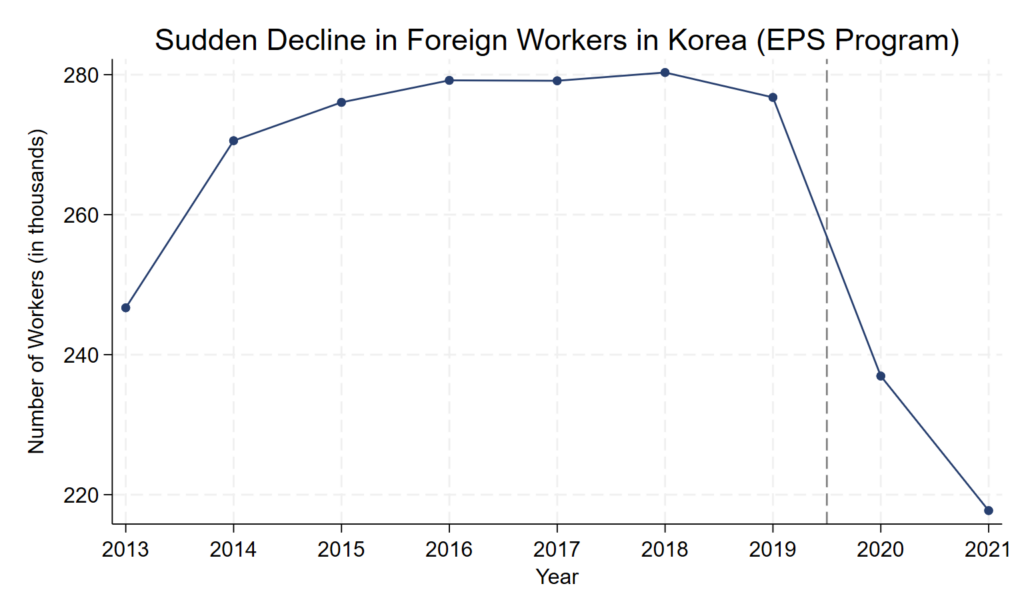
After several years of a stable supply of immigrant workers, the COVID-19 pandemic triggered an unexpected shock. Border restrictions sharply reduced the inflow of new migrant workers, while many existing workers returned home in 2020 and 2021. As a result, the number of EPS workers fell dramatically from about 276,000 in 2019 to 217,000 in 2021—a decline of roughly 22%. For many firms, this represented a sudden and severe labor supply shock.
Figure 1: Sudden decline in foreign workers in Korea (2013–2021)
Using detailed firm-level data, we compare firms that relied heavily on immigrant workers before the pandemic with firms that did not. A feature of the EPS helps identify these differences. The number of immigrant workers a firm was allowed to hire depended on its size. For instance, firms employing between 11 and 30 employees were only allowed at most 10 EPS. Hence this created a variation in how much firms relied on EPS workers, ranging from 90% of employees (for a firm with 11 employees) to 30% of them (for one with 30). We exploit this variation across similar firms to identify our effect.
Without replacement labor, firms had to adjust
When the supply of foreign workers collapsed, firms with greater exposure to immigrant labor experienced substantially worse outcomes. Production disruptions became more common. Firms reported delays in fulfilling orders and difficulties maintaining operations. Many firms reduced production or scaled back activity—for each percentage point decline in EPS employment, firms became 1.7 percent more likely to experience revenue drops and 1.3 percent more likely to experience production setbacks.
Since firms could not respond by hiring more native workers, they attempted to reorganize their existing workforce. Korean employees were often reassigned to perform lower-skill tasks previously done by migrant workers. This reallocation reduced productivity and led to occupational downgrading and wage reductions for native workers in affected firms. This resulted in a 0.6 percent decline in the average wage of Korean workers for each percentage point of EPS employment lost. As firms struggled to maintain operations with fewer workers, they adjusted internally rather than expanding domestic hiring.
Firm closures increased
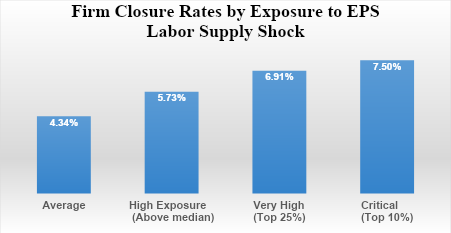
The consequences went beyond operational disruption. Firms that had relied more heavily on migrant labor were also significantly more likely to exit the market altogether. As shown in Figure 2, the probability of a firm closing escalated in direct proportion to its exposure to EPS. Compared to a baseline exit rate of 4.3%, the closure rate rose to 5.7% for firms in the top 50% of exposure. This impact was even more pronounced for highly dependent firms: those in the top 25% saw a closure rate of 6.9%—an increase of 60% relative to the baseline—while the most exposed firms (top 10%) reached 7.5%.
Figure 2: Firm Closure Rates by Exposure to EPS Labor Supply Shock
Firm closures carry broader economic consequences. When a small manufacturing firm shuts down, the effects ripple outward. Workers lose jobs, suppliers lose customers, and local economic activity declines. In our sample, firms that exited the market employed an average of three foreign workers and eight Korean workers, meaning that immigration restrictions may indirectly reduce employment opportunities for natives through firm shutdowns.
These dynamics highlight an often overlooked mechanism in immigration policy debates: restrictions on migrant labor can reduce labor demand for native workers if firms shrink or disappear. Our findings therefore support the idea that migrant and native workers frequently perform complementary roles rather than competing for identical jobs.
The broader policy lesson
Immigration policy debates often focus on wage competition between migrants and native workers. But the real economic effects of immigration operate through firms and production.
When migrant workers are an integral part of production, restricting their supply can disrupt entire firms. This suggests that policymakers should consider the firm-level consequences of sudden immigration restrictions. In sectors with declining labor supply and increasing difficulties in hiring, migrant workers can help sustain production and prevent firm closures. By supporting firm activity, migrant labor indirectly supports employment opportunities for native workers.
These dynamics are especially relevant for economies experiencing demographic decline. Countries such as South Korea, Japan, and many European economies face shrinking working-age populations. As younger cohorts become smaller, labor shortages in low-skilled sectors are likely to intensify. Immigration policies will therefore play an increasingly important role in sustaining economic activity.
When low-skilled immigration stops suddenly, firms do not simply hire natives instead. They shrink. They struggle. And sometimes they shut down. Understanding this dynamic is essential for designing immigration policies that account not only for labor markets but also for the functioning of firms and local economies.
Author’s Disclosure: The author reports no conflicts of interest. You can read our disclosure policy here.
Articles represent the opinions of their writers, not necessarily those of the University of Chicago, the Booth School of Business, or its faculty.
Subscribe here for ProMarket’s weekly newsletter, Special Interest, to stay up to date on ProMarket’s coverage of the political economy and other content from the Stigler Center.