







Julia Cagé, Caroline Le Pennec, and Elisa Mougin discuss their recent research on France’s 1995 ban on corporate contributions to political campaigns. The ban pushed candidates to de-emphasize local politics in favor of national issues and, in many cases, adopt more extreme rhetoric.
Campaign finance regulations vary across countries and time. While some countries limit political donations or impose transparency requirements, others do not. Similarly, corporate funders are banned in some countries but not in others. These regulations may have large consequences regarding the political power of firms and, more broadly, political inequality between citizens.
Yet, little is known regarding the consequences of a ban on political donations from private firms and, in particular, its impact on the way candidates campaign. In a recent paper, we study how bans on corporate donations impact the content that candidates communicate to voters during their campaigns. We find that political donations are indeed likely to affect the ideas that candidates highlight on the campaign trail and, consequently, the information that citizens receive before they vote.
In our study, we exploited an unanticipated ban on campaign contributions from firms (the ban included any legal entity that was not an individual or political party) passed in France in 1995. We collected novel data on the amount and source of the donations received by each candidate running for a seat in the French parliament in the 1993 and 1997 legislative elections. We then combined this data with information on their electoral performance and their campaign manifestos.
Estimating how the ban affects candidate rhetoric
In France, each candidate issues their own campaign manifesto before an election. These two-page documents are mailed to registered voters by the state and represent a systematic record of candidates’ communications with voters. They are distributed a few days before the election, after most fundraising and campaign spending have finished. To estimate the causal impact of banning firm donations on the content of candidates’ manifestos, we exploited the fact that candidates’ reliance on corporate donations varied significantly before the 1995 ban: in 1993, about one-third of all candidates received at least one donation from a firm, while two-thirds did not receive any. Therefore, we expect some candidates (i.e., those who previously relied on firm donations) to be more affected by the ban than others. However, we must take into account the fact that these candidates were not chosen randomly. For example, as shown in Figure 1, candidates from the two mainstream parties at the time—the left-wing Socialist Party and the conservative Republicans—received, on average, more corporate donations in 1993 than other parties’ candidates, and the share of firm donations as a percent of their total revenue was also higher. If we were to simply compare the 1997 manifestos of candidates depending on whether they previously relied on firm donations, we might thus just capture underlying party differences.
Figure 1: Total campaign revenue and firm donations across parties
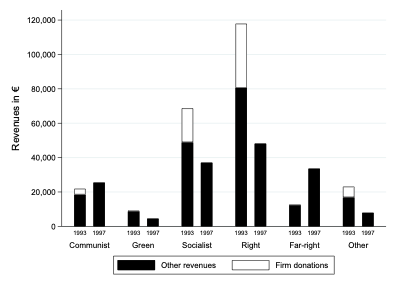
Notes: The figure shows the average amount in corporate and other donations that candidates received during the 1993 and 1997 legislative elections, depending on their party affiliation. The sample includes all candidates endorsed by one of the five main parties (Communist, Socialist, Green, right-wing and far-right), as well as candidates affiliated with smaller parties and independents. Revenue (which includes donations, party contributions, and personal financing) is in 2020 constant euros. N= 11,372.
To alleviate this concern, we used a difference-in-differences approach and compared the change in rhetoric—i.e. from before to after the ban—between candidates who previously received corporate donations and those who never did. This within-candidate approach ensured that the estimated effect of losing corporate donations is not confounded by the fact that candidates who received donations before the ban differed from those who did not in many ways, including their rhetorical choices. Our specification controlled for party-specific time trends, which account for any global change in political rhetoric over time within each party (e.g., the fact that the topics highlighted by all Socialist or right-wing candidates tend to change from one election to the next). Finally, we controlled for candidate characteristics that vary over time and that may correlate with changes in their campaign communication, such as incumbency and the other electoral mandates that they hold (e.g., being a mayor).
Predicted resource and composition effects
Theoretically, how should we expect the ban on corporate donations to affect political rhetoric? First, it may generate a “resource effect”: by reducing the funds available to candidates, the ban constitutes a negative financial shock that can directly affect the quality of their manifestos. Figure 2 displays the composition of total revenue in 1993 and 1997 for candidates who received corporate donations in 1993 and for those who did not. Naturally, the amount of corporate donations dropped to zero in 1997, leading to a substantial decrease in total revenue (donations as well as party contributions and personal financing) for candidates who received such donations in 1993.
Figure 2: Campaign revenue composition in 1993 and 1997
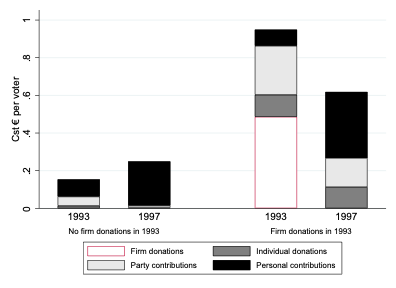
Notes: The figure shows the composition of campaign revenue, in 2020 constant euros per voter, for the candidates who received corporate donations in 1993 and for those who did not, in 1993 and 1997, separately. The sample includes all candidates who ran both in 1993 and 1997. N=2,832.
Although parliamentary candidates seek a national mandate, they must win in one of the 555 local constituencies, creating a tradeoff between tailoring their campaign to local voters and emphasizing national party politics. Under the resource effect hypothesis, the ban may shift this trade-off by limiting candidates’ ability to write a personalized manifesto tailored to their local electorate (which, arguably, requires more resources than simply copying and pasting the national platform of their endorsing party).
Furthermore, as the ban alters the sources of campaign revenue, a “composition effect” can also arise: candidates may adjust the content of their campaign communication to secure future contributions from their party or from their core ideological supporters rather than from firms. Under this hypothesis, this effect is also likely to push candidates away from local campaigning, since candidates now seek the support of donors whose primary concern is national politics—as opposed to small and local firm owners who may care more about the local economy and particularized benefits. Lastly, as candidates run a more national campaign, they may focus more on the traditional ideological divide between parties and use more partisan language as a result.
Our findings
We show that candidates who lost more corporate donations as a result of the ban indeed tended to de-emphasize their local presence in their manifestos. According to our estimates, a one-standard-deviation decrease in the amount of corporate donations received by a candidate decreased the relative prevalence of local references over national politics in their manifesto by 13% of a standard deviation. This effect was mainly driven by a decrease in the frequency of local references (e.g., the names of municipalities in the district), but we also observed an increase in the frequency of national references (e.g., national party organizations or prominent politicians). The impact of banning firm donations on the prevalence of local references was negative across all parties. However, we show that it was particularly strong for non-mainstream candidates endorsed by parties with limited resources. As losing corporate donations pushed these candidates away from local campaigning, it also led them to adopt a more extreme rhetoric (i.e., left-wing candidates shifted further to the left in their discourse, by using words predominantly used by left-wing parties more often, while right-wing candidates shifted further to the right by using more often words such as immigration, deportation, decadence, patriot etc.).
Next, we find that, as candidates moved away from local campaigning, they also tended to focus on policy topics that are less relevant to firms. Losing donations pushed candidates to drop local economic issues from their communication strategies (such as construction and amenities or retail) in favor of social issues or foreign policy. Once again, these effects were larger for candidates from non-mainstream parties, suggesting that the candidates whose chance of winning the election was virtually zero were those who responded the most to the ban. While changes in these politicians’ rhetoric may seem inconsequential, encouraging marginal candidates to adopt a more polarized discourse—and to focus on some policy topics more than others—may have pushed their mainstream opponents to adapt their own discourse, with possible longer-term effects on political rhetoric more broadly.
Finally, besides the negative effect on the prevalence of local references, we do not find any significant effect of the ban on alternative measures of manifesto quality or personalization (such as its length, the frequency of candidates’ references to themselves, or the diversity of policy topics covered). In other words, our findings point to a composition rather than a resource effect: losing access to corporate donations pushed candidates who had relied on them to raise money from other sources and adapt their campaign rhetoric accordingly. This funding constraint was particularly binding for candidates from non-mainstream parties, whose funding opportunities were limited, and who responded by shifting their discourse to secure the support and donations from more extreme voters. These candidates may also have felt freer to run a more polarized campaign, closer to their own ideological preferences, when they were forced to rely on personal funds rather than contributions from firms.
Conclusion
Overall, our findings shed new light on the influence of money in politics and the role of campaign finance regulations, providing evidence that campaign contributions and the identity of the donors affect the issues that candidates focus on during the electoral season. Hence, not only do campaign expenditures affect electoral outcomes directly, but campaign contributions and their sources influence voters through their indirect effect on politicians’ strategies. Financial contributions shape the content of campaign advertising distributed during the electoral season and, ultimately, the information voters use to form their voting decisions. While our results draw from French data and a policy reform enacted in the 1990s, they remain relevant today and hold lessons for other countries.
Authors’ Disclosures: The authors report no conflicts of interest. You can read our disclosure policy here.
Articles represent the opinions of their writers, not necessarily those of the University of Chicago, the Booth School of Business, or its faculty.
Subscribe here for ProMarket’s weekly newsletter, Special Interest, to stay up to date on ProMarket’s coverage of the political economy and other content from the Stigler Center.