






Responding to Mark Lemley and Jacob Noti-Victor, Shishene Jing argues that licensing deals struck by incumbent artificial intelligence firms with content owners will not disadvantage smaller AI rivals. Even if such deals establish a legal precedent requiring licenses, content owners have little incentive to actually sue small, cash-poor AI startups, making the precedent toothless in practice.
Mark Lemley and Jacob Noti-Victor’s “anticompetitive acquiescence” thesis is an elegant piece of theory, and it identifies a real puzzle: Why would OpenAI, Amazon, and other large artificial intelligence developers pay content owners like the New York Times and Reddit for data to train their models when their use of the data may be protected by the fair use doctrine that exempts some uses of copyrighted material from copyright infringement? Why would these AI companies make these deals even in the absence of pending lawsuits? Lemley and Noti-Victor’s answer is that these AI market incumbents are willing to absorb licensing costs because doing so manufactures a legal standard that will be too expensive for smaller, capital-constrained startups to pay. The precedent of paying to license data will keep startups from entering or surviving the market. It’s an intuitive answer and fits a long tradition in antitrust scholarship exploring how incumbent firms raise rivals’ costs to reduce competition.
But this mechanism depends on the unstated and, upon inspection, flawed premise that the legal change incumbents allegedly manufacture will actually be enforced against the small rivals it is meant to burden. That premise treats precedent as self-executing. It isn’t. A stricter licensing precedent only bites a small AI company if someone sues that company, wins, and collects the monetary compensation.
The actors with standing to bring that suit (media companies, publishers, record labels, stock-photo agencies) are themselves rational actors facing the same cost-benefit arithmetic that governs every other area of litigation. When you run that arithmetic, it points overwhelmingly toward leaving small AI firms alone for the same reason Lemley and Noti-Victor’s thesis makes sense in the first place: they can’t afford to pay up. The “established licensing market” precedent Lemley and Noti-Victor worry about is a fair concern, but its enforcement is asymmetric in a way their model doesn’t account for. That asymmetry has well-documented analogues in other regulatory regimes, where rules nominally bind everyone but litigation in practice extracts payouts only from the larger players who can actually be made to pay up.
Cost-benefit analysis of litigation
Copyright suits over AI training data are not cheap, templated affairs. They require understanding training corpora and model weights, expert testimony on output similarity and memorization, and often years of multidistrict litigation before any liability determination. These costs are largely independent of the size of the AI company: the defendant. It costs roughly the same to depose engineers and retain a machine-learning expert whether the defendant is a $100 billion frontier lab or a four-person startup. What does vary enormously across defendants is the payoff the plaintiff can expect to collect if they win: the size of any judgment or settlement that’s actually collectible, the deterrence and reputational value of the case, and the press cycle it generates.
Most small AI companies are exactly the kind of defendant that cannot afford large damages. They are frequently pre-revenue, funded by venture rounds that get spent on compute rather than sitting as a war chest, uninsured against intellectual property claims, and structured (often deliberately) so that a catastrophic judgment simply triggers a wind-down rather than a payout. Suing such a company produces a favorable precedent on paper and approximately nothing in recoverable damages. A rational media company’s general counsel will not authorize years of expensive litigation against a target that, even in total victory, yields a bankruptcy filing instead of a check. This is a point Steven Shavell makes in his work exploring why potential plaintiffs under-sue potential defendants even when the social costs of the harms justify litigation.
The optics problem cuts the same direction as the economics
In addition to legal expenses, there’s a second, less-discussed reputational and political cost of litigation for content owners in these cases. Litigation against OpenAI, Google, Microsoft, or Meta lets a plaintiff tell a clean, sympathetic story: Goliath stole our journalism to build a trillion-dollar product, and we’re making them pay. That story is good for subscriptions, good for advertisers, and good for the institution’s standing as a defender of the press. In contrast, suing a small AI startup founded by a handful of engineers reads as a legacy media conglomerate strangling a scrappy competitor in its cradle, and it is the kind of headline that generates exactly the wrong kind of attention for a plaintiff that needs public sympathy to win its broader policy fight. Large newspapers have previously incurred public backlash for suing bloggers and website operators who republished excerpts of their work, for example.
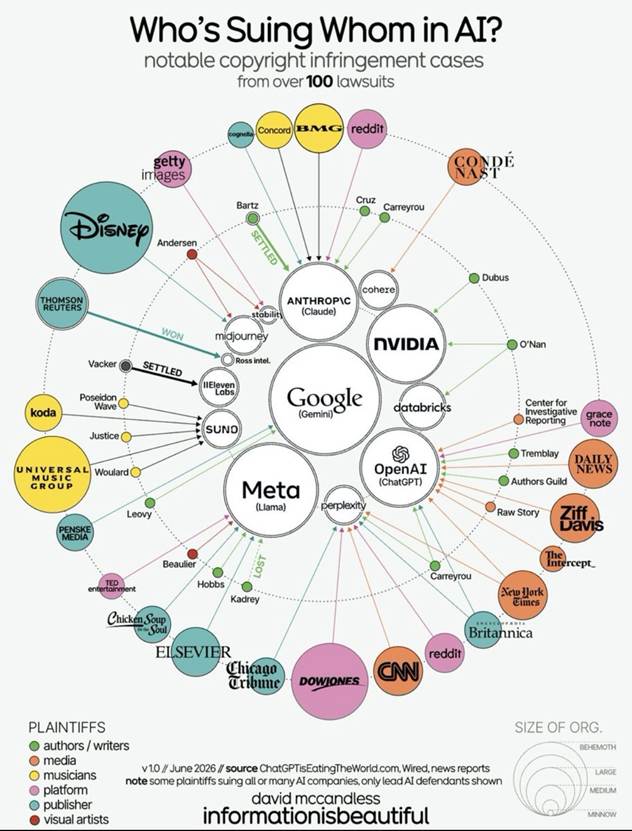
The empirical record bears this out. The content-owner plaintiffs’ own list of generative-AI copyright suits names defendants like OpenAI, Microsoft, Meta, Google, Anthropic, Stability AI, Midjourney, and Suno/Udio. These are, with minor exceptions, almost exclusively well-capitalized firms backed by billions in venture or corporate capital or well-established tech giants themselves. Despite the proliferation of small AI startups—arguably a much larger population of potential copyright infringers in raw numbers—few of the major plaintiffs have devoted resources to suing them. If “anticompetitive acquiescence” worked the way Lemley and Noti-Victor’s theory predicts, we’d expect to see more of these opportunistic suits against smaller players designed to lock in the unfavorable precedent broadly. Instead, the docket looks exactly like what rational litigation-cost allocation predicts: plaintiffs sue mostly the targets who can pay.
Modern analogues to AI copyright litigation
This pattern of formal rules being applied specifically against deep-pocketed defendants recurs across regulatory domains. There is a precedent contradicting anticompetitive acquiescence that suggests AI copyright will be no exception.
Patent assertion entities sue the firms that can pay. Empirical research on non-practicing entities (NPEs), often known as patent trolls (individuals or firms which own patents but don’t produce or sell the protected products), found that NPEs disproportionately target cash-rich firms in litigation. This pattern holds even when the cash is unrelated to the alleged infringement. A one-standard-deviation increase in a company’s cash holdings roughly doubles its odds of being sued.
The interesting wrinkle is the counterexample that proves the rule: a different breed of patent troll does target small businesses en masse, sending hundreds or thousands of cheap, templated demand letters and settling for a few thousand dollars each. But that model only works because the marginal cost of generating a new demand letter is close to zero. Copyright suits against startups for using content to train their models look nothing like that: they’re individually expensive, discovery-heavy, and not susceptible to a mass-demand-letter strategy, at least not yet. Where per-target litigation cost is low, small defendants get swept in. Where it’s high, plaintiffs cluster on defendants who can pay. AI copyright litigation is squarely the second kind.
Wage-and-hour collective actions chase the chains, not the corner stores.Attorneys defending workers’ rights to collective actions under the Fair Labor Standards Act overwhelmingly target large multi-location employers like national retailers, restaurant chains, and logistics companies. This is because collective and class lawsuits generate value through aggregation: thousands of similarly situated workers across many locations multiply a thin per-worker claim into a recovery worth the litigation investment. A small employer with three locations committing the exact same violation as a national chain is a far less attractive target.
Securities class actions follow market capitalization. Law firms will sue public companies for disclosure failures and other securities-law transgressions on behalf of a class of shareholders. The plaintiffs’ lawyers build compensation schemes around damages models tied to stock-price drops and market capitalization. Large-cap stock issuers generate damages estimates large enough to support a contingency-fee case. Small and micro-cap issuers committing comparable disclosure violations are chronically under-litigated, not because regulators or plaintiffs’ firms think the conduct is less wrongful, but because the same fixed litigation costs can’t be justified against a smaller damages pool.
In each of these legal regimes, the formal rule is general, but the realized enforcement is concentrated on defendants selected by capacity to pay, not by culpability. That mechanism governs AI copyright exposure, too, and it cuts directly against the licensing-market precedent Lemley and Noti-Victor worry about..
The strongest version of the counterargument, and why it still doesn’t rescue the theory
A fair counter is that small AI firms don’t need to actually be sued to be harmed; the mere existence of a “licensing market” finding in court raises the perceived litigation risk that venture investors price into funding decisions, producing a chilling effect on entry. This concern deserves to be taken seriously rather than waved away.
But it doesn’t rescue the anticompetitive acquiescence mechanism for two reasons. First, if sophisticated investors and counsel understand that media plaintiffs systematically decline to sue low-asset defendants, then the chilling effect should be smaller than the theory assumes. Second, and more importantly, to the extent any doctrinal precedent on the existence of a licensing market actually gets set, it will be set in litigation against large defendants, because—per everything above—those are the only suits that get litigated to a judgment. Litigation against small startups end in bankruptcy, not compensation. Nobody wants to be the plaintiff whose marquee “established market” precedent was set against a company that folded mid-litigation and generated press coverage about predatory IP enforcement.
The asymmetry between suing large and small AI companies described here is contingent on the current cost structure of AI copyright enforcement, which is expensive and bespoke. If rightsholders organize into collective licensing bodies, which several music and publishing groups are already moving toward, the marginal cost of enforcement against any given target drops sharply. This is because a collective entity can issue standardized licenses and pursue standardized infringement claims at scale, much like the patent trolls described above. At that point, the economics shift, and small AI firms could become exactly the kind of low-cost, high-volume target that a collective licensor finds worth pursuing. That’s a real risk, but it’s a different risk than incumbents’ deliberate cost-raising strategy: it’s a function of whether enforcement infrastructure scales down, not whether OpenAI signs a deal with The New York Times.
None of this should be read as a claim that small AI entrants face no structural disadvantage relative to incumbents, only that the disadvantage isn’t the one the acquiescence theory identifies. The more durable competitive concern is input foreclosure through exclusivity: licensing deals that grant an incumbent the only right to train on a given corpus, locking out everyone else regardless of what fair use ultimately holds. That mechanism is the kind of vertical foreclosure that antitrust law already has tools to scrutinize, and where antitrust should focus its attention.
Author disclosure: The author investigated the artificial intelligence industry while working for the Federal Trade Commission. While at the FTC, she also helped investigate other Big Tech companies, the specifics of which are not public. In private practice, she has done work on the AI and adjacent markets. None of this work related to copyright. You can read our disclosure policy here.
Articles represent the opinions of their writers, not necessarily those of the University of Chicago, the Booth School of Business, or its faculty.
Subscribe here for ProMarket’s weekly newsletter, Special Interest, to stay up to date on ProMarket’s coverage of the political economy and other content from the Stigler Center.