






Meta prevailed in its monopoly case against the Federal Trade Commission by showing that the FTC’s market definition of personal social media was too narrow. However, Meta’s argument—and Judge James Boasberg’s ruling—rested on a flawed empirical assumption that confuses how users divert their time to other activities when no longer able to use a Meta platform with true product substitution, writes Clement Mulock.
“[T]he single best evidence of what consumers consider alternatives to Meta’s apps” was how Judge James Boasberg, presiding in FTC v. Meta, characterized the field experiments presented by Meta’s expert witnesses.In a research brief on their findings, published after the trial, the economists that won the day for Meta celebrated the significance of this moment, noting that it “marked the first time field experiments played a central role in a major federal antitrust case.”
In FTC v. Meta, the Federal Trade Commission alleged that Meta had monopoly power in the market for personal social networking and, since 2012, had unlawfully maintained that market power through anticompetitive acquisitions of actual and potential competitors (Instagram and WhatsApp). The case was allowed to proceed to trial, where a battle of economists commenced. Drawing on experiments, company data, “hot documents,” and internal communications, economists for the FTC and Meta clashed over relevant market definitions. A narrow market definition would favor the FTC’s argument that Meta had monopolized the market. A more expansive definition would suggest the market still enjoyed plenty of competition.
Key to Meta’s arguments were several experiments purporting to demonstrate that applications outside the FTC’s market definition (composed of Facebook, Instagram, Snapchat, and some smaller applications like MeWe) were substitutes for Facebook and Instagram. These experiments examined what happened when users’ access to various applications was restricted. For example, one study monitored the activities of 6,000 participants, divided into a control and treatment group. The control group was paid merely to stay in the experiment, allocating their time across online platforms as they normally would, while the treatment group was paid $4 per hour to reduce their usage of Instagram and Facebook. The study found that participants in the treatment group diverted more of their time to platforms like TikTok, YouTube, and browsing Google Chrome than to Snapchat, undercutting the FTC’s market definition of with whom Meta was competing.
Time displacement evidence convinced Boasberg that Meta was not a monopolist. Meta’s experiments told “a consistent and unmistakable story…When consumers cannot use Facebook and Instagram, they turn first to TikTok and YouTube…When they cannot use TikTok or YouTube, they turn to Facebook and Instagram.” In the end, the results “left the Court with no doubt that TikTok and YouTube compete with Meta’s apps.”
While this was the first significant use of such experiments in a federal antitrust trial, there was already a growing number of similar time displacement studies in the academic literature. In one study, Guy Aridor attempted to measure substitution patterns by installing software on experimental participants’ phones that restricted access to YouTube and Instagram and monitored time spent on different mobile applications over a five-week period. Aridor found that while participants spent more of their time on Facebook, TikTok was the next largest substitute, with small diversions to Snapchat. In a different study, Saharsh Agarwal and Uttara Ananthakrishnan found that TikTok adoption led to declines in the amount of time spent on “traditional” social media platforms—those built around a user’s existing social network of friends and family—like Facebook and Instagram. In yet another study, Avinash Collis and Felix Eggers measured changes in time spent on digital activities when access to Facebook, Instagram, and Snapchat was restricted, finding that users replaced time spent on social media with time spent on instant messaging applications, like WhatsApp.
In January 2026, the economists responsible for Meta’s field experiments added to this body of literature, publishing a research brief and working paper in which they touted their winning evidence. They theorized that the cost of using platforms like Facebook and Instagram, which are nominally free, consists of the opportunity cost of the users’ time: “Time spent on Facebook isn’t simply time that would’ve been spent on Snapchat, it’s time that would’ve been spent doing literally anything else.” The results, they argued, demonstrated that “Facebook and Instagram compete broadly for user time,” vying with other time intensive activities and “not just with social media apps like Snapchat, but with YouTube, gaming, web browsing, and even sleep.” Their “clear message for regulators evaluating future tech mergers: account for time-based competition, not just functional similarity.”
The problem with time displacement evidence
Time displacement evidence is not without criticism, and in fact it can be highly misleading. It is subject to several familiar criticisms often leveled at evidence based on the cross-elasticity of demand, or how changes in the price of one good change demand for another. First, several of Meta’s experiments assessed substitution based on infinite price increases, when small increases were the proper test. The proper way to assess if a firm has market power is to see if they could profitably impose a small but significant increase in price over a sustained period. If a firm can increase prices by 5-10%, for example, without causing enough consumers to switch to a substitute product, the firm has market power. In stark contrast, several of Meta’s experiments examined whether consumers substituted Meta with another application during a total outage or ban of an online platform—for example, Meta’s 2021 global outage and India’s 2020 ban of TikTok. An outage or ban is akin to an infinite price increase because no matter how much the consumer is willing to pay, they cannot access the product. Thus, when Meta showed that consumers substituted Facebook with TikTok during the 2021 Meta outage, for example, that does not foreclose the possibility that Meta could profitably raise prices by a small, medium, or large amount.
Second, even if taken as evidence of substitutability, the time displacement evidence only showed substitution at the prevailing price (the advertising load or how many advertisements Meta shows its platforms’ users). In other words, Meta’s evidence only considers how consumers switch from it to platforms like TikTok or YouTube at the advertising load Meta currently imposes on consumers. This ignores the possibility that Meta may already be charging monopoly prices by imposing an advertising load well above what a competitive market would allow.
Third, the time displacement experiments define markets so broadly as to render them useless as analytical tools for assessing market power. It is hard to argue that sleep, let alone general web browsing, operates in the same market as Facebook and Instagram even if Meta platform users may sleep more when cut off from its applications. Indeed, this is the fundamental criticism of time displacement evidence and the core fallacy that pervades Meta’s experiments and the related academic literature: Equating time displacement with substitutability is not useful when these things may be completely unrelated. Merely because a new product displaces time spent on an older product does not mean that the consumer necessarily views the two products as substitutes in competition with one another. While there is a finite stock of time in a day, and thus every decision to spend time on a product involves a choice to forego time spent on another product, that does not make the products substitutes. Further, there are certain types of products for which there is a steady baseline of consumption. When this is the case, the firm producing that product can still exercise market power even as a new product displaces some of the time the consumer had previously spent on their product.
For example, imagine an exercise enthusiast who pays for a gym membership and works out for two hours each day. They adopt a puppy that must be taken out frequently. Thus, they now can only spend one hour at the gym each day before taking their puppy outside. Time spent with the puppy has displaced half the time this person spent at the gym. Does this make puppies and gyms substitutes? Of course not, because they are not responsive to price changes in one another. The person with a baseline exercise level is not going to further cut their gym time because of how much they enjoy their puppy. Nor will they spend more time with their puppy if the gym raises its membership fee. The puppy will not discipline the gym’s ability to raise prices.
Similarly, Meta’s experiments conflated displacement of time with substitution. When Instagram users reduced their time on Instagram and began to spend more time on TikTok, for example, Meta construed this decision as reflecting the consumers’ perception that Instagram and TikTok were substitutes for one another. The fact is, this reallocation of time from Instagram to TikTok does not necessarily show that they are substitutes.
How to measure the relevant market
The evidence produced at the trial demonstrated that Meta offers a unique product feature in the form of content from friends and family (namely posts, photos, and stories). While users seeking video content can switch between Facebook and Instagram Reels, TikTok, and YouTube, users seeking content from friends and family lack alternatives to Meta’s platforms. Thus, Meta exercises market power over users who want to see content from their friends and family but cannot switch to an alternative when Meta charges them supracompetitive prices in the form of ads. Any competition between Meta, TikTok, and YouTube over video content will not change the fact that when users want to see content from people they know, they have no real alternative but to return to Facebook and Instagram and endure whatever advertising load Meta decides to impose upon them.
Perhaps the best indicator that Meta offers something unique was the fact that the data proffered by their own economists showed that when access to Facebook and Instagram was restricted, the most common response by users was to put their phone away. In Meta’s experiments, the greatest diversion of user time from Facebook and Instagram was to off-device activity. Time spent on off-device activity was significantly higher than any other digital application. To show that TikTok and YouTube were the next closest substitutes says very little when the closest substitute was spending time doing basically anything else (going for a walk, watching television, staring at the ceiling).
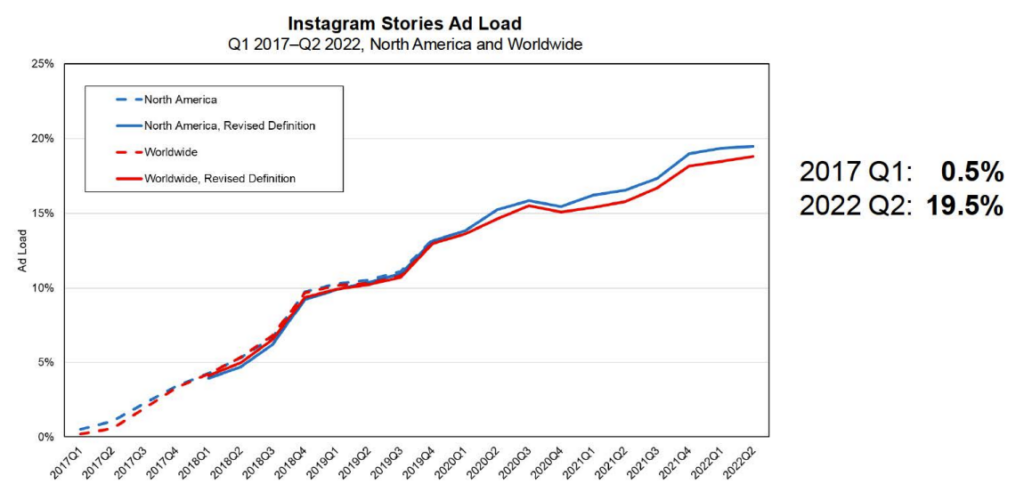
Assessing time displacement across online platforms is misleading when platforms like Facebook and Instagram offer multiple features. While Meta competes vigorously with TikTok and YouTube on video content, TikTok (much less YouTube) offers no real competition for Meta on friends and family content. Users—despite spending a greater percentage of their time on video content—continue to engage with a baseline level of friends and family content. Less than 1% of Facebook users and around 5% of Instagram users do not use feed posts and stories, which is content from creators who are not personally connected to the user (these are “Reels only” users). Put another way, 99% of Facebook users and roughly 95% of Instagram users spend some time looking at the platform verticals that contain friends and family content. With a captive audience for friends and family content, Meta has steadily and profitably increased advertising loads on its platforms. On Instagram stories, for example, advertising load in 2017 Q1 was 0.5%. By 2022 Q2, it had ballooned to 19.5%.
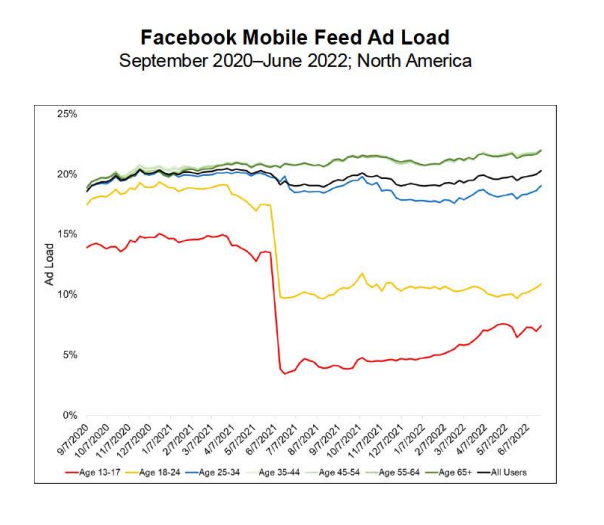
The evidence strongly suggests that Meta is aware that users continue to seek friends and family content, even as such content occupies less time as a proportion of their online activity. As the sole meaningful provider of such content, Meta engaged in price discrimination, charging higher prices—in the form of higher advertising loads—for groups that were most likely to use Facebook and Instagram for friends and family content. Recognizing that younger users are more sensitive to ads, Meta varies ad load by age. Documents elicited during discovery showed that Meta knew that tenured users were most likely to use its services for friends and family content. Correspondingly, ad load increases with each additional year that an account is active.
It is true that people now spend more time online watching videos on TikTok and YouTube and less time looking at friends and family content on Meta’s platforms. But this time displacement has not inhibited Meta’s ability to charge supracompetitive prices. Meta retains market power over friends and family content and charges monopoly prices to users seeking to access such content on its platforms. This suggests that the FTC’s personal social networking market definition was essentially correct and that the Court’s analysis in FTC v. Meta was led astray by the displacement-substitution fallacy.
Author’s Disclosure: The author declares that there are no relevant financial or non-financial interests to disclose regarding the content of this report. You can read our disclosure policy here.
Articles represent the opinions of their writers, not necessarily those of the University of Chicago, the Booth School of Business, or its faculty.
Subscribe here for ProMarket’s weekly newsletter, Special Interest, to stay up to date on ProMarket’s coverage of the political economy and other content from the Stigler Center.