




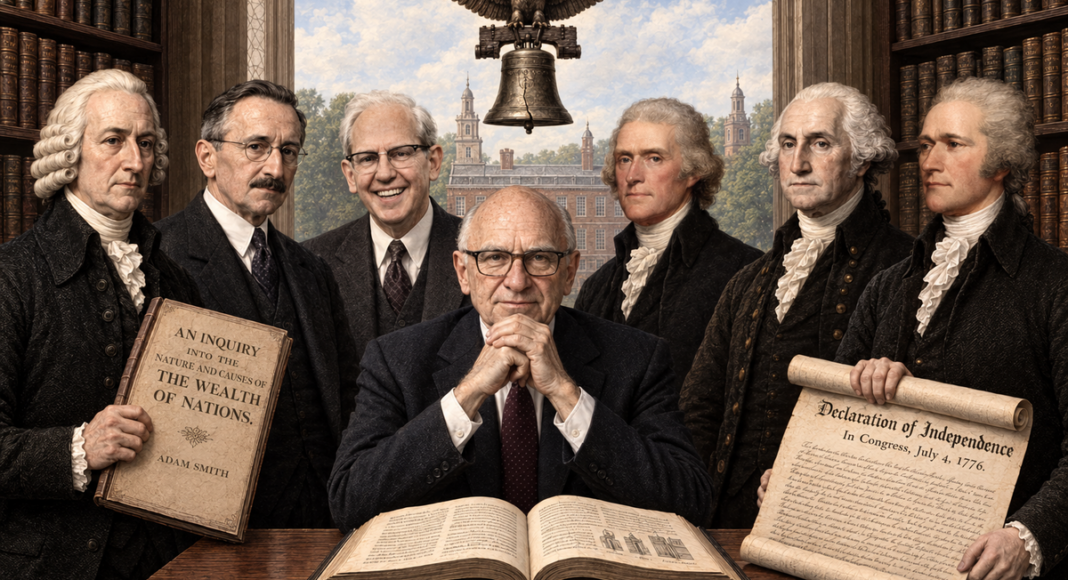


The connections between Adam Smith’s Wealth of Nations and Theory of Moral Sentiments reveal a much more complicated understanding of how markets work than developed in the common interpretation by the Chicago School of economics or that of its critics. Smith’s political economy based on commerce, sympathy, and competition produced social good but only when complemented and checked by other forces. When not checked, Smith worried about “factions” that produce bad outcomes, write Sandra J. Peart and David M. Levy.
Editor’s note: This year celebrates the 250th anniversaries of the American Declaration of Independence and the publication of Adam Smith’s Wealth of Nations. It is also 50 years since Milton Friedman won the Nobel Prize in economics. This article is part of a symposium revisiting the ideas of freedom and political economy expounded by the American revolutionaries, Adam Smith, and the Chicago School of economics, and how they connect to contemporary concerns about capitalism and democracy. You can read the rest of the articles here as they are published, with contributions from Peter Boettke, David Mitch, Robert Van Horn, Sandra Peart & David Levy, Maha Rafi Atal, Edward Nik-Khah, and Richard John. We welcome responses, which you can send to promarket@chicagobooth.edu.
For centuries, the standard account of economics held that Adam Smith’s Wealth of Nations is independent of his Theory of Moral Sentiments. This view of Smith’s economics was promoted by the University of Chicago’s eminent scholar, Jacob Viner (1927), who held there was an “Adam Smith Problem,” whereby the two works are incommensurate. Economists in the twentieth century paid attention to the Smith of the Wealth of Nations but not his Theory of Moral Sentiments. They regarded Smith as an individualist who taught about the benefits of unfettered trade, while his views on moral sentiments were unimportant to economic decisions.
At least in part because of a rich and growing experimental literature that demonstrates a significant gap between predicted and actual economic behavior, a more capacious view of Smithian economics has emerged. This new interpretation regards Smith as a moral theorist who defended economic activity as the primary means by which people acquire a sense of reciprocity and virtue. It is now widely recognized that there exists a connection between Theory of Moral Sentiments and The Wealth of Nations, one thatoccurs via sympathy and the human desire to earn, and deserve, praise.
What remains less appreciated, however, is that Smith also saw a dark side to sympathy. For Smith, sympathy is first partial and the desire to be praiseworthy can be warped by the desire for within-group—or faction—approval. Smith saw that factions collude to reduce competition and they harm those outside the group. This article highlights how Smith’s potential remedies for collusion focused on the North American colonies with examples that are germane as we celebrate two 250th anniversaries: the signing of the Declaration of American Independence and the publication of the Wealth of Nations. It complicates the views of the Chicago School of economics and its critics, the latter who often view the Chicago School’s individualist interpretation as an explanation for capitalism’s problems and who neglect the roles of sympathy, competition, and growth in ameliorating market failures and social conflicts.
The mechanics of sympathy and moral imagination
In Smith’s view people become moral by acting within a framework of institutions that emerge outside the scope of human design, the market first and foremost. For Smith, human interactions begin with those whose interests are most similar (e.g., with family members). The child begins to learn self-control but since it is indulged, this learning is only partial. When interactions extend beyond the family, however, as when a young child goes to school, or, later, engages in economic transactions, they encounter others who treat them without indulgence. In these wider interactions, people enter the “great school of self-command”:
When [the child] is old enough to go to school, or to mix with its equals, it soon finds that they have no such indulgent partiality. It naturally wishes to gain their favour, and to avoid their hatred or contempt. Regard even to its own safety teaches it to do so; and it soon finds that it can do so in no other way than by moderating, not only its anger, but all its other passions, to the degree which its play-fellows and companions are likely to be pleased with. It thus enters into the great school of self-command, it studies to be more and more master of itself, and begins to exercise over its own feelings a discipline which the practice of the longest life is very seldom sufficient to bring to complete perfection.
Economic interactions—trade and discussion—have a schooling effect that generates moral behavior. People learn how to gain the approbation of the famous “impartial spectator” who represents the approval of all. Smith’s first lesson about trade, then, is that it is the basis for imaginative exchange, for the placing of oneself in another’s shoes. Via trade, people learn how others perceive their actions and the exchange of approbation generates reciprocity and civility.
Smith distinguished between “praise” and “praiseworthiness” in The Theory of Moral Sentiments, and he held that all people desire to be praiseworthy. While they may not always know how to obtain the approbation of others, they observe reactions to their choices, and they learn what constitutes appropriate or virtuous conduct by observing what is generally approved. As Smith puts it, “ignorant and groundless praise can give no solid joy” but we are pleased “with having done what is praise-worthy. We are pleased to think that we have rendered ourselves the natural objects of approbation.” Importantly, for Smith all that is required for this is language, discussion, and the freedom to exchange approbation.
Collusion, the dark side of sympathy
Yet as noted, for Smith sympathy is first partial, as between family members. Consequently, there was always a danger that people would seek the approval of only those most like them. This is how factions emerged, took hold, and persisted. Smith used many words, including “cabal,” “monopoly,” “combination” and “faction” to describe such groups. Since he used “faction” often, we follow his lead and use faction to describe a group with like interests.
Factions raise two important questions, the answers to which provide insight into how Smith justifies institutional reform. First, how do small groups function and hold together? Second, what judgment does Smith make about the outcomes associated with factions? To answer the first question, Smith points to the commonality of interest, as well as the size and economic power of the group. In answer to the second, he suggests that factions generate bad outcomes for society. While cooperation sometimes generates good outcomes, such as through trade, factions reduce the well-being of those outside the faction, and this is why factions represent the dark side of sympathy.
Smith’s most famous example of factions occurs in his analysis of the labor market. He believed that there was a strong tendency for employers to collude to keep wages below the competitive rate. Smith wrote that “Masters are always and every where in a sort of tacit, but constant and uniform combination, not to raise the wages of labour above their actual rate.” This faction is held together by approbation, not of the impartial kind but rather partial, of those most like the masters: “To violate this combination is every where a most unpopular action, and a sort of reproach to a master among his neighbours and equals.” Importantly, masters regard one another as “neighbours and equals”: they are close to each other in social and economic dimensions, and they seek and obtain the approval of those within the group by taking steps that harm those outside the group, keeping their wage offers low. The expectation that disapprobation from other masters would follow any defection from this tacit collusion makes the collusion persist.
While Smith focused on the economic problem of collusion, political and religious factions also troubled him. In one of his most famous lines from the Wealth of Nations, he opined that the rules are mankind have been factionalized: “All for ourselves and nothing for other people, seems, in every age of the world, to have been the vile maxim of the masters of mankind.” Political rulers, in this view, seek and obtain the approval of those who are close to them in the hierarchy, while taking from those who are farther away from their “rank,” as Smith referred to their station in the hierarchy.
This sketch of Smith’s views on collusion highlights a neglected and important feature of his work. In the mainstream, Chicago-style interpretation of Smith, just one group exists: the public itself and Smith cheers for competitive economic activity in a free society. However, Smith saw the potential for collusion amongst economic and social sub-groups, with all its associated harm. In short, those whose positions are similar cooperate at the expense of those outside the group. Factions produced social harms.
The problem of faction became more urgent in the nineteenth century, with the coming element of democratic politics. As Smith’s follower James Mill put it, factions emerge out of and then rely on and reinforce political and economic power. Unchecked power is the means by which an individual or a group promotes its interest to the detriment of others. In line with Smith’s views on the “masters of mankind,” Mill opined that the rulers and the ruled are the principal example of factions, a division that in turn reflected a deep divide between rich and poor, one that left the laboring classes rightly “suspicious” of the ruling class. While factions form because of common interests and sympathetic bonds of association, Mill wrote that the control of knowledge helps them persist. In his view, colonial conquest and expansion were the predictable results of “the few” exploiting “the many.”
Remedies to faction: Smith looks to the American colonies
Smith characterized the British labor market with competing factions held together by desires for approbation amongst those who have common interests. An employer would not offer workers more than other employers would offer because of the disapprobation that would flow from other employers. Smith provides several reasons why the faction of employers will succeed while the opposing faction of workers will fail. There are fewer employers, the employers are richer and can do without income for longer, and the employers have influence with Parliament. In the wage bargain, employers therefore have a great advantage.
Nonetheless, Smith recognized that the situation would be quite different in America, and this provides a clue as to some of his remedies for factions. He writes about how the rapidly growing economy in the North American colonies has caused an increase in the demand for labor and this weakened the collusion there. To attract and keep workers, employers resorted to higher wage offers and their tacit agreement to depress wages fell apart.
George Stigler’s theory of oligopoly has much in common with Smith’s account. Both presuppose initial collision and ask what causes collusion to fail. But while Stigler believes oligopoly failed when incentives to cheat, market noise, and new competition brought down collusion, Smith’s sympathetic principle offers another analytical asset based on growth and competition for labor.
Growth, Smith writes, is good for society and it’s especially good for the least powerful and least well-off. In the “advertisement” to his Wealth of Nations, Smith defends economic growth as the way to save the helpless, infants, the aged and the infirm. Smith writes that a young widow with several children would have little chance for a second husband in Europe, but she would be courted in America, where labor was scarce and the wages of children were high.
Smith’s account of religion in America is even more dramatic. Religious faction had been at the center of centuries of religious warfare in Europe. Here violent factions of great size warred to gain power and resources from the state. Smith speculates that if the “independent” religious groups had their way, there would have been many small factions who would find it to their interest to compete peacefully. He offers evidence from Pennsylvania for this conclusion. In Pennsylvania, he writes, there is no established religion, but only peaceful competition among relatively small sects and the largest sect, the Quakers, has no more privilege than other religious groups. Competition among groups is an additional way to break up factions.
Conclusion
How sanguine was Smith about the beneficent results of free trade in a free society? While he focused on trade and specialization as the keys to economic growth, he also clearly recognized the potential dangers associated with economic and other types of factions. He worried about how the interests of less powerful groups would be overwhelmed by the desires and consequent actions of more powerful groups, of factions whose desire for sympathy was partial and distorted. Unless factions were weakened or prevented via competition and economic growth, Smith foresaw that people would act to benefit those with whom they are most like, at the cost of harming others. His remedies focused on limiting the power of those in the faction and measures, such as the free exchange of goods and approbation, to extend sympathy to those unlike us.
Sadly, notwithstanding the awarding of Nobel prizes in economic science to economists or political scientists such as James Buchanan, Douglass North, Elinor Ostrom and Vernon Smith, whose works center on arrangements that best align individual and group interests, Smith is still all-too-often regarded as an individualist who neglected the dynamics of group interactions. As political discourse has become increasingly factionalized and rancorous, it is perhaps more than ever important to revisit, and revitalize, a commitment to the study of how group dynamics warp our moral imagination.
Authors’ Disclosures: The authors report no conflicts of interest. You can read our disclosure policy here.
Articles represent the opinions of their writers, not necessarily those of the University of Chicago, the Booth School of Business, or its faculty.
Subscribe here for ProMarket’s weekly newsletter, Special Interest, to stay up to date on ProMarket’s coverage of the political economy and other content from the Stigler Center.