



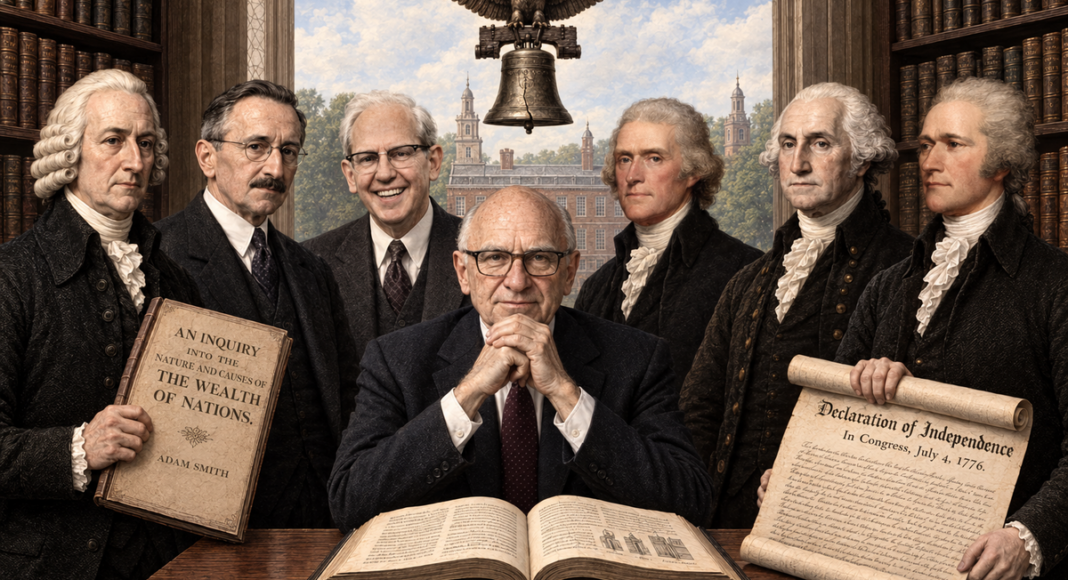

Adam Smith and the Founding Fathers envisioned a society in which economic and political freedom, grouped together in the ideology of liberalism, would produce a wealthy, free, and peaceful society. Centuries later, this vision has come to fruition, and F. A. Hayek and Milton Friedman helped elaborate and advance that vision in their economic and philosophical works. The lesson for today’s populist moment is not to abandon these principles, but to continue to pursue them, as it is their imperfect realization, not their imperfect conceptualization, that burdens today’s society, writes Peter Boettke.
Editor’s note: This year celebrates the 250th anniversaries of the American Declaration of Independence and the publication of Adam Smith’s Wealth of Nations. It is also 50 years since Milton Friedman won the Nobel Prize in economics. This article is part of a symposium revisiting the ideas of freedom and political economy expounded by the American revolutionaries, Adam Smith, and the Chicago School of economics, and how they connect to contemporary concerns about capitalism and democracy. You can read the rest of the articles here as they are published, with contributions from Peter Boettke, David Mitch, Robert Van Horn, Sandra Peart & David Levy, Maha Rafi Atal, Edward Nik-Khah, and Richard John. We welcome responses, which you can send to promarket@chicagobooth.edu.
March 9, 2026, was the 250th anniversary of the publication of Adam Smith’s An Inquiry into the Nature and Causes of the Wealth of Nations. July 4,, 2026, was the 250th anniversary of the signing of the Declaration of Independence. These two documents are pillars of the great liberal tradition: free trade and economic freedom, the natural rights of each individual, and political freedom. Given the timing of publications, one cannot draw a direct line of influence from Smith’s scientific tract to the practical political demands of the Declaration. However, there is a great deal of evidence that the founding fathers knew of Adam Smith and the Scottish Enlightenment and drew inspiration from their works. My task here is not to revisit this question of influence, but to seek to find the common ground between the two documents we are celebrating this year, and to suggest how that common ground influenced the development of liberal political economy in the 20th century in the hands of F. A. Hayek and Milton Friedman, the latter who won the Nobel Prize for Economics 50 years ago.
The great historian of the American Revolution, Gordon Wood, argued in The Radicalism of the American Revolution that what is most overlooked in discussions is the radical transformation of society that resulted. Colonial America was a society of status, of privileges, of station. Patronage and personal favoritism by those with power played a major role in social mobility—to the extent that it existed. This social system would all be transformed by the Revolution. One prominent example of the legal transformation was the abolition state by state of the practice of primogeniture between 1777 to 1798. Not only did this change the laws of inheritance, but transformed the meaning and use of property, encouraged entrepreneurship, credit markets and social and geographic mobility. Legal distinctions based on rank disappeared, and economic opportunities were based in interest, aptitude and talent rather than birth. Certainly not perfectly, it must be acknowledged. But in a far more sweeping nature than anywhere else in the world, ordinary individuals were enabled to “give it a go,” as the historian Deirdre McCloskey likes to stress about the ascendancy of the Bourgeois Era. Almost overnight, Wood argues, Americans became “the most liberal, most democratic, most commercially minds, and most modern people in the world.”
As a result, America became the richest country in history over the next 250 years. It did so without an aristocracy, and without central planning or a comprehensive blueprint by the governmental authorities. The Revolution succeeded because it created the institutional conditions for commercial civilization. It unleashed the creative powers of a free people to a greater degree than had ever been experienced before. As Hayek would stress, the transformation for a society of status to one of contract is critical to experiencing modern economic growth. And this is only possible if the governing system seeks to eliminate privileges and instead binds itself to the rule of law.
The American Constitution, democratic self-governance, geographic advantages, and abundance of resources all played a role, but it was the transformation of society that drove progress. The system of social hierarchy, deference, patronage, and inherited privileges was transformed into a system of equality before the law, civil society consisting of voluntary association, social mobility, entrepreneurship and dignity and respect for ordinary work. Commercial activity ceased being morally suspect and the marketplace was characterized by entrepreneurs, shopkeepers and independent participants rather than clients dependent on the good graces of the privileged and powerful elite.
It might make sense to pause for a minute and reflect on Smith’s choice of words for the title of his great treatise: “An Inquiry,” not “The Theory,” followed by “Into the Nature and Causes of the Wealth of Nations,” not merely “Into the Wealth of Nations.” Smith’s work was no doubt concerned with material abundance, but not exclusively so. The division of labor, as reflected in Adam Smith’s depiction of the production of a common woolen coat, wasn’t merely about productive specialization, but the establishment of peaceful social cooperation among strangers. Rather than the traditional society of domination, commercial society is based on mutually beneficial exchange. Commerce rewards prudence, trustworthiness, reliability, reputation, and self-command. The market process in this regard is a civilizing influence by taming the passions and encouraging cooperation with others of great social and physical distance. Trading, not raiding, characterizes commercial life; just as making, not taking, is recognized as the way to generate wealth.
Smith was writing at the dawn of liberty. The American experience in the centuries after that Revolution is the realization of that liberty. Again, it has never been perfect and is still not perfect, but it always strives and bends toward that Smithian liberal plan of liberty, equality and justice. In the 20th century, the two most important political economists pressing these Smithian points and the exemplary importance of the American project were Hayek and Friedman, perhaps most importantly in their works The Constitution of Liberty and Free to Choose.
My choice of books to link these two together is somewhat unusual because most writing an article such as this would focus instead on the relationship between Hayek’s The Road to Serfdom and Friedman’s Capitalism and Freedom and the intimate connection between economic freedom and political freedom. These works, of course, are foundational to any discussion of the liberal principles of political economy and justice. But I chose The Constitution of Liberty and Free to Choose because both can be read as making significant contributions to the field of constitutional political economy (most associated with another University of Chicago product and fellow Nobel Prize winner, James M. Buchanan).
Critical to this specialized field of inquiry is how the establishment of general rules creates the conditions conducive the progress. To Hayek, America’s uniqueness was in creating a constitution and embracing institutions that formed the “machinery of government,” where millions of economic and social experiments could be going at the same time. America—however imperfect—embodied the principles of an open commercial civilization where individuals will discover opportunities, tinker and innovate, and develop new technologies. Economic freedom is not merely permission to give it a go, but a discovery procedure to learn what is worth going for in a way that nobody can know outside of the market process itself.
Friedman rightly contrasts the power of the market with the tyranny of control. The maintenance of commercial society requires limits on political power, competition to limit coercion, and choice to preserve and protect liberal pluralism. Economic freedom is not only efficient, it disperses power in society. It erodes privileges. It creates space for ordinary individuals to achieve extraordinary things. Economic freedom results from the security of property rights, freedom of contract and association, stable money and fiscal responsibility, all embodied in the rule of law.
This to me is the enduring lesson in political economy that we should derive from reflecting on the twin 250th anniversaries and allow to guide us through our contemporary debates which too often seem to have forgotten these. Let me add one other aspect that is too often overlooked. When Hayek founded the Mont Pelerin Society, one of the names he toyed with was the Acton-Tocqueville Society. This was rejected by the original group for a variety of reasons, but it does reflect Hayek’s thinking. In the context of this article, I think we can argue that Alexis de Tocqueville provides a bridge between Wood’s historical account of the American Revolution and Hayek and Friedman’s theoretical accounts of economic and political freedom. Tocqueville observed what Wood described as the transformation of American society: a social order characterized by vibrant civil society of voluntary associations, social mobility, local initiative, and unbounded energy. Hayek explains to us why this decentralized dynamism is a source of discovery and continuous learning how to better pursue productive specialization and realize the gains from peaceful social cooperation. Friedman explains how the constitutional structure of government, by limiting power and privileges, preserves the open society and its properties of creativity, innovation and social and material progress.
Both the left and right in our current political and intellectual culture have abandoned these principles, at least in their rhetoric. New York Mayor Zohran Mamdani and Vice President J. D. Vance have recently gone out of their way in respective speeches to dismiss the ideas of Hayek and Friedman. Critics of neoliberalism repeatedly target Hayek and Friedman without seemingly any sense of understanding the subtleties and nuances in their arguments. Post-liberals are even worse. Thinkers like Patrick Deneen argue that free market policies result in the erosion of community, destroy the social fabric, and increase inequality. The individual becomes isolated and lacks any great purpose as a result. The remedy offered is the abandonment of the free market system with its emphasis on material growth and the adoption of public policies that stress virtue, local obligations, and the moral community. Scholars under the New History of Capitalism movement see the coercion and abuse of corporate and state power as attributes inherent in capitalism. To both groups of critics, support for capitalism must either elide over these abuses or even justify them as the lesser evil to growth.
These criticisms are grounded in a misunderstanding of the argument for the liberalization of markets from David Hume and Adam Smith to F. A. Hayek and Milton Friedman. Markets are no doubt vehicles for efficiency in exchange and production and the creation of great material abundance, but that isn’t the side of markets that was stressed by Hayek and Friedman, let alone Smith. Smith was a champion of the doux commerce thesis that commerce civilized. Thomas Paine, of American Revolution fame, wrote that: “If commerce were permitted to act to the universal extent it is capable of, it would extirpate the system of war…” Commercial life civilizes people. Peaceful social cooperation among strangers replaces violence and conquest. Montesquieu wrote that “wherever the ways of man are gentle, there is commerce; and wherever there is commerce, there the ways of men are gentle.”
And certainly, by solving the violence trap, humanity was able to generate the wealth of nations, and this has been a boon to the flourishing of people everywhere that should be celebrated, but which capitalism’s critics so often seem to overlook or read as evidence of rapacity. In recent history, capitalism and trade has led to the great escape from abject poverty. When I was first learning economics in the 1980s, around 40% of the global population lived in extreme poverty (less than $2/day). Today that number is under 10%. Again, there is still work to be done to achieve Smith’s liberal plan of liberty, equality and justice for all. But we are farther along the path to that achievement than at any time in recorded history. The arguments of the great classical liberal economists from Smith to J. S. Mill, as well as the refinements that were made by great liberal economists of the 20th century such as Frank Knight, Ludwig Mises, F. A. Hayek and Milton Friedman, are critical to our scientific understanding and our practical appreciation of freedom and free enterprise. These ideas of property, contract and consent are embedded deeply in the American Project, and the promise of that project is one of the Open and Opportunity society. The direction forward is not to turn our backs on the American Project and reject the principles of free markets and entrepreneurialism, but to encourage the principles on which our democracy was founded and that, for all of its imperfections and momentary regressions, has created one of the wealthiest, free, and, yes, egalitarian nations in the history of civilization.
Author’s Disclosure: The author reports no conflicts of interest. You can read our disclosure policy here.
Articles represent the opinions of their writers, not necessarily those of the University of Chicago, the Booth School of Business, or its faculty.
Subscribe here for ProMarket’s weekly newsletter, Special Interest, to stay up to date on ProMarket’s coverage of the political economy and other content from the Stigler Center.