






In new research, Reilly S. Steel finds that corporate leaders’ individual political preferences are shifting left, but their aggregate spending remains skewed to the right.
For decades, scholars have cast large American businesses as a conservative stronghold. But in recent years, scholars, politicians, and journalists have devoted increasing attention to what appear to be important changes in the political activities of these firms. This has included complaints about corporations aligning their brands with social causes, particularly the “woke capitalism” associated with the progressive left. Despite these visible changes, there has been little systematic evidence about the evolving ideological views of the corporate directors and executives who decide how these companies participate in politics. This has led to confusion and conflicting views about the political landscape of corporate America.
In a recent paper published in the American Political Science Review, I reconciled these conflicting views with new data on the revealed political preferences of 97,469 corporate directors and executives at 9,005 different companies in the United States. Driven largely by turnover, I found evidence of a moderate leftward shift among corporate leaders, supporting a middle-ground position between conventional wisdom casting “big business” as a conservative stronghold and revisionist views holding the opposite. I also undertook additional analyses to investigate the reasons for these changes and assess their consequences. In the remainder of this article, I summarize key findings from this paper as well as discuss new analysis. One key finding from the new analysis: even though corporate leaders have moved left, the money in the form of political donations hasn’t followed.
The evolving ideological composition of American corporate elites
My original analysis revealed important shifts in the political landscape of corporate America in recent years. Tracking corporate director and executive ideology over time based on their political donations, I found that between 2001 and 2022, the average observed ideology of these individuals as a whole moved meaningfully to the left, starting from a modest conservative skew and eventually landing around the middle. In 2001, about half the individuals in my sample were conservatives, while the remainder was roughly evenly split between moderates and liberals. By 2022, conservatives had dropped to 35% of the sample, moderates had dropped to 20%, and liberals had risen to 45%. The leftward shift in the average is large when compared against the overall distribution of the ideology scores of the individuals in my sample, amounting to about 42% of a standard deviation. It also appears to have been driven largely by turnover in the ranks of corporate directors and executives—a change in the old guard, as opposed to a change in the views of the old guard—with the proportion of liberals increasing over time.
Anecdotes about prominent business leaders who have recently turned to the right, such as Marc Andreessen, have led some to speculate that this leftward shift was temporary. However, in new results extending my prior analysis through 2024, I find that the leftward drift has not reversed. Figure 1 shows that the leftward movement appears to have leveled off, but it has not snapped back to the right.
Figure 1: Average Ideology by Corporate Position over Time
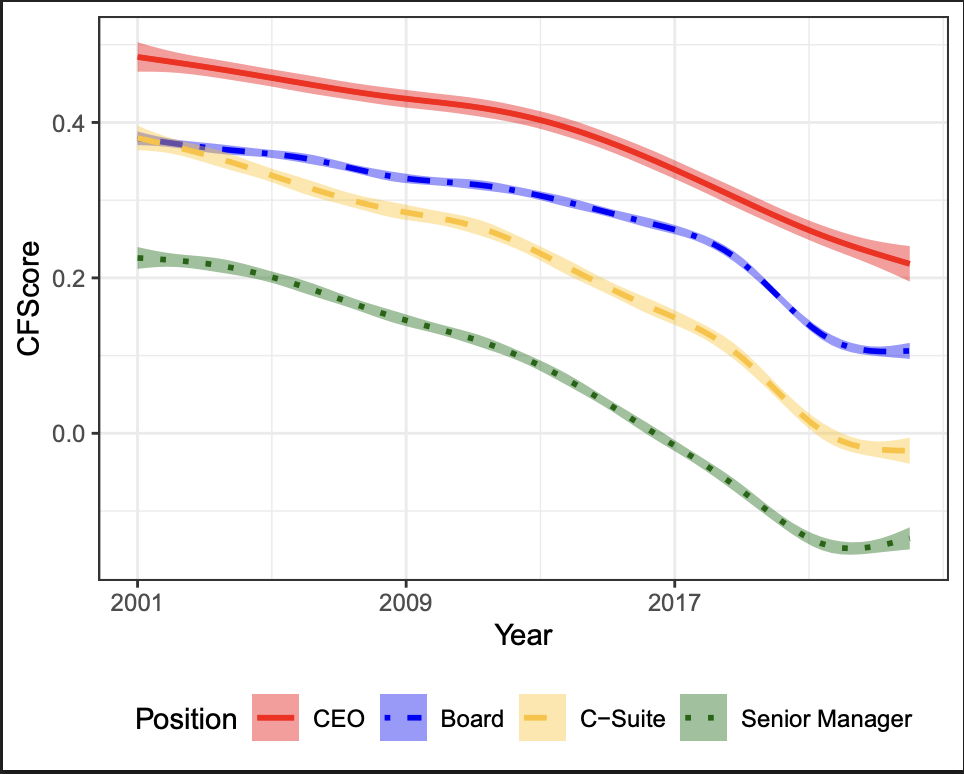
It is also important to recognize that there is variation across different industries and corporate roles. Certain industries, such as energy, have been and remain largely conservative, while others, such as technology, have moved considerably to the left. Meanwhile, individuals in different corporate roles follow different ideological distributions, with chief executive officers skewing the most conservative and senior managers skewing the most liberal. Most CEOs continue to be conservative, even as liberal CEOs have become increasingly common, whereas senior managers have changed from a roughly even split to a strong liberal skew.
Explaining the changes
Why did these changes take place? In the original paper, I performed a decomposition to predict individual ideology based on different counterfactual scenarios for certain characteristics associated with political ideology (e.g., demographics, geography, the mix of firms, etc.). This exercise suggests multiple reasons for the leftward shift, ranging from increased demographic diversity to geographic changes in where corporate elites are drawn from. Interestingly, using a difference-in-differences design to study the political effects of legally mandated gender diversity for corporate boards, I found no evidence that such requirements translate into more liberal boards, complicating the diversity explanation.
Ultimately, about half the leftward shift appears to be explained by other factors that have changed over time, suggesting broader forces at work. One potential interpretation is that corporate America—which has been and remains largely populated by educated whites—has experienced the same generational changes in ideology that educated whites more broadly have experienced.
Understanding the consequences
Why might these changes matter? One potential consequence is a change in how companies engage with politics, particularly on culture war issues like LGBTQ rights. Supporting this hypothesis, I found that companies with a more liberal set of directors and executives are much more likely to speak out in support of LGBTQ rights. In another recent working paper, co-authored with Nolan McCarty, we found that companies with more liberal leadership tend to issue more commitments to diversity, equity, and inclusion. Although selection issues make it hard to pin down causation, these results provide evidence that these ideological changes have real consequences.
As consequential as these changes may be, however, it is important to be clear about what they do not mean.
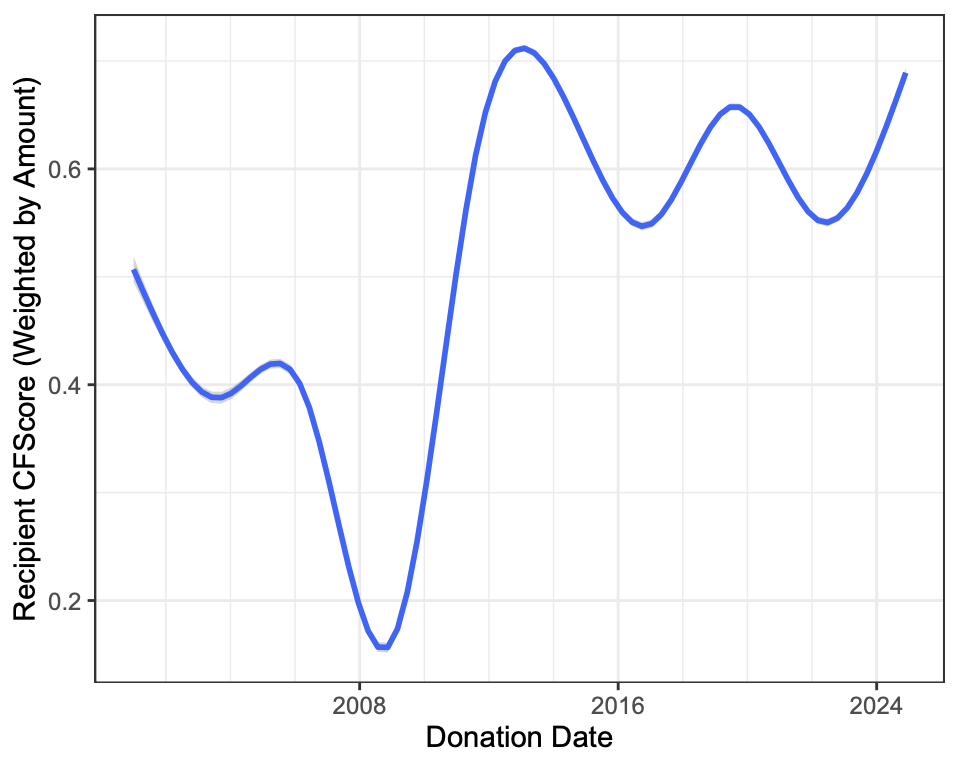
First, we must understand that changes in the ideological distribution of corporate directors and executives do not necessarily imply equivalent changes in the distribution of dollars contributed by these individuals to political campaigns and causes. The main analysis reported in the paper treats each individual equally, regardless of the amount donated. That approach is useful for understanding ideological composition, but it cannot tell us where the money is going. To follow the money, a different approach is needed. To that end, in a new analysis, I calculate the weighted-average recipient ideology score using donations as the unit of analysis, where the weights are given by the dollar amount of the donation. In other words, this analysis asks where the average dollar goes, rather than the average person. Figure 2 shows that these dollars remain skewed to the right—and in fact became even more right-skewed around 2012 than they were at the beginning of the millennium—even as the rightward skew has disappeared at the individual level. In short, the leftward ideological shift has not been accompanied by equivalent changes in the flow of money from corporate elites.
Figure 2: Ideology for Average Dollar Donated over Time
Second, these ideological changes do not necessarily mean that firms are engaging differently on bread-and-butter issues, such as lobbying for policy that favors the company’s economic interests. It may very well be the case that ideology influences corporate stances on culture war issues while doing little to change traditional lobbying and contribution strategies. Additional research on these issues is necessary before any definitive conclusions can be reached.
Third, even if ideology matters at the margins, that does not necessarily mean that it overrides other considerations. The response of the law firm Paul, Weiss, Rifkind, Wharton & Garrison to President Donald Trump’s executive order targeting the firm is a good illustration. The executive order addressed “harmful activity” from the firm, including bringing a lawsuit against individuals who participated in the January 6 U.S. attack on the Capitol and discriminating against employees by having DEI policies. Trump took steps to suspend security clearances for the firm’s lawyers, prohibit agencies from awarding federal contracts to the firm’s clients, and limit access to federal buildings for the firm’s employees. Even though Paul Weiss had traditionally been viewed as a left-leaning firm, it quickly settled with the administration after its business was threatened. This settlement included commitments to provide pro bono legal services in support of the administration’s goals and to eliminate its DEI policies, departing from the firm’s prior left-leaning ethos.
Nevertheless, taking a broader perspective, the transformation documented in the paper could have important consequences for American politics. Corporate elites have traditionally been a key source of support for the Republican Party, but my findings suggest that they are now increasingly ideologically fractured and, in some industries, may even be more aligned with Democrats. These shifts seem to be part of a larger story about the political realignment of American politics, partly along educational lines.
To the extent that such coalitional changes can also prompt changes in the policies championed by each party, this could fundamentally alter the policy environment as well. For example, survey evidence has shown that technology entrepreneurs tend to be fairly conservative on regulatory policy, even though they are liberal on redistributive economic policy and social issues, raising questions about whether the leftward shift in the technology industry could push Democrats to the right on regulatory policy. Going forward, researchers should be attentive to the potential policy effects of these shifting coalitions.
Author’s Disclosure: The author reports no conflicts of interest. You can read our disclosure policy here.
Articles represent the opinions of their writers, not necessarily those of the University of Chicago, the Booth School of Business, or its faculty.
Subscribe here for ProMarket’s weekly newsletter, Special Interest, to stay up to date on ProMarket’s coverage of the political economy and other content from the Stigler Center.