






The revived American Innovation Choice Online Act singles out a handful of Big Tech giants for unique, antitrust-like restrictions, but without the standard methodological rationale of antitrust analysis. The bill risks harming one of America’s most innovative sectors, writes Herb Hovenkamp.
The American Innovation Choice Online Act (AICOA), which Senators Amy Klobuchar (D) and Charles Grassley (R) originally proposed in 2021, died a quiet death. Now a new version has been proposed with several changes, but most of the problems remain. The statute operates as a kind of reverse industrial policy initiative. Instead of promoting domestic high achievers in order to boost the economy, it does precisely the opposite, singling them out for adverse treatment.
The proposed statute renews most of the questions that were asked the first time the AICOA bill emerged during the Biden administration. Does internet commerce create problems that need to be addressed? The answer is clearly yes. Commercial activity on the internet has led to both claims and provable cases of fraud, unreliable information, misappropriation of private data and other invasions of privacy, cybersecurity risks, and harm to vulnerable groups, including children. Most of these could be addressed by properly targeted regulation. Most are not antitrust problems, however. Although there may be overlap, their primary concern is not the preservation of low prices, high market output, or unrestrained innovation that the antitrust laws contemplate. In any event, good and effective mechanisms exist for expanding antitrust enforcement without imposing such enormous costs. For example, antitrust refusal-to-deal doctrine today is too restrictive to address the workings of multi-participant networks. Many of the practices that the AICOA targets, such as self-preferencing and tying, are procompetitive at least as frequently as they are harmful. Thay are necessary to preserve product differentiation in a multi-firm economy. Good competition policy needs to be able to sort these out.
Unlike the antitrust laws, which cover nearly all of interstate commerce, the proposed AICOA covers only internet commerce (e-commerce) and applies only to a subset of products which it identifies as “systemically important platforms.” These are large digital platforms identified by revenue or usage, not by market share or another attribute of market power. While the statute does not identify who is covered, the likely candidates are three Alphabet products: Google Search, Android, and perhaps YouTube; Amazon marketplace and perhaps its cloud services; probably two Apple products, its App Store and perhaps its iOS operating system. For Meta, the covered systems very likely include Facebook, Instagram, and WhatsApp. The Microsoft Windows OS for desktop and laptop computers is also a possibility, as is TikTok. This list is not necessarily exhaustive.
While the antitrust laws can reach every business actor engaged in commerce, it also has its own coverage screens. The market power requirement that applies to most cases requires a market share in the neighborhood of 60 percent or more for unilateral conduct, or at least 40 percent or so for multi-firm agreements. Very likely fewer than 10 percent of markets in the United States have a single dominant firm. Anticompetitive multi-firm conduct can occur in less concentrated markets, depending on the number of firms who are participating. Merger law also incorporates a set of structural requirements that relate to the number of firms in a market and their market shares.
The differences between the AICOA approach and the antitrust approach to the selection of enforcement targets are profound. Antitrust is directed at market power, evidenced by low market output, high prices, and restraints on quality or innovation. The AICOA is directed at absolute size. When fixed costs are high or scale economies are substantial, this means that the statute often targets lower cost providers, or those providing superior products, for adverse treatment. To that extent it promotes higher prices or lower output, and acts as a brake on innovation. Internet commerce, and digital content in particular, exacerbates these differences because it is heavily subject to both high fixed costs and significant scale economies.
Further, the AICOA’s revenue-size classifications seem suspiciously arbitrary, as if someone first selected preferred enforcement targets and then manufactured the numbers so as to make them fit. The given percentages that identify a “systemically important platform” fall very far short of establishing market dominance, and do not track any identifiable criteria for establishing market power. The bill identifies covered platforms as those with at least $175 billion in average annual gross revenue and active users representing at least 34 percent of the population over the age of 12 that actively uses the internet, or 34 percent of subscriber households, with no adjustment for multi-homing. “Active” users are defined very liberally to include anyone who has invoked a site at least once a month, whether or not they log in. Because many of these apps are free to install, that means there could be a tremendous difference between the number of registered users and actual usage. For example, about 25 percent of U.S. devices have the X app installed, and one-third of social media users have an X account. However, its usage market share, measured by global social media traffic, is a little more than 5 percent. Because Microsoft’s Bing search engine is preinstalled on Windows 10 or 11 computers, 100 percent of these computers have that app installed. Roughly 56 percent of desktop/laptops worldwide run Windows and thus have Bing preinstalled, but only 20 percent or fewer Windows users actually use Bing as their primary search engine. Most use Google Search. As a result, the gap between installation and actual usage is enormous.
The proposed AICOA is not technically an “antitrust law” as the antitrust statutes themselves define that term. One important consequence is that, at least in its current form, it cannot be enforced by private parties. On the other hand, the AICOA adopts many terms and concepts from the antitrust laws. Except for private plaintiffs, it is enforced by the same government entities that enforce the antitrust laws—namely, the Department of Justice, the Federal Trade Commission, and state attorneys general. Not only that, but the bill indicates that these agencies should enforce this Act “in the same manner, by the same means, and with the same jurisdiction, power, and duties” as the antitrust laws and the FTC Act. The bill also provides for “expedited” procedures and docketing, not only for AICOA enforcement actions, but also for antitrust actions involving covered platforms, with “priority over all other civil actions.” In addition to these antitrust-related enforcement provisions, the AICOA also defines covered harms as actions that “materially harm competition,” which means “any actual or reasonable risk of lessening of competition or impairing the competitive process that is more than a de minimis amount.” So, the legal analysis of practices is very “antirust-like,” even though its assessment metrics differ significantly.
For most of the challenged practices, the defendant may offer to show as an “affirmative defense” that this harm to competition will not occur, but the burden of proof is on the defendant. Within the antitrust laws, the Clayton Act is more aggressive than the Sherman Act because it reaches practices whose effects “may be substantially to lessen competition.” The AICOA standard is intended to be even more aggressive than the Clayton Act’s. Further, some practices such as tying seem to be covered by a kind of “per se” rule, in which the plaintiff does not even need to show material harm.
Thus, the AICOA is best described as a kind of “quasi-antitrust” statute, but its coverage is far more aggressive than that of the existing antitrust laws. Is such aggressiveness justified? Or is competition so much more vulnerable or at risk in internet commerce than in commerce generally? Here, the answer is a resounding no. Quite the opposite, in fact.
The competitive performance of markets can be assessed and compared in several ways. Under every reasonable metric, internet commerce overall is significantly more competitive than offline commerce. The growth rates of the internet’s “Big Tech” five (Microsoft, Apple, Alphabet, Amazon, and Meta), which are the likely targets of nearly all AICOA enforcement except for TikTok, is significantly greater than that of the economy as a whole.
Perhaps the growth of the Big Tech five is so great because their anticompetitive practices are stealing sales from smaller internet firms. In that case their growth would be at the expense of the internet as a whole. However, that is not happening either. This graph, based on U.S. census data, compares the rate of sales growth in internet commerce (red) and traditional offline commerce (black) going back to about the time the commercial internet came into existence:
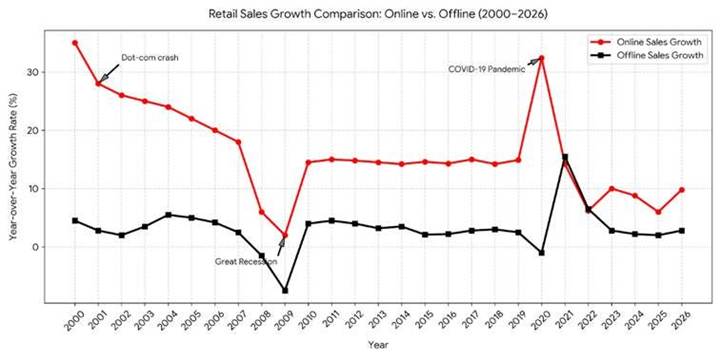
In every year since the first commercial internet transactions in the mid-1990s, sales growth in e-commerce has outpaced the growth of offline commerce by a large margin. Covid produced a period in the early 2020s where the growth rate was much higher, but even today after things have settled down internet commerce continues to grow more than twice as fast as offline commerce. These are hardly signs of a market that needs aggressive fixing.
In addition are a number of other factors that govern internet competitiveness. First, consumer search costs are lower on the internet than in offline commerce. The customer unhappy with a price or product selection at a hardware store can drive to a different store. The customer unhappy with the same choice on the internet can change stores with a mouse click. Further, product offerings on the internet often offer much greater information about things such as usage or customer satisfaction. For example, someone looking at an electric saw on a Home Depot shelf does not have immediate access to customer reviews or other performance information that is routinely available in online stores.
Internet barriers to entry are lower than entry barriers in old commerce. First, building a website is almost always cheaper than building a chain of stores, and can reach many more people. Second, when markets are expanding new entry is more likely. As a result, the rate of new business entry is much higher into internet commerce than traditional commerce, and this is so even when new entrants compete with well-established big tech firms. For example, while Amazon is an internet powerhouse in merchandising, many new firms enter e-commerce each year even when they must compete with Amazon. This is starkly different from the monopolist in traditional commerce, which is a dominant firm that faces few or even no new entrants.
The combination of lower consumer search costs and easy entry results in internet price dispersion that is almost always lower than in old commerce. This simply reflects the fact that as markets are more competitive and consumers have greater ability to switch among alternative sellers, prices tend to move closer together. Ironically, the ready availability of internet price comparison also serves to make offline commerce for competing goods more competitive as well. That is, not only is e-commerce more competitive, but to the extent that customers make comparisons across online and offline sellers its presence actually provides a competitive boost to offline commerce as well.
Similar factors apply outside of markets for tactile products, to such things as search engines and social networking. First, customers can choose among them with a mouse click. Second, multihoming is nearly always easy. In fact, many people have apps for multiple search engines or social networks on their devices.
Further, to the extent that output is digital there are fewer capacity constraints. As a result, both current size and market share overstate competitive significance. Market share is a serviceable although rough estimate of market power because it considers the extent to which a larger firm can reduce output without having those sales immediately taken over by rivals or new entrants. For example, if an automobile manufacturer with a 70 percent share of electric vehicles raises its price customers will be tempted to switch to a different seller. But successful switching requires competitors to have the capacity and ability to pick up the slack. If Facebook or Google Search do something to make their particular product less attractive, customers can very likely switch much more easily, and alternative sites will be able to accommodate them. Widespread availability of multihoming reduces these switching costs to nearly zero, something that offline commerce seldom experiences. As the court its in decision in Federal Trade Commission v. Meta Platforms observed:
The next factor … asks whether firms outside the proposed market could quickly enter or whether their current production technology would need to be overhauled. In other words, how much would TikTok and YouTube need to change to produce an app like Facebook, Instagram, or Snapchat?
Not much at all.
So, what criteria should determine when a market segment is sufficiently problematic that it should be “targeted” for more aggressive antitrust enforcement? Suitable targets are stagnant industries in which not very much is happening. They show little innovation and few attempts at product differentiation that can enable firms to break out of the pack. Such industries are prone to collusion and often exhibit some history of it. Likely candidates in the U.S. are construction materials, such as concrete and asphalt, lumber, or drywall; generic commodities, such as corn syrup sweeteners or chemicals; and fertilizer and many agricultural commodities.
Big Tech exhibits none of these features. Internet tech in general, and Big Tech in particular, experience very high rates of innovation, whether measured by patent grants or research budgets. The Big Tech five have the largest absolute R&D budgets among U.S. firms, except that Apple is number six. Of course, they are also very large firms, and their research budgets are less impressive in relation to firm size. When measured as a percentage of firm size, the “R&D intensity” of big internet tech firms all remain in the top fifty or so. Here, one important difference is that the large size of the big tech firms is attributable mainly to consumer or advertising sales. Firms that are much more specialized in research and intellectual property acquisition have higher relative R&D budgets. These include biotech firms, pharmaceutical companies, semiconductor and computer hardware infrastructure firms, and software producers. By any measure, however, the Big Tech five are highly innovative firms, as are many smaller internet tech companies.
Another feature of big internet tech is product differentiation and perpetual variation, which are important avenues of competitiveness. The large internet firms all compete aggressively to differentiate their offerings from those of rivals. Witness, for example, the extreme levels of current investment in artificial intelligence (AI) products. Here, Alphabet, Amazon, Meta, and Microsoft are the largest investors in the incorporation of AI technology into their products. Further, they are largely developing different sets of AI tools. Given the presence of AI and the uncertain future it produces, relative market shares among Big Tech companies are significantly up for grabs. This serves as a warning to antitrust enforcers to be aggressive about mergers or market dominance within AI, but these fall within established antitrust laws and are not even addressed by the AICOA.
While aggressive R&D competition leads to valuable differentiation, widespread sharing obligations do just the opposite. Here, antitrust policy and the AICOA operate at cross purposes. Antitrust policy prefers a lively market of differentiated products that customers can choose from readily. By contrast, the AICOA would create a world of broad sharing obligations converging on the same technology. The Act’s listed prohibitions include “self-preferencing,” which occurs when the platform operator prefers its own secondary product over that of another firm (§3(a)(1)(A), as well as requirements for interoperability (§3(a)(2)). Self-preferencing is an important avenue for furthering differentiated competition. The alternative is a world in which every store sells the same thing. Excessive interoperability produces a similar result, effectively making each firm a sales agent for competitors’ products. The Google Search decision expressed this concern in its antitrust remedy. It declined to use expansive licensing of Google assets to create a situation in which numerous search firms exist, but only as “white label” agents selling a larger firm’s product. Whether more sharing is justified for truly dominant firms without good alternatives is a question worth debating. But it is certain to impoverish internet competition when it is applied to products that have viable alternatives, as most of those identified in the AICOA do.
The AICOA also prohibits tying (§3(a)(3)), defined as “[c]onditioning platform access, partial access, preferred status, or placement on purchase or use of other platform-operator products or serves that are not intrinsic to the platform.” This appears to be an attempt to emulate the discredited per se rule against tying. Antitrust law already reaches anticompetitive tying, but attempts to do so selectively in the small set of instances when it actually harms competition. In fact, tying is a major avenue of innovation. Many new technologies are combinations of two or more things that had previously been provided separately, starting with the automobile, which replaced separate provision of horses and buggies. The Windows operating system replaced a large number of separate programs. Social network sites combine multiple activities that make them attractive to people who do not want to go to one place to share messages, another to share videos or photographs, and another to obtain their news. One could go on with this list, but the implications should be clear. Tying arrangements are unions of complements. Overwhelmingly they coordinate and lower the costs of production on the supply side, or make products more attractive to consumers on the demand side. A reasonable antitrust rule must be able to identify the small minority of cases that operate as exceptions.
Not only does the AICOA differ from the antitrust laws in the way it identifies covered firms, it also departs from any rationale for regulation other than capture. Its criteria appear to be unconcerned with whether a market is performing competitively, as measured by output, price, or innovation. If regulation is concerned with correcting market failure, where is the failure? In sum, the firms and products that the AICOA targets represent areas in which competition in a highly dynamic portion of the economy is working the way it should be working. The AICOA offers little potential to improve that. Rather, there is a big risk that it will hamper economic growth.
Author’s Disclosure: The authors report no conflicts of interest. You can read our disclosure policy here.
Articles represent the opinions of their writers, not necessarily those of the University of Chicago, the Booth School of Business, or its faculty.
Subscribe here for ProMarket’s weekly newsletter, Special Interest, to stay up to date on ProMarket’s coverage of the political economy and other content from the Stigler Center.