





The House v. NCAA private antitrust settlement professionalized collegiate sports by requiring colleges and universities to compensate student athletes. The case has changed the economics of college sports, pushing schools to spend big to pay for top athletes to field teams that compete for championships. New research from the Progressive Policy Institute finds that although the new model has narrowed success to the top programs, the ability for schools to pay for success has now been mostly priced in, writes Diana L. Moss.
The new model in the United States of paying college student athletes emerged from a complex settlement in the 2025 House v. NCAA private antitrust class action. The settlement supercharged Division I schools’ incentives to fund high-revenue sports programs because they need to pay for millions of dollars in required revenue-sharing with their student athletes. The prospect of generating this revenue relies heavily on the financially lucrative spillover effects of winning championships, such as media rights, ticket sales, and donations.
Of course, winning requires fielding the best teams by recruiting top athletes that, in turn, requires significant financial resources. Evidence from the NCAA March Madness men’s basketball tournament shows that much of this change has likely been “priced-in.” This means that pumping additional resources into top programs probably won’t increase the probability of winning beyond current levels, prompting us to ask: Is the massive level of spending on college sports in the post-House v. NCAA era sustainable?
From amateurism to professionalism
It is rare when a settlement in a U.S. antitrust case results in the restructuring of an entire market. The breakup of AT&T’s telecommunications monopoly into seven individual companies in 1984 is one of a miniscule number of examples. It is even rarer when a private antitrust settlement, as opposed to federal legislation, achieves the same result. The House v. NCAA settlement did just this by effectively dismantling the 120 year-old model of amateurism in college sports and remaking it into a professional system.
The House v. NCAA settlement requires schools to compensate athletes, looking both backward and forward. The settlement recovers almost $3 billion in back damages for payments for “name, image, and likeness (NIL)” that were illegally denied by anticompetitive NCAA rules in the past. The settlement also restores competition by establishing a forward-looking compensation scheme based on schools sharing an estimated $20 billion dollars of sports-related revenues with athletes for the next decade.
Even before the settlement was approved, however, there were plenty of road signs indicating where college sports was headed. The House v. NCAA antitrust class action was the capstone for a series of antitrust cases. In those cases, student-athlete plaintiffs challenged NCAA rules as illegal agreements among member schools to restrict competition by denying educational benefits and compensation.
Two major developments foreshadowed the free agency system and a major source of compensation for staffing college teams with the best players under the new model. One was the creation of the transfer portal in 2018 to facilitate the movement of student athletes to other schools in between seasons, and the other was the legalization of NIL contracts in 2021. More recently, colleges and universities began making cuts to over 400 college sports programs, even as the House v. NCAA case was being litigated, in order to begin redirecting resources to high-revenue sports, like basketball and football.
Financing college athletics to win championships
The pay-to-play model envisioned in the House v. NCAA settlement is a tectonic shift. Its practical effect is to define a new raison d’etre for college sports: mobilizing financial resources to win championships. Winning generates massive financial windfalls from lucrative media-rights deals, higher ticket sales, higher donations, and (allegedly) higher school enrollments. More recent developments reveal the rapid pivot to the new model.
For example, the flow of athletes through the transfer portal has increased dramatically since 2021. Men’s college basketball program budgets grew by 50-100% over the last ten years, with Duke University at the top at $25 million in 2025. The University of Connecticut recently offered freshman basketball phenom Braylon Mullins a $4-5 million NIL package to match the NBA’s expected annual salary, were he to declare for the 2026 NBA draft. Matching offers mean that the leagues compete in the same market for professional athletes.
All of this is to say that anecdotal evidence of a transition to the new model in the time preceding, during, and after the House v. NCAA settlement is not in short supply. The question now is whether the costs of obtaining top talent to create winning teams and secure championships are sustainable, given the results obtained thus far. Moving from anecdote to hard evidence on the impact of the settlement, however, requires more concrete indicators that schools are operationalizing the new financial model. The NCAA March Madness men’s basketball tournament is a leading case study that we look to for an answer to this question.
The NCAA men’s basketball March Madness case study
High-revenue college sports teams like men’s football and men’s and women’s basketball need to win for pay-to-play college sports to make sense. And to win, teams need to perform. The likelihood of performing well in a tournament like March Madness is generally gauged by a league process of “seeding” teams, which determines the order by which teams play each other, with high seeds initially facing low seeds. High-seed teams are more likely to win and low-seed teams are more likely to lose. The NCAA’s website explains how seeds are determined for the tournament. It notes that seeding does not guarantee performance but rather serves as a best predictor based on regular-season metrics.
Seed v. performance metrics vary across sports because skill and luck both play a role. For example, NBA basketball shows the highest skill-based outcomes, with a strong correlation between seed and performance. A recent study of Olympic judo also finds a strong relationship between seeding and securing medals. In contrast, a study of the UEFA Champions and Europa football leagues finds no evidence that seeding alone “contributes positively to the team’s success in the tournament.” While this metric is less studied in amateur sports, the transition to pay-to-play in the U.S. college system shines new light on what it might reveal.
The Progressive Policy Institute used March Madness data to assess changes in the statistical relationship between seed and performance as a proxy for success in the post-House v. NCAA era of college sports. The analysis uses a simple, back-of-the-envelope approach. It is not based on economic market modeling that attempts to explain tournament outcomes based on major drivers of success. (Note: reminder that correlation does not imply causation. The former is a statistical association, whereas causation implies a direct cause-and-effect link.)
High-seed schools are getting better results
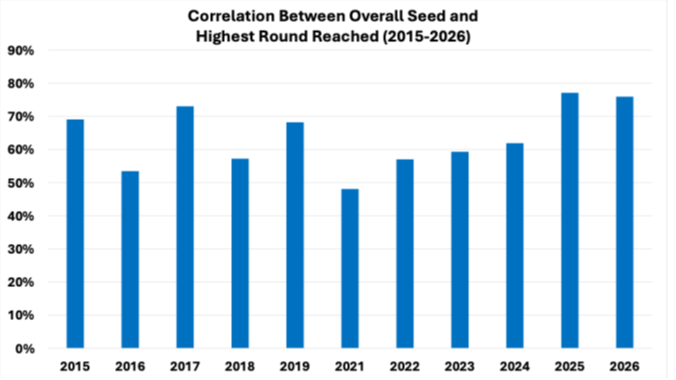
The first analysis looks at annual correlation between a school’s overall seed and final round it reached in the March Madness tournament from 2015-2026 (excluding 2020, when March Madness was not played due to the Covid-19 pandemic). The assumption is that high-seed teams make deeper runs into the tournament. If the new model of college sports is focused on financing better teams that win championships, then we might expect to see an incrementally tighter correlation between seed and performance as schools operationalize the requirements of, and incentives created by, the House v. NCAA settlement.
Figure 1 shows the trend in the correlation. The first thing to notice is that correlation in the pre-House v. NCAA settlement years, 2015-2019, is relatively volatile. In 2021, correlation was the lowest, likely due to the disruption in the wake of the pandemic. A second standout is that since 2021, when the NCAA authorized NIL payments, correlation between seed and last round has steadily increased and remained at about the same level from 2025-2026.
Figure 1
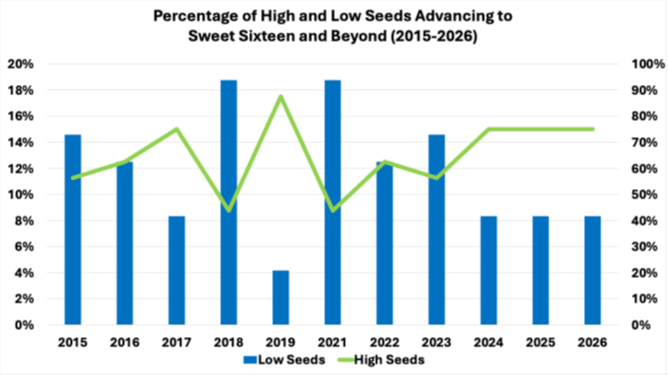
The second analysis looks at the rate at which teams advance deeper into the tournament (i.e., the Sweet Sixteen and beyond) from 2015-2026, based on seeding. We therefore measured the rate of penetration for two groups of seeds?: “high” and “low.” The highest 16 seeds include top schools and the mid-majors while the low-seeds are seeded 17-64. The assumption is that high-seed teams, which are better financially resourced, are more consistently able to make deep runs into the tournament. This is not true of low-seed teams, which do not have the financial resources to bid on top talent and may even be cutting athletic budgets. The analysis thus captures the theoretical loss of the “Cinderella” effect under the new model of college sports, in which low-seed teams upset high-seed teams.
The data on men’s basketball program budgets supports the idea that better funded teams produce better performers and success in March Madness. Between 2015-2024 (the most recent year for which budget data is available), for example, the correlation between seed and school budgets is very high. The budget data also helps explain why high-seed schools—with an average real budget that just over double that of low seed schools—increased real spending by 64% between 2021-2024, after NIL payments were authorized, while low-seed teams decreased spending by 2%.
Figure 2 shows the data on penetration rates into the tournament based on type of seed. Both high-seed and low-seed teams show significant variability in reaching the later rounds of the tournament from 2015-2023. However, the penetration rate for low-seed schools falls off dramatically in 2024. In contrast, the penetration rate shoots up for high-seed schools. Both rates remain at the 2024 levels through 2026.
Figure 2
Are the results good enough to justify the cost?
Even a simple analysis of March Madness data signals two relatively compelling takeaways. One is the lightning speed with which colleges and universities have “priced in” the changes in financial model wrought by the House v. NCAA settlement. For example, correlation between seed and final round reached increases steadily from 2021, when the NCAA authorized NIL payments, and peaks around 76%-77% in 2025 and 2026. Likewise, the rate at which high-seed teams reach the higher rounds of the tournament increased to 75% in 2024 and have remained at that level since. In other words, higher seed, better funded teams are getting results in terms of performance.
A second takeaway is less certain, but nonetheless worth suggesting. That is, static levels of seed versus performance from 2024-2026 may mean that further improvements in school performance are not forthcoming. In other words, this may be “as good as it’s going to get” at current levels of spending on college athletics in the post-House v. NCAA model. If so, the question is whether these are the results that schools need to justify a massive financial commitment to the new model of college sports and whether it is sustainable. Only time will tell.
Author’s Disclosure: Diana Moss works for the Progressive Policy Institute. PPI is supported by corporations, individuals, and foundations such as the Lumina Foundation, Peterson Foundation, and Arnold Foundation. No funding source influenced the arguments expressed in this article or stands to benefit from them.
Articles represent the opinions of their writers, not necessarily those of the University of Chicago, the Booth School of Business, or its faculty.
Subscribe here for ProMarket’s weekly newsletter, Special Interest, to stay up to date on ProMarket’s coverage of the political economy and other content from the Stigler Center.