




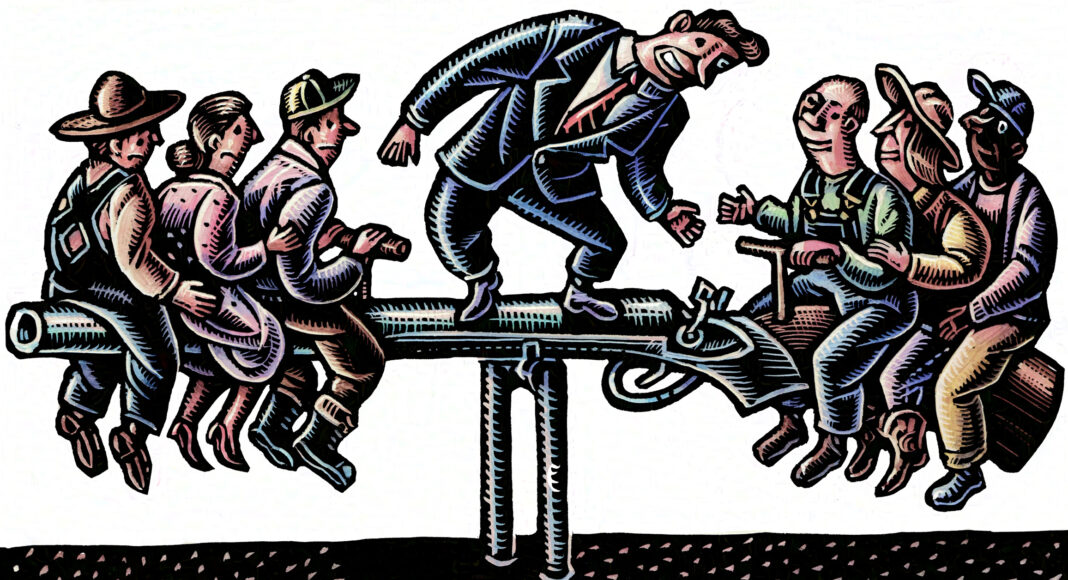


In new research, Jack Kappelman and Haotian Chen investigate how mass violence impacts legislative voting on firearm-related bills. They conclude that on average, state representatives do not change how they vote on gun policy even when mass shootings occur in the very districts they represent.
When an 18-year-old gunman killed 19 children and two teachers at Robb Elementary School in Uvalde, Texas in May 2022, the tragedy appeared to crack the Republican Party’s united front on protecting gun rights. Two Republican state representatives, Sam Harless and Justin Holland, broke ranks to advance legislation raising the minimum age to purchase semi-automatic rifles from 18 to 21. Harless defended his vote as “the least we could do for the families” of the victims.
Yet the bill died anyway, and our research suggests this kind of defection remains rare, despite the rise of mass shootings around the United States in the last few decades. In our working paper, we analyze voting on over 15,000 firearm-related bills introduced across all 50 U.S. states from 2011 to 2022, and estimate the latent gun policy positions of 14,585 individual state legislators. We further cross-examine legislative positions against mass shootings and find that even when mass shootings occur in the very districts that state legislators represent, legislators generally fail to shift their gun policy votes.
The findings reveal a sobering reality about American democracy: partisan polarization on gun regulation has become so entrenched that even the most horrific local tragedies cannot overcome it.
Measuring legislative firearm policy
To measure an individual legislator’s position on firearms policy over time, we introduce a novel metric called the “Gun Issue Score.” This measurement captures where state legislators stand on the permissive-to-restrictive spectrum of gun policy. Unlike general ideological measures, this score specifically captures the policy-issue dispositions of a legislator by analyzing how they vote on firearm-related bills relative to their peers. Using a statistical technique called the Bradley-Terry model, we compare how supportive of gun control (or supportive of gun rights) a legislator is relative to their peers across all recorded votes. This approach produces a measure that tells us not just that a legislator is “liberal” or “conservative,” but specifically where they stand on firearms policy from most permissive (supporting constitutional carry, opposing assault weapon bans) to most restrictive (supporting red flag laws, opposing permitless concealed carry).
To do so, we rely on hand-coded data compiled by the Giffords Law Center (GLC), a gun violence prevention advocacy organization. The GLC tracked over 15,000 bills introduced in every state legislature from 2011 to 2022 and ranked bills according to the organization’s policy preferences: would it strengthen, weaken, or leave neutral the state’s gun control environment? Combined with roll-call voting records, this produces an unprecedented dataset revealing how polarized gun politics has become.
Figure 1: Polarization on Firearms Policy in U.S. State Legislatures, 2011-2022
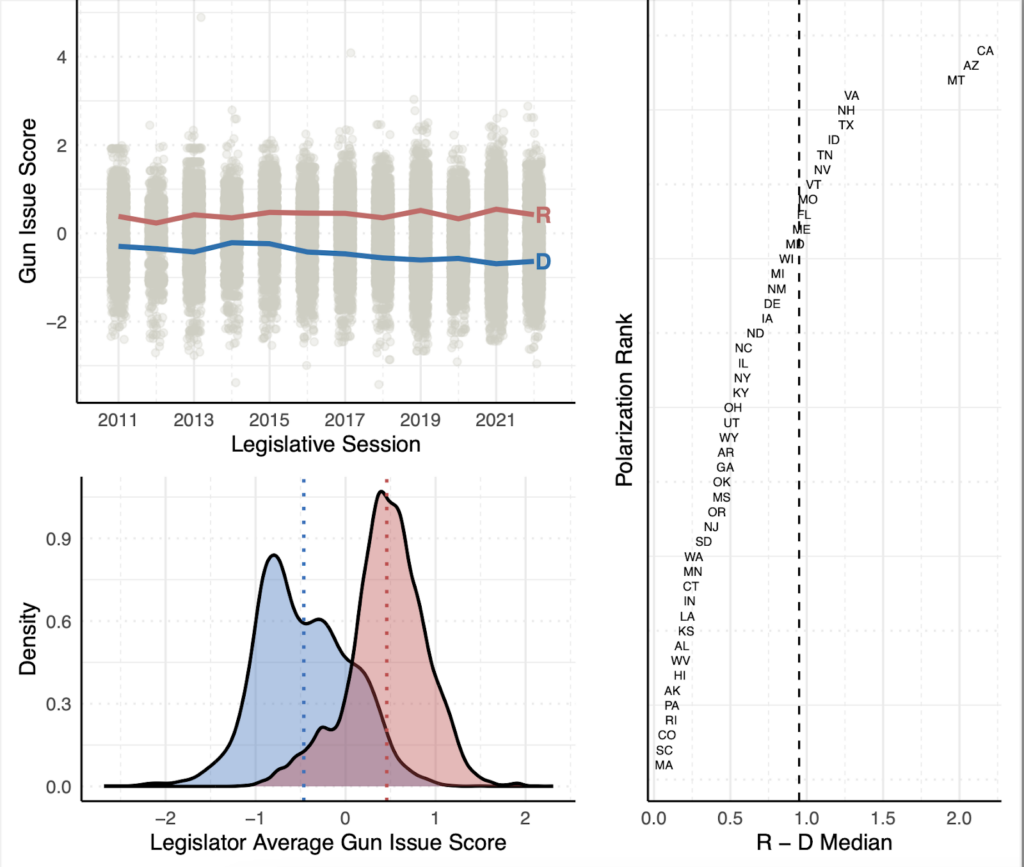
The patterns are clear. As shown in Figure 1, Democratic and Republican legislators occupy distinctly separate positions on gun policy both over time (top left panel, with annual party averages shown as solid lines and individual legislator-year scores as underlying points) and across the study period (bottom left panel, with party medians denoted as dotted lines). This separation has remained stable: both parties have drifted toward more polarized positions over the twelve-year period, and the gulf between them persists.
The right-hand panel reveals substantial variation in how polarized gun politics has become across states. We estimate each state’s level of polarization—defined as the difference between the median Gun Issue Score of Republicans and Democrats within that state—and rank states relative to the national average. California emerges as the most polarized state, where the gap between Democratic and Republican positions on firearms policy far exceeds the typical divide. States like Massachusetts and South Carolina show less partisan sorting on this issue.
Individual legislators illustrate the extremes of this distribution. John Tobia, a Florida Republican who was the only representative in his state to vote against a gun control bill introduced after the Sandy Hook school shooting in Connecticut, scored as the most permissive legislator nationwide. Daniel Hernandez, an Arizona Democrat who survived the 2011 shooting of Representative Gabby Giffords and is credited with saving her life, scored as the most restrictive. The Gun Issue Score captures variation in legislators whose voting records show unwavering opposition to any gun control measures and those who consistently support the most restrictive policies.
Mass shootings do not change legislators’ voting behavior
Using a research design that compares legislators whose districts experienced mass shootings to legislators whose districts did not, our study examines 53 mass shootings occurring in the districts of 90 state legislators across 23 states. The core finding: mass shootings had essentially zero effect on voting behavior.
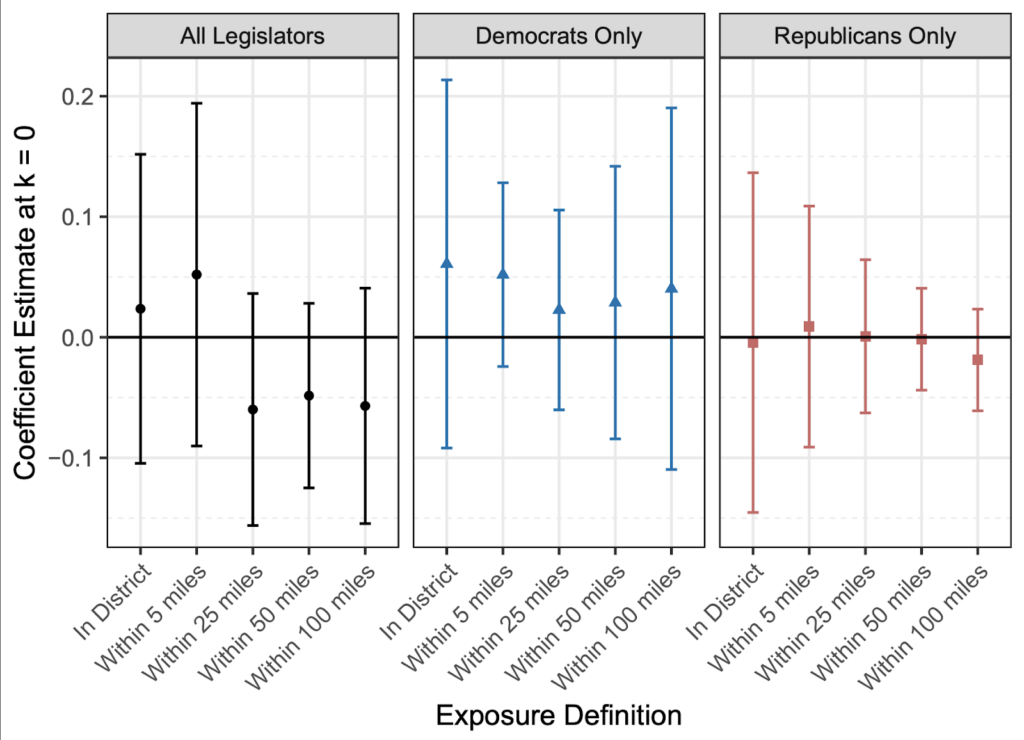
The precision of this result is noteworthy. Our statistical analysis is sensitive enough to detect quite small changes in voting behavior—moving from, say, opposing all gun control bills to supporting background checks, which would translate to a moderate change in year-to-year scores for a legislator. We can confidently rule out any shift larger than about one-fifth of the typical difference between pro-gun rights and pro-gun control legislators. In other words, if mass shootings were changing how legislators vote, we would see it, but we don’t. Further, as shown in Figure 2, it does not appear to matter whether a shooting occurred directly in a legislator’s district or within 5, 25, 50, or 100 miles of it. This absence of any statistically significant change holds for both Democrats and Republicans separately, and across parties. School shootings, workplace shootings, acts of terror, hate crimes—none produced measurable average effects. Even the deadliest incidents, exceeding the average of 8.5 fatalities, failed to shift legislator’s positions on gun policy in the aftermath of a shooting.
Figure 2: How shootings change legislators’ voting behavior by district distance from shooting
Why don’t legislators move?
For decades, overwhelming majorities of Americans have supported common-sense gun reforms: 92% favor universal background checks, breaking down to 97% of Democrats and even 90% of Republicans. Meanwhile, annual firearm deaths have surged 45% since 2011, from 33,000 to over 48,000. Mass shootings have become both more frequent and more deadly, with several of the deadliest incidents in U.S. history occurring in the past decade. While violence has increased, so too has American’s dissatisfaction with existing U.S. gun laws.
Yet policy remains frozen. When mass shootings occur, we might expect legislators—especially those whose own districts are affected—to respond to this combination of public demand and escalating crisis. Prior to our empirical analyses, we conducted qualitative interviews with California state legislators who had represented affected districts at the time of mass shootings. Their accounts reveal that intense institutional pressures prevent legislators from breaking partisan ranks.
One Republican legislator reported that party leadership threatened severe consequences if they spoke publicly on social media platforms, such as X, about supporting gun control after a local mass shooting: “I was told directly, if I speak about [gun control], it’s going to cost $1,000,000 per Tweet. For us to defend you in the next election, it’s going to cost 1,000,000 bucks a Tweet.” Whether this claim can be verified or not, the legislator indeed stayed silent on gun control following the shooting—posting their first relevant Tweet opposing a restrictive measure six months after the shooting occurred.
Democratic legislators described different but equally powerful constraints. While personally moved by tragedies, they recognized that their constituents already expected strong gun control positions. Many legislators have already positioned themselves at or near their party’s ideological limit on guns. For a Democrat who already supports every gun control measure introduced, there’s literally nowhere left to move after a shooting except away from party lines. For a Republican who opposes all restrictions, the same holds true—any movement in the opposite direction would require overcoming massive partisan barriers, primary challenges, the wrath of party leadership, interest group pressure, and other structural or behavioral constraints.
When high public support meets zero legislative movement
These findings challenge a basic assumption of democratic accountability: that politicians respond to crises affecting their constituents. Research has shown legislators do adjust behavior following natural disasters, economic shocks, and crime waves. Why not mass shootings?
The answer lies in the unique politics of firearms. Unlike disaster relief or trade policy, where legislators may have more room to maneuver, gun policy has become a litmus test of partisan identity. The National Rifle Association and gun rights advocates maintain exceptionally high levels of political organization and closely monitor any deviation. If a Republican who is openly anti-gun control and is backed by the NRA decides to vote for a restrictive bill, then they may face reelection pressures. Gun control advocates have, in more recent years, mobilized as well, creating countervailing pressures that may prevent Democratic lawmakers from moderating. Together, these forces may operate to create a vise that prevents movement. Even as firearm deaths reach record levels and public support for reforms remains overwhelming, partisan constraints appear to prevent the translation of tragedy into legislative action.
Is there hope for change?
Our findings establish uncomfortable boundaries of democratic responsiveness. If high degrees of public support, escalating prevalence of violence nationally, and acute local crises cannot overcome partisan gridlock, then what can?
The results are sobering, but not hopeless. Our results do not suggest that legislators are indifferent to the tragedies affecting their constituencies. Translating tragedy into legislative action (in either direction) likely requires broader shifts in public opinion, sustained mobilization, or changes to electoral incentives. In some states, this may mean focusing on ballot initiatives rather than legislative action. In others, it may require building broader coalitions that can protect legislators who break with party orthodoxy—making the “$1 million per tweet” sanction less threatening than an alternative.
The question facing American democracy is whether this finding represents a system working as intended—with legislators adhering to stable ideological commitments rather than responding to every tragic event—or a system that has calcified to the point where meaningful accountability has become impossible. The answer likely depends on whether we believe gun policy should be responsive to discrete tragedies or to broader, more sustained shifts in public preferences and democratic will.
Authors’ Disclosures: The authors declare that there are no relevant financial or non-financial interests to disclose regarding the content of this report. You can read our disclosure policy here.
Articles represent the opinions of their writers, not necessarily those of the University of Chicago, the Booth School of Business, or its faculty.
Subscribe here for ProMarket’s weekly newsletter, Special Interest, to stay up to date on ProMarket’s coverage of the political economy and other content from the Stigler Center.