





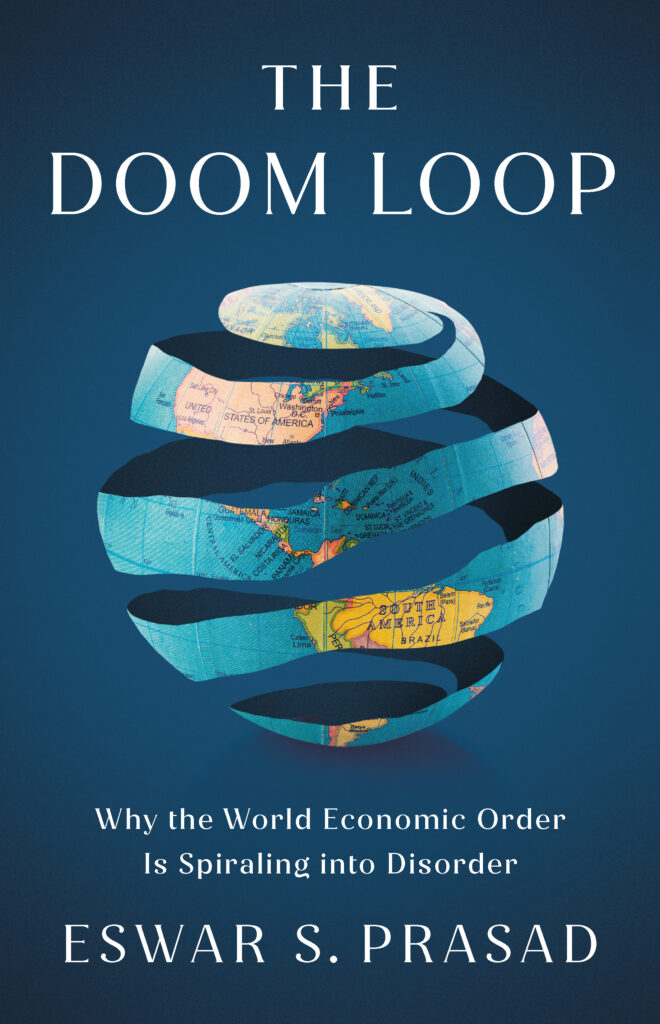
The following is an excerpt from “The Doom Loop: Why the World Economic Order Is Spiraling into Disorder” by Eswar Prasad,” now out at Hachette Book Group.
My tribe of economists believes that competition is a positive force in practically every realm, certainly better than the alternative of unchecked monopoly power. Competition spurs efficiency, discipline, and innovation. Uber’s technology for matching people seeking rides with those willing to offer them was remarkable, but it is competition that has kept the company on its toes. Uber’s competition with Lyft in the United States and with other ride-sharing apps in various countries keeps prices down for riders and forces those companies to continually innovate and manage costs. Apple and Microsoft have to do the same in their incessant battle for market share, while at the other end of the spectrum Google’s dominance in search and other services arguably gives it undue power that is not in the best interests of consumers.
Now, it is true that basic precepts of microeconomics do not always apply to the complex world of geopolitics. However, the underlying logic—that power cemented in the hands of only one or a few is less beneficial to society than a system where power is shared among many—is the animating force behind the democratic principles the West holds dear. A unipolar world is not without its advantages, though. A hegemon willing to exercise leadership and use its heft to maintain a rules-based system can be conducive to stability. For much of the post–World War II era, the United States willingly took on that role, but its muscular approach to maintaining order earned legitimate criticism. Indeed, the United States itself, particularly under the Trump administration, appears to have lost its appetite for this role.
Shifting from a unipolar world, in which the United States and its Western allies dominate in every sphere of global competition and influence, to one where new powers such as China and India assert their presence should offer opportunities for greater stability, as countries deploy their power in constructive ways for fear of losing influence. That, at least, is the theory. Reality is proving to be rather different.
Intensifying competition in the marketplace for global power is fomenting destabilization and tribalism as the world lurches toward a new order in which instability seems typical. Some might find comfort in the hope that this turmoil is simply the result of the world’s adapting to a reconfiguration of economic and financial power and that eventually things will settle into a new and more stable equilibrium. This is not the case, though. In fact, I contend that the forces that should be pushing the world toward balance are deepening the rifts and inciting disorder rather than fostering stability.
Global trade and financial capital flows, driven by private businesses seeking profit and investors searching for better returns, once helped create bridges even between countries that were geopolitical rivals. American firms, for instance, invested heavily in China while building up their global supply chains. China benefited from the technology these firms brought with them. The firms were thus in a position to advocate with both governments for policies that would help to maintain good relations between the two sides.
Amid rising bilateral tensions and growing hostility from the Chinese government, American companies have begun retreating from China. The tensions cut both ways, with Chinese firms that operate in the United States now facing greater scrutiny. The social media app TikTok, created by the Chinese company ByteDance, found that even its user base of over half the American population did not insulate it from the threat of a ban on national security grounds. Legions of distressed teenagers and social media influencers do not, unfortunately, carry as much weight in geopolitical matters as business interests.
Moreover, it is not just American and Chinese companies that are shifting their behavior in the face of the rising hostility they face in each other’s countries. Worldwide trade in intermediate goods, final consumer products, and even technology is being reshaped as firms look to run their supply chains through friendlier countries that have established better relations with their home countries. Flows of financial capital are similarly reorienting in line with geopolitical fissures, deepening rather than bridging over those fractures.
These developments are shredding the script about how the mutual benefits from economic integration offset or even outweigh the intrinsically competitive structure of geopolitical influence, in which one country’s gains are another’s losses. That script worked well for a while. Globalization, the expansion of international trade and financial flows that gathered momentum in the mid-1980s, delivered many benefits. Countries saw a future of common prosperity, with improving living standards not only supporting a shift toward open and democratic societies but also giving political leaders reason to tamp down geopolitical tensions that could damage economic and financial integration. China looked as though it was gradually but surely being coopted into the liberal democratic order, led along by the promise of growing affluence.
Now, however, the feedback loop between economics, domestic politics, and geopolitics is spiraling out of control and becoming destructive on every front, turning into a doom loop. It has become apparent that the benefits of globalization have been distributed unevenly, resulting in debt-fueled financial crises in developing countries and wiping out manufacturing firms in some industries in advanced economies. The ensuing populist backlash has put in power leaders who have undermined democratic institutions and are hostile to globalization. International trade has been portrayed by these populists as a phenomenon in which one country gains only at the expense of others rather than enabling common prosperity. And the system of rules that underpinned the post–World War II world order is at risk of decay or, worse, irrelevance.
Thus, the prospects of a multipolar world are creating new dangers rather than quelling old ones. This is where we begin our exploration of the shape a new world order might take, the forces that will determine its contours, the perils that lie ahead, and some reasons for hope. This book will guide us through the twists and turns of this perilous journey, with some unexpected outcomes along the route. (That route is laid out by chapter below.) Forces that should promote stability, I argue, have become perverted into instruments of instability. Rather than just a transitory phase enroute to a calmer and more orderly system, we find ourselves in a deeply troubled new world in which destabilization has become the norm.
This article is excerpted from “The Doom Loop: Why the World Economic Order Is Spiraling into Disorder.” Copyright © 2026 by Eswar Prasad. Available from Basic Venture, an imprint of Hachette Book Group, Inc.
Articles represent the opinions of their writers, not necessarily those of the University of Chicago, the Booth School of Business, or its faculty.
Subscribe here for ProMarket‘s weekly newsletter, Special Interest, to stay up to date on ProMarket‘s coverage of the political economy and other content from the Stigler Center.