




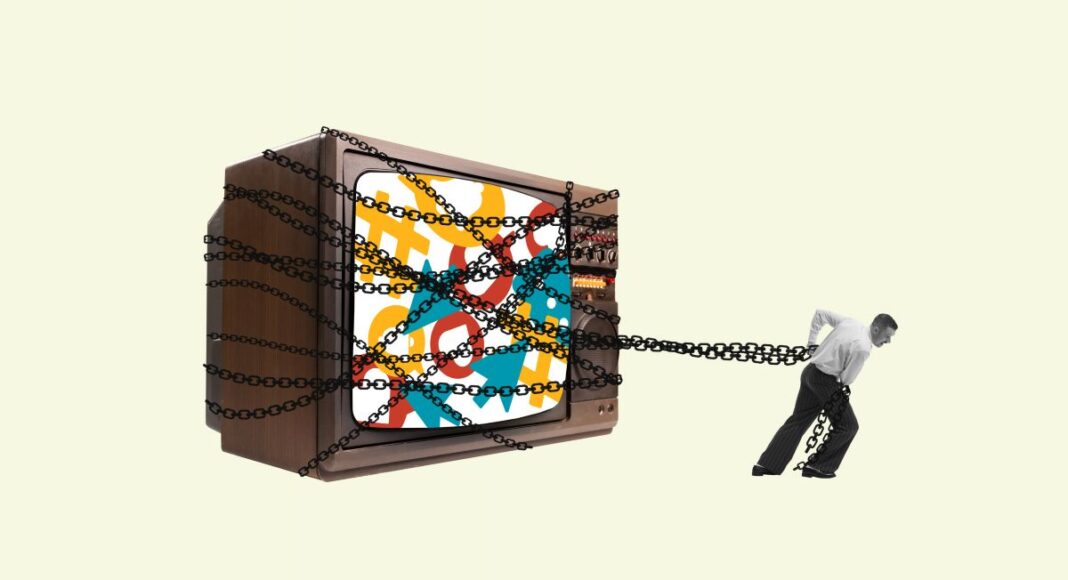

The proposed merger of local broadcast television station owners Nexstar and Tegna will create a behemoth that threatens to raise consumer prices for multi-video programming subscriptions, increase advertising rates for local businesses, and reduce viewers’ exposure to diverse viewpoints. The government can and should block the merger but politics threatens to usurp law and economics, writes Diana L. Moss.
Last fall, local broadcast television station owners Nexstar and Tegna announced a $6.2 billion merger. The deal will vault the first and third largest local TV station owners in the United States into the top slot, opening a yawning gap between the size of Nexstar-Tegna and the next largest station owner, Gray Television. The resulting behemoth will control about 265 full-power TV stations, capable of reaching larger regional areas, as compared to lower-power stations. These stations operate in the vast majority of states and in over 60% of local markets, or designated market areas (DMAs). Its national audience reach will top over 80% of U.S. households.
The myriad ways in which a single, powerful TV station owner will touch the lives of hundreds of millions of Americans are stunning. By eliminating major, head-to-head competition in local TV, the merger will tilt bargaining power in markets all along the supply chain. This risks higher subscription prices for multi-video programming (MVP) services that carry local TV stations; higher TV advertising rates for local businesses; and the erosion of diversity of political, social, and cultural viewpoint in local news reporting and content.
In any other political administration, Americans could have counted on the Federal Communications Commission (FCC) and Department of Justice (DOJ) to ensure that the Nexstar-Tegna merger never made it out of the boardroom or, alternatively, was dead on arrival at the agencies’ doorsteps. Not so under the Trump administration. The deal is papered with opportunism and cronyism that is now the hallmark of a politicized U.S. antitrust enforcement and regulatory system. U.S. consumers will be the big losers.
The Nexstar-Tegna deal achieved a semblance of notoriety just before the companies filed their application to transfer broadcast TV licenses with the FCC. After a Jimmy Kimmel monologue that referenced the Charlie Kirk murder, FCC Chairman Brendan Carr threatened to revoke the TV station licenses of ABC, which broadcasts the late night show. Soon after, Nexstar—owner of almost 200 local TV stations, many of which affiliate with the national networks to broadcast their content—pulled the Kimmel show off the air, caving to political pressure while simultaneously greasing the skids for FCC approval of its merger.
Mergers of local TV stations are subject to dual review by the FCC and the DOJ. Despite the difference between the FCC’s broader public interest standard and the DOJ’s “no harm” to competition standard, both agencies have taken a fairly consistent, pro-competition and pro-consumer line in rejecting consolidation that eliminates head-to-head rivalry in local TV markets. This means saying no to deals like Nexstar-Tegna that concentrate local TV markets and exceed the FCC’s 39% national audience viewership cap.
Combining Nexstar and Tegna eliminates head-to-head competition in local TV in almost 70% of “overlap” DMAs where Tegna currently operates. The effects will be felt in numerous cities, including Los Angeles, Indianapolis, Memphis, and Tampa, to name a few. President Donald Trump has publicly supported the deal for political reasons—namely to push back against the “fake news” national TV networks. His FCC chairman, who has actively chipped away at the agency’s local TV ownership rules, has fallen into line, committing to wave away the congressionally mandated national cap to allow the merger to proceed.
It doesn’t take an advanced degree to appreciate the gravity of creating a firm that wields enormous control over local TV stations in the U.S. Let’s start with the consumer “pocketbook” issues. First, the Nexstar-Tegna merger will give the company significantly more bargaining power in negotiations over retransmission fees. Those fees are paid by multi-video programming distributors (MVPDs), which provide bundled television channels through cable, satellite, fiber optic, or virtually (e.g., YouTube and Hulu Live), to local TV stations to carry their signals. This market has become more competitive over the last 15 years with the entry and expansion of new players.
The higher retransmission fees for carrying TV signals that Nexstar-Tegna will extract will skew the competitive dynamics among physical and virtual MVPDs. Fees will be passed on to subscribers through higher prices for MVPD services. Negotiation disputes will inevitably lead to more blackouts while Nexstar-Tegna pressures MVPDs to meet their demands, and some MVPDs may choose to drop local TV signals altogether. This threatens to drive up consumer prices for content, including local news, and reduce access to programming.
Second, the Nexstar-Tegna merger could increase TV advertising rates to local businesses. With more market power, the merged company will have the ability and incentive to raise advertising spot rates, making it harder for local businesses that serve communities to compete and survive. The systemic effects of this anticompetitive effect on communities could be substantial as businesses lose sales, visibility, and trust, and a robust local economy that consumers rely on.
Last, but not least, the loss of head-to-head competition and increased concentration in local news markets that will result from the Nexstar-Tegna merger imperils diversity in local TV news. The FCC ownership cap was expressly designed to promote diversity of viewpoint and preserve independent news in local TV markets. Lifting it to facilitate the Nexstar-Tegna merger virtually guarantees less diversity, at a time when Americans are struggling to make sense of extreme bias and conflict in the political system.
None of this is good news for competition and consumers. Nexstar-Tegna wave these concerns away with arguments that, under any other administration, would likely crumple under scrutiny.
For example, the company claims that local TV news competes in the same market as that produced by large players like Big Tech and big media. Were the government to buy into the narrative that consumers view all news outlets as perfect substitutes, local TV stations would compete in an enormous market, dwarfing the impact of the merger on competition.
This rationale is likely to play well at the FCC, given recent changes in thinking about news media markets. But it will run afoul of established DOJ precedent that local TV is a distinct market. At the recent Senate Commerce Committee hearing on the merger, for example, lawmakers heard evidence for why local TV is a separate market because Americans turn to it as a unique source for information on news and emergencies, and community connection.
Given the likelihood that the FCC considers local TV news in a larger market, there would be little to stop it from agreeing that Nexstar and Tegna need to bulk up to compete more effectively against larger players. No so with the DOJ. This rationale would face intense scrutiny under the 2023 Merger Guidelines, which are skeptical of “efficiencies defenses” for highly concentrative mergers. Moreover, Nexstar-Tegna cannot realize their touted revenue cost and synergies without counting the higher retransmission fees the company will extract by exercising market power against MVPDs. This also runs afoul of the 2023 Merger Guidelines, which do not count claimed merger efficiencies that result from the anticompetitive worsening of terms of trade.
Were the U.S. in a different presidential ecosystem, the Nexstar-Tegna merger would be dead on arrival. But it isn’t. The FCC has committed to do Trump’s bidding in what has become the new norm—unprecedented White House interference in independent agency investigations and decision-making to advance a political agenda. The politically charged ouster of Assistant Attorney General Gail Slater at the DOJ’s Antitrust Division on February 13 virtually guarantees that a favorable outcome for the Nexstar-Tegna merger is in the bag.
Americans will feel the pain of the enormous consolidation of economic power in the hands of a merged Nexstar-Tegna. Consumers will struggle to pay for higher MVPD subscription fees and see less competition in multi-video programming; local TV advertising rates will go up; and local TV stations will be forced to change their reporting. When this dismal landscape unfolds, the full impact of a supercharged political takeover of the U.S. antitrust and regulatory system will be felt, and the Nexstar-Tegna merger will add to the growing list of politicized mergers that imperil due process and the rule of law.
Author’s Disclosure: Diana Moss works for the Progressive Policy Institute. PPI is supported by corporations, individuals, and foundations such as the Lumina Foundation, Peterson Foundation, and Arnold Foundation. No funding source influenced the arguments expressed in this article or stands to benefit from them.
Articles represent the opinions of their writers, not necessarily those of the University of Chicago, the Booth School of Business, or its faculty.
Subscribe here for ProMarket’s weekly newsletter, Special Interest, to stay up to date on ProMarket’s coverage of the political economy and other content from the Stigler Center.