




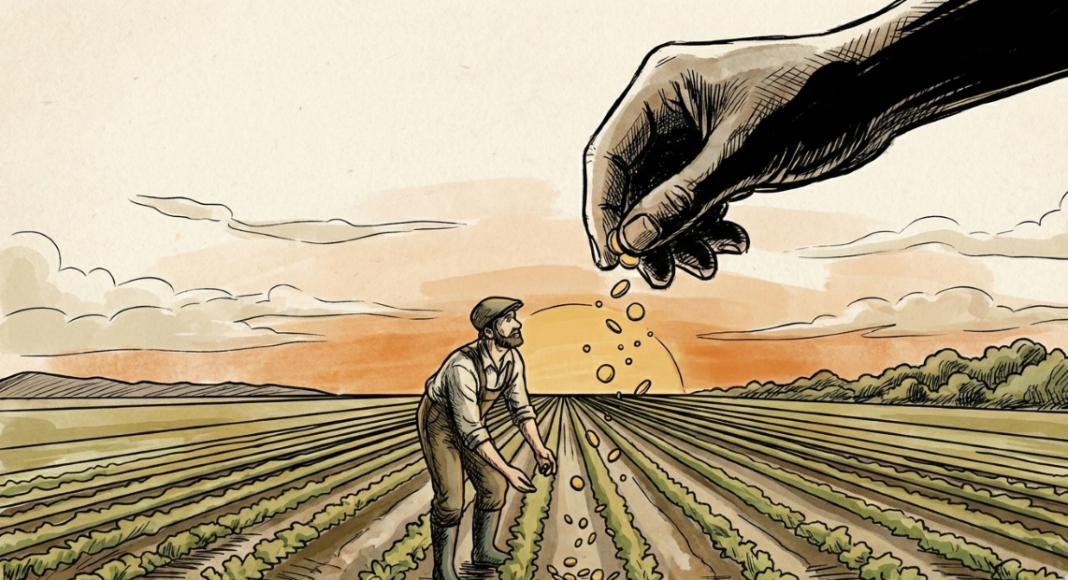

Department of Justice Assistant Attorney General Gail Slater recently gave a speech repudiating the laissez-faire antitrust enforcement policy of past administrations. Meanwhile, President Donald Trump has ordered antitrust agencies to investigate how price-fixing has raised food prices. If the administration is serious about bringing food prices down for Americans, it should begin by addressing the costs farmers face. For that reason, Slater should investigate and possibly challenge the mergers between large seed sellers that occurred during Trump’s first term in office, writes Peter Carstensen.
In November, Department of Justice Assistant Attorney General Gail Slater criticized the weak merger enforcement policies of the Reagan, Bush Sr. and Clinton administrations. These administrations bought into the ideas of the Chicago School, which naively believes that the free market works optimally, even in highly concentrated markets. Their assumption that firms would be very unlikely to act in tacit, if not overt, collusion when concentration is high enough—even to the threshold of monopoly—ignored the economic and business realities of such market structures.Another frequent assumption, embodied in the famous diagram from Oliver Williamson, postulates that firms can set monopolistic prices that are net efficient, but ignores the fact that net efficient mergers are rare and only occur in highly unusual conditions. Rather, firms operating in concentrated markets have a strong incentive to raise prices for consumers and exploit suppliers by imposing lower prices.
A post-Chicago ethos of stronger merger enforcement arose during the early 2000s, but lax merger enforcement continued through the 2010s, including during Trump’s first term. However, Trump in his second term appears to be reversing course in some markets as Americans fret over the cost of living, particularly high food prices. The question is, to tackle food prices, whether his administration will reverse the mergers of large agricultural firms his officials approved during his first term.
Will the Trump administration take on high food prices?
The effects of mergers on agricultural markets have come into focus as the prices of groceries have increased. In December, Trump signed an executive order on food price-fixing. It directed the DOJ and Federal Trade Commission to form a task force to investigate “whether anti-competitive behavior exists in food supply chains” and “whether control of food-related industries by foreign entities is increasing the cost of food products.” It also ordered the antitrust agencies to bring lawsuits and propose new rules “to remedy any anti-competitive behavior” they find in food-related companies.
In her November remarks, Slater acknowledged that the first Trump administration had allowed massive consolidation in the seed industry between Bayer and Monsanto, ChemChina and Syngenta, and DuPont and Dow. These approvals came with only some limited divestitures. These mergers reduced the number of major seed competitors from six to three, though divestitures from Bayer as a condition of its merger with Monsanto has allowed BASF to emerge as a more significant, if still minor, market participant. This consolidation resulted in sizable increases in market power in at least two seed markets. In the corn seed market, DuPont, which had a 34.7% market share, was allowed to merge with Dow, which had 4.1%. The merged firm now has 38.3% (using the most recent statistics). For soybean seeds, DuPont had a 31.9% market share and Dow had 5.8%. Together, they held 37.7% which they spun off into a new company, Corteva.. These changes, however sizable in themselves, significantly understate the market dominance of these firms.
The big four collectively own 95% of corn seed intellectual property (patented traits) and 84% of soybean IP, according to a 2023 Department of Agriculture report. Bayer alone controls 57% of corn seed IP and 43% of soybean IP, and with Corteva, it dominates corn and soybeans with only token representation by other firms.
The use of patents for seed technology is a result of courts creating rights in plant technology that conflicted with the model Congress created in its 1970 law to protect the intellectual property in seeds: the Plant Variety Protection Act. That law provided 20-25 years of exclusivity for new plant varieties, but allowed farmers to save and replant seed, authorized other seed developers to use the variety in developing new varieties (similar to the exemption for drug companies to use a patented medicine in developing new patentable drugs), and authorized the United States Department of Agriculture to impose compulsory licensing of the variety under limited circumstances. In the 1980 case Dimond v. Chakrabarty, the Supreme Court expanded patent law to include the patenting of life forms. The lower courts interpreted this to include seeds. Then in its 2013 decision in Bowman v. Monsanto Co., the Supreme Courtexpanded the scope of the patent right by determining that if a farmer saved and replanted seed with a patented gene, this infringed the patent owner’s rights. This greatly limited the scope of first sale doctrine as applied to seeds.
These judicially created patent rights impose excessive and burdensome limits on innovation in the development of new traits and types of seeds that, for example, are genetically modified to better survive certain herbicides or have more desirable characteristics as food ingredients or fodder for animals. These decisions confer on the patent holder the absolute power to restrict the uses the farmer can make of a seed containing such a trait. Indeed, patent holders can prohibit farmers from planting their seeds altogether by refusing to license the farmer. These interpretations have also greatly expanded the power of a seed trait patent holder to control when and how third parties incorporate that trait into commercial seeds. A 2023 report from the USDA highlights the problems that exist for farmers and smaller plant breeders, including higher prices and less choice.
This total control of essential technology has made “independent” companies selling seed to farmers into vassals of the big four. Patent licenses and loyalty programs preclude them from operating as truly independent competitors in the seed markets to provide competing and specialized variants of seeds. The harms to competition were recently highlighted in a congressional hearing in which the exploitation and abuse by the big four were documented. The big four demand that the independent seed companies disclose their customer lists and prices while the big four are directly competing for those customers. They set high base prices for traits and then provide substantial rebates but only if the seed company delivers a very high percentage of its sales to the patent holder.
Unwinding the harmful agricultural mergers
The levels of concentration resulting from the 2017-18 mergers are ones that “may . . . substantially lessen competition” in both the seed and the seed IP markets. In addition, they “may . . .tend to create a monopoly” in these markets. It deserves emphasis that the tendency to create a monopoly is a distinct basis for rejecting a merger. The Supreme Court’s International Salt ruling, which applied Section Three of the Clayton Act’s identical “tend to create a monopoly” language, confirms this understanding. As the Court’s majority opinion said, “Under the law, agreements are forbidden which ‘tend to create a monopoly,’ and it is immaterial that the tendency is a creeping one rather than one that proceeds at full gallop[] . . . .”
The seed mergers were not blocked when they occurred in 2017-18, perhaps because the decisionmakers applied the old, weak merger enforcement ideas that Slater condemned. The good news is that these mergers could be challenged today because consummated mergers that continue to have anticompetitive effects are continuing violations of the Clayton Act.
Will Trump’s executive order trigger action by the DOJ? The crucial question is whether Slater will attempt to correct these past mistakes. Slater has spoken important truths about how mergers among major competitors can harm competition, consumers, and producers. Now she has the chance to correct enforcement failures that arose from 2017-18 for the reasons she articulated in November. She should immediately reopen investigations into these seed mergers.
Author’s Note: The author is grateful to Robert Lande for his feedback and help on the initial draft.
Author Disclosure: The author reports no conflicts of interest. You can read our disclosure policy here.
Articles represent the opinions of their writers, not necessarily those of the University of Chicago, the Booth School of Business, or its faculty.
Subscribe here for ProMarket’s weekly newsletter, Special Interest, to stay up to date on ProMarket’s coverage of the political economy and other content from the Stigler Center.