






In new research, Alexander Furnas, Timothy LaPira, and Clare Brock find that most politically active organizations engage in either campaign contributions or lobbying, but rarely both. The findings have implications for regulation and future academic research.
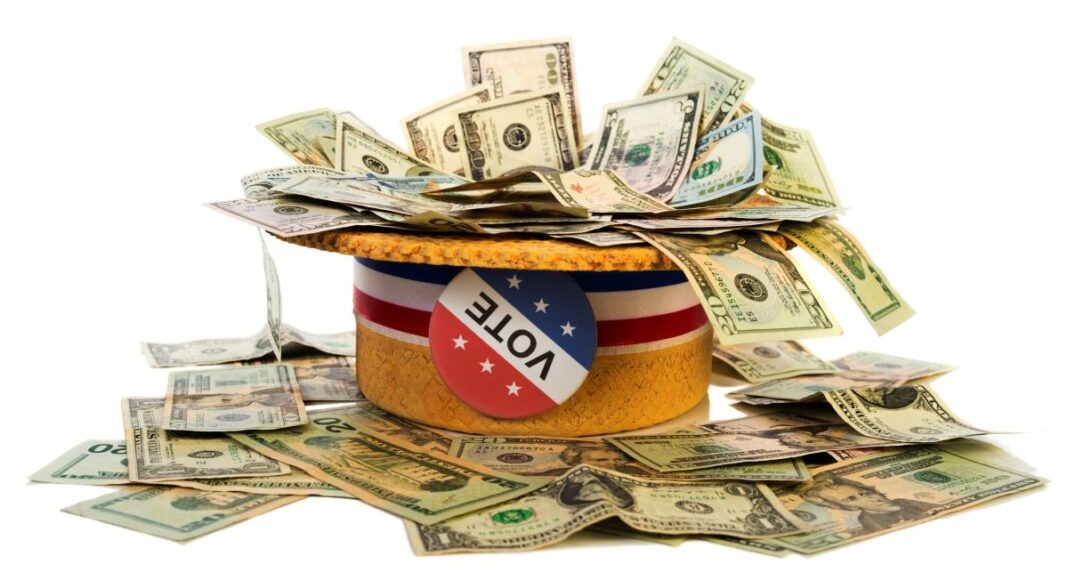
When Americans hear the phrase “money in politics,” they tend to imagine a single, unified system of influence. Lobbyists, campaign donors, political action committees (PACs), fundraisers, and access are often treated as interchangeable parts of the same machinery. In public debate, journalistic coverage, and even federal law, lobbying expenditures and campaign contributions are routinely conflated—as if organizations that give money to candidates are the same ones that lobby policymakers, and as if both activities serve the same purpose.
Our recent research shows that this intuition is wrong in a fundamental way. Lobbying and campaign giving are not just legally distinct. In practice, they are pursued by different sets of organizations. Misunderstanding this fact has distorted how scholars, reformers, and policymakers think about political influence. Clarification will help produce more effective reform.
Why lobbying and campaign giving are lumped together
The idea that lobbying and campaign contributions go hand in hand is deeply ingrained. The standard story is straightforward: interest groups donate to candidates to gain access when they win office, then use that access to lobby for favorable policy. This logic appears in classic theories of access, in countless news stories about K Street, and in popular accounts of corruption and capture.
The legal and regulatory framework reinforces this intuition. The 2008 Honest Leadership and Open Government Act, for example, expanded disclosure requirements for lobbyists by requiring them to report campaign contributions—effectively treating electoral giving as a subset of lobbying activity. Media coverage routinely slides between the two, describing campaign donors as “lobbyists” and implying that fundraising and policy advocacy are part of the same transactional exchange.
Yet until now, there has been surprisingly little systematic evidence on whether organizations actually behave this way. Do most groups that lobby also give campaign money? Are PACs intimately tied to lobbying operations? Or are these activities more separate than we tend to assume?
A simple accounting exercise
In our study, we take a basic empirical step that is often skipped: we study organizations. Using comprehensive federal data from 1998 to 2018, we link organizations’ lobbying disclosures with their campaign contributions through affiliated PACs. We focus on official organizational activity—registered lobbying and PAC giving—rather than donations by individual executives or lobbyists acting in their personal capacity. This allows us to observe how organizations themselves choose to engage in politics.
The results are striking. In any given election cycle:
- The majority (72.7%) of politically active organizations register to lobby but do not make PAC contributions.
- A smaller share of politically active organizations make PAC contributions but do not lobby.
- Only about 10–15 percent of organizations do both in the same year.
This pattern is remarkably stable over time. Even as the total number of politically active organizations grew—particularly during the late 2000s—the basic division between lobbying-only, PAC-only, and dual-engagement groups remained steady. The typical politically active organization specializes in one strategy rather than combining both.
Big spenders versus typical organizations
At first glance, this finding seems to clash with another familiar fact: the biggest players in Washington appear to do everything. And in a narrow sense, that is true.
When we examine spending rather than headcounts, lobbying dollars are highly concentrated. A relatively small number of large, well-resourced organizations account for most lobbying expenditures, and these organizations almost always have affiliated PACs. Between 1998 and 2018, roughly three-quarters of all lobbying spending came from organizations that also made PAC contributions.
But this concentration is precisely why conflating different forms of money in politics is misleading. A small set of elite organizations dominates total spending, while thousands of others pursue far more limited strategies. Over the full 20-year period we study, only about six percent of organizations that appeared in lobbying or PAC records ever engaged in both activities.
In other words, the groups that both lobby and give are real, but they are exceptional and have outsized influence. Treating them as representative of normal organizational or corporate behavior obscures the actual behavior of the vast majority of politically active organizations.
Why organizations choose one strategy—or the other
Why would most organizations specialize rather than combine lobbying and campaign giving?
One reason is that the two activities operate on very different cost structures and time horizons. Lobbying has high startup costs. Hiring in-house staff or retaining a lobbying firm requires sustained financial and organizational commitment. Furthermore, once an organization begins lobbying, it often stays engaged over long periods: monitoring legislation, shaping regulatory details, or defending the status quo.
PAC contributions are different. Many organizations make relatively small donations, sometimes under $10,000 in an election cycle, without any expectation of ongoing interactions with politicians. Campaign giving can be episodic, symbolic, or partisan rather than relational. It does not require the same long-term investment as maintaining a lobbying presence.
These choices appear to be deliberate. Qualitative evidence from lobbying practitioners underscores that many organizations consciously avoid campaign finance altogether, relying instead on expertise, reputation building, number of members for organizations like the AARP or AAA, or repeated professional interaction to gain access. Others engage in electoral politics without ever building a lobbying operation.
Implications for access and influence
These patterns complicate the common story about how money buys power. If most lobbying organizations do not give campaign money, they must be gaining access in other ways—through information provision, credibility, constituent representation, or long-standing relationships. Conversely, if most PACs are not attached to lobbying operations, campaign contributions alone cannot be understood primarily as tickets to lobbying access or policy success.
This does not mean money is irrelevant. Rather, it suggests that different kinds of political spending do different kinds of work. For the small set of well-resourced organizations that both lobby and contribute, PAC spending appears to be additive—layered on top of already substantial lobbying operations. For most organizations, however, the notion that lobbying and campaign giving are substitutes is myth, not reality.
Conclusion
Conflating lobbying and campaign contributions has real consequences. It blurs analytical distinctions in academic research, encourages overly broad claims about “money in politics,” and leads to regulatory designs that miss their target. When reform efforts assume that campaign finance rules will meaningfully reshape lobbying—or that lobbying disclosure will illuminate electoral influence—they risk addressing the wrong problem.
A clearer understanding of how organizations actually engage politically suggests a more modest but more accurate conclusion: lobbying and campaign engagement are distinct strategies, used by different actors for different purposes, with limited overlap except among the select few most powerful players.
If we want a more informed debate about political influence, and more effective policy responses, we need to stop treating all political money as equivalent. The details matter, and the data show that the American pressure system is more segmented and more strategic than the usual narratives allow.
Authors’ Disclosures: The authors report no conflicts of interest. You can read our disclosure policy here.
Articles represent the opinions of their writers, not necessarily those of the University of Chicago, the Booth School of Business, or its faculty.
Subscribe here for ProMarket’s weekly newsletter, Special Interest, to stay up to date on ProMarket’s coverage of the political economy and other content from the Stigler Center.