


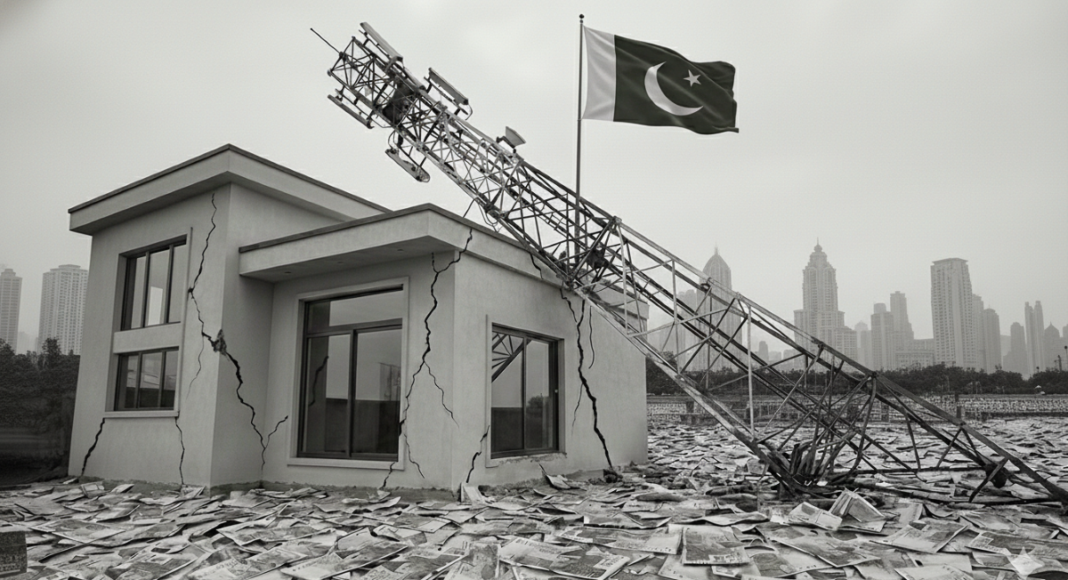

Hamza Azhar Salam discusses the recent history of real estate moguls in Pakistan buying up media outlets to influence government investigations against them and their properties and win access to powerful government offices. The moguls’ capture of the media has led to capture of the state.
Six prominent Pakistani real estate developers each own a newsroom dedicated to covering politics: Aleem Khan (SAMAA TV), Saad Nazir (Suno TV), Malik Riaz (Nukta), Chaudhry Aurangzeb (News One), Mian Mushtaq of Al Rehman Group (Public News), and Gohar Ejaz (Channel 24). Of Pakistan’s 31 licensed television news channels, these six developers control five, representing 16% of the market. Nukta is a digital news platform.
None of the six real estate developers had any prior experience or demonstrable interest in media before entering the industry. Nor were their acquisitions or launches sound business ventures. Since Pakistani media companies are privately held, their financial accounts are not publicly available, making statistics on industry-wide profitability impossible to verify. However, the available evidence suggests most are losing money. SAMAA TV disclosed accumulated losses of 11.15 billion rupees ($39.5 million) when Khan acquired it in 2021. Although television still outpaces digital alternatives with an estimated 150 million viewers, 31% of ad revenue has migrated to digital platforms since 2023. Still, Nukta laid off 37 employees, or reportedly about 35-50% of its total staff, within a year of its launch in October 2024.
Though often unprofitable or operating on thin margins, these media outlets offer the real estate moguls a more important function: the ability to influence regulation, oversight, and public perception. Cable penetration in urban areas stands at 97%, and news channels account for 19% of total television viewership. Indeed, before their media acquisitions or launches, at least four of the six real estate developers faced severe regulatory burdens, legal disputes, or active investigations regarding their real estate operations. Many of these issues disappeared soon after their media forays and the attendant influence campaigns they ran afterward.
Aleem Khan: from National Accountability Bureau custody to federal cabinet
Take Aleem Khan. In February 2019, Pakistan’s anti-corruption agency, the National Accountability Bureau (NAB), arrested Khan on charges of owning assets beyond his means. The bureau alleged that Khan had at least 1.4 billion rupees (about $5 million) in assets beyond his known sources of income.
In December 2020, the Islamabad High Court revoked Khan’s non-objection certificate (NOC), which businesses need from their relevant regulators to legally operate, for his primary holding, Park View City, a housing society development in the capital, Islamabad. The High Court declared the project illegal for causing 2.1 billion rupees ($7.5 million) in losses to the national exchequer due to irregular and unjustified restoration of a previously cancelled NOC. The Capital Development Authority, responsible for providing municipal services in Islamabad Capital Territory, then cancelled the project again.
Months later, in September 2021, Khan acquired SAMAA TV, Pakistan’s fourth largest 24-hour news channel. The channel commands a 7% market share in Pakistani news television. In less than three years, not only would most of Khan’s legal troubles disappear, but he would also take the oath as Pakistan’s minister for both privatization and communications, overseeing the very industry in which he holds financial stakes as well as the sale of state assets worth tens of billions of dollars. He is currently just the minister of communications and still owns SAMAA TV.
Amendments to the National Accountability Ordinance 1999 in 2022 resulted in NAB dropping cases against multiple individuals, including Khan. The amendments raised the investigation threshold for corruption to 500 million rupees and removed the requirement that the accused persons prove their “money trail”—making it significantly easier for wealthy individuals to escape prosecution.
Regulation of real estate in Pakistan
Most real estate firms in Pakistan operate in a regulatory grey area. Many lack NOCs, violate zoning laws, or infringe local governments’ provincial master plans for development. Aleem Khan’s Park View City came under recent scrutiny again after the housing society experienced severe flooding last summer. Reports emerged that Khan had built part of the society on environmentally sensitive and state-owned areas, including riverbeds vulnerable to flooding, in collusion with local officials.
Not all zoning infringements are intentional. Protected lands are often poorly demarcated. That said, developments are also rife with fraud, including selling more plots than they own or underdelivering on infrastructure and amenities. In Rawalpindi, the third-largest city in Punjab, the Rawalpindi Development Authority declared over 340 of 405 housing societies to be illegal in 2023. That same year, in Islamabad, the Capital Development Authority declared over 100 societies illegal. In response to these violations, development authorities cancel NOCs, courts impose fines, and the NAB and other accountability organizations open criminal investigations.
This has not stopped developers from continuing their operations. Illegal societies are still profitable because enforcement is weak, transparency is non-existent and rarely expected by homebuyers, and there is no effective mechanism for governments or buyers to claw back money. Media outlets ignore orders from the Pakistan Electronic Media Regulatory Authority (PEMRA) to stop advertising illegal societies. Police and local authorities can be co-opted, and developers have hired relatives of senior officials to influence investigations and oversight. Once middle-class Pakistanis invest in the societies and move in, it becomes impossible for the government to shut down the societies outright, which would displace constituents. Nevertheless, defrauded homeowners and investors become stuck with legally unprotected assets.
Media influence campaigns offer another solution for the real estate moguls who can afford them.
Malik Riaz: Pakistan’s most powerful developer
This would explain why Malik Riaz launched Aap News in 2018, a loss-making news channel that shut down in 2020 due to financial problems. Riaz was among the first of the real estate developers to begin snapping up media assets.
Riaz is Pakistan’s largest real estate developer and arguably the country’s most famous businessman. He founded Bahria Town in 1997 and is reportedly worth $2.5 billion. He’s also been investigated for various alleged crimes since the early 2000s.
In 2012, the Supreme Court ordered probes into Bahria Town, which has since expanded throughout Pakistan. Riaz responded by showing that the chief justice’s son had extorted bribes from him. That same year, it emerged that Bahria Town had hired the daughter of the NAB chairman, who later resigned from her “lucrative” post due to conflicts of interest. Riaz has often gone on record admitting that he gives bribes, claiming it is the norm and only way to do business in Pakistan. Indeed, Transparency International found that Pakistan ranks 135 out of 180 countries in corruption and the World Bank ranks Pakistan in the bottom 20% of all economies for many factors in its “Business Ready” index, which replaced its “Ease of Doing Business” Index. These include judicial transparency and arbitration services. Riaz is infamous for having said that he greases the regulatory process with cash to speed up bureaucratic approval, or, as he put it, “puts wheels on files.”
Only in the late 2010s did investigations finally catch up to Riaz. In 2018, the Supreme Court ordered new probes into Bahria Town and fined the society 460 billion rupees (over $3 billion at the time) in 2019. The Supreme Court claimed that the Riaz had built the society with an illegal acquisition of 16,896 acres of land previously owned by the Malir Development Authority.
That same year, the United Kingdom’s National Crime Agency settled with Riaz for 190 million pounds over concerns that his massive unexplained wealth in the U.K. had been acquired through money laundering. The settlement included a valuable property at One Hyde Park Place and nine freezing orders on accounts holding upwards of 140 million pounds in U.K. banks.
By October 2023, Bahria Town had only paid 13% of the total Supreme Court fine. Most of this was controversially “adjusted” from the 190 million pound NCA settlement: the U.K. settlement funds, which were supposed to be repatriated to the Pakistani government for unrelated money laundering concerns, were instead applied to the Supreme Court fine. This became a major corruption case in Pakistan that ensnared former Pakistani prime minister Imran Khan.
By 2024, Pakistani authorities began seizing Bahria Town assets. Riaz absconded to the United Arab Emirates, where he launched his second media venture, Nukta. The platform is led by veteran journalist Kamran Khan.
Nukta frequently positions Bahria Town and Malik Riaz as legitimate developers, actively promoting Bahria Town projects despite current cases and asset freezes in Pakistan. Promotional content for Bahria Town appears regularly on Nukta’s platforms, presenting the company as operating per usual. In one news story from May 2025, Nukta promotes Bahria Town’s expansion into Dubai, leaving out that the NAB had warned Pakistani investors against participating in the project and that efforts were being made to extradite Malik Riaz back to Pakistan. Hundreds of thousands of residents do still live on in its Pakistani developments, though Riaz’s assets are now being auctioned to pay for his liabilities.
This follows the same pattern: SAMAA promotes Aleem Khan, News One endorses Chaudhry Aurangzeb, Suno TV protects Saad Nazir. The outlets act as arms of public relations for their owners’ real estate businesses while providing leverage against actors investigating them.
How real estate has captured the Pakistani state
Saad Nazir is the founder of Blue World City, a housing society near Islamabad. In 2020, the Rawalpindi Development Authority declared Blue World City illegal for encroaching on state land. The Rawalpindi Capital Police Officer had also accused some of the society’s owners of murder, kidnapping, and terrorism. There are 38 first information reports—complaints lodged with the police to initiate an investigation— registered against co-owner Chaudhry Naeem Ijaz, including charges under the Anti- Terrorism Act. Various real estate marketing websites suggest the society could provide housing for hundreds of thousands of people. The exact size is unknown, as the project is still under development.
In January 2023, Blue World City launched Suno TV, a 24-hour news channel. Just a month after Suno TV began operations, Rawalpindi’s Capital Police Officer formally wrote to PEMRA, alleging that Suno TV was “running a scathing campaign against Rawalpindi Police” and “using the news channel as a weapon to threaten the police force and prevent them from acting against the ‘renowned Qabza Mafia.’” Qabza Mafia refers to organized criminal entities in Pakistan that exploit legal loopholes or use coercion and fraud to possess public and private land. Suno TV’s coverage specifically targeted senior police leadership who were conducting raids on Blue World City’s offices.
Meanwhile, the Rawalpindi Development Authority wrote to PEMRA demanding it stop illegal housing societies from advertising on mainstream television, specifically mentioning Blue World City. PEMRA did not take action, and no known reason was given.
The investigation against Blue World City continues but the society has not been permanently closed. It is actively selling plots. In October 2024, Blue World City became the sole bidder to acquire Pakistan International Airlines. The deal was overseen by Aleem Khan, who had become the minister of privatization. Though the deal ultimately fell through, the scenario illustrates the depth of real estate’s capture of Pakistani institutions: one property developer bidding for a national airline, with another property developer-turned-minister deciding the outcome.
In 2020, NAB and the Lahore Development Authority investigated Chaudhry Aurangzeb’s Al Kabir Group for a 25 billion rupee (about $90 million) scam involving selling over 13,000 illegal plots when they had permission to sell only 804. In September 2023, the Al Kabir Group joined the list of real estate tycoons owning media groups when they acquired News One. The investigations have not resulted in prosecution. Now, the outlet continues promoting its owner’s real estate projects, even conducting hour-long sycophantic interviews with Aurangzeb. In one interview, the journalist describes Aurangzeb as not “just a tycoon but a brand in real estate. He is the one who showed that real estate isn’t just about buying and selling but the realization of dreams. He considers real estate not as a business but a mission to enable the common man to buy their own home.”
Similarly, Al Rehman Group, a real estate firm, acquired Public News in March 2023. The outlet follows the same pattern, actively promoting its owner Mian Mushtaq and presenting Al Rehman developments as legitimate and lucrative investments despite ongoing investigations.
These transitions can run the other way. Salman Iqbal, the owner of ARY News, one of Pakistan’s largest news channels, launched ARY Laguna in 2020. ARY News actively promotes ARY Laguna as a promising real estate investment. The project has been subject to various controversies, including allegations of defrauding investors.
From regulatory capture to becoming the state
Real estate moguls’ manipulation of the state has not ended with media capture and PR campaigns masquerading as news. In some cases, the moguls have become the state. Aleem Khan, as mentioned, became the minister of privatization and communication in 2024, which he held concurrently until 2025, when he continued with just the latter.
Gohar Ejaz and Mohsin Naqvi collectively invested in Channel 24, another 24-hour news channel. Ejaz, initially a textile spinner, ventured into real estate via Lake City Lahore, a 2,000-acre development, in 2004. Gohar Ejaz has been accused of illegally occupying land alongside Mohsin Naqvi, an established media baron, in the Punjab Government Servants Cooperative Society.
Since 2022, Channel 24 has pandered to the current government and criticized the previous prime minister, Imran Khan. In 2023, Ejaz took the oath as federal minister for commerce, industries, and production, with the powerful interior portfolio added later, which he held on an interim basis until March 2024. Naqvi was simultaneously appointed caretaker chief minister of Punjab until 2024. Naqvi is currently the federal minister for interior and also chairs Pakistan’s cricket board.
Real estate actors have transformed regulatory oversight into self-serving mechanisms. The 2025-26 Federal Budget provides clear evidence. The federal excise duty on property transactions, which used to run from 3-7%, has been withdrawn entirely. Withholding taxes on property transactions have been reduced from 4% to 2.5%. Stamp duty on real estate transactions in Islamabad has been reduced to 1%.
The capture of the media and state by Pakistan’s real estate moguls has made it all the more difficult for Pakistan’s anti-corruption and media regulators to stop illegal activity. Investigations are being dropped and laws on taxation changed in the favor of the moguls. With so many Pakistanis reliant on the moguls’ societies and newsrooms, there is at present no clear pathway by which Pakistan can extricate itself from the moguls’ control.
Author Disclosure: Malik Riaz, one of the principal characters in this story, and his team have previously threatened the author for his reporting on Riaz’s involvement in corruption in Pakistan. Reporters Without Borders condemned those threats and United Nations Special Rapporteurs wrote to the Government of Pakistan calling for the author’s safety.
Articles represent the opinions of their writers, not necessarily those of the University of Chicago, the Booth School of Business, or its faculty.
Subscribe here for ProMarket’s weekly newsletter, Special Interest, to stay up to date on ProMarket’s coverage of the political economy and other content from the Stigler Center.