







Nancy L. Rose and Jonathan Sallet respond to a recent article by Herbert Hovenkamp, in which he argues that the merger-efficiencies defense, which requires merging parties to demonstrate competitive benefits of a merger in order to rebut a prima facie case of harm presented by plaintiffs, is too burdensome and runs contrary to empirical evidence.
In his recent article, “The U.S. Supreme Court and the Merger Efficiency ‘Defense’,” Herbert Hovenkamp contends that the “cumbersome” use of a merger-efficiencies defense, which places on defendants—the merging parties—the task of demonstrating pro-competitive benefits, “puts the cart before the horse.” Louis Kaplow’s Rethinking Merger Analysis advances a similar theme. We believe, however, that maintaining an efficiencies defense keeps the horse from escaping the barn before careful analysis determines whether the barn door should be open or closed.
Hovenkamp’s conclusion that government enforcers should assess the relevant efficiencies as “part of the evaluation of a merger’s threats to competition, not an efficiency defense,” seems to suggest that antitrust enforcers do not currently assess efficiency claims when investigating a merger and before filing a lawsuit to block a deal. In our experiences serving in the Department of Justice Antitrust Division, however, one of the first things parties do in discussing a merger with agency staff is to provide arguments and white papers on the claimed efficiencies and pro-competitive benefits of the transaction, and the evaluation of those claims continues if an investigation is opened. If instead Hovenkamp is suggesting that the standard for evaluating efficiencies is too high, or that the government should bear the burden of disproving efficiencies as part of its prima facie case when challenging a merger, the conclusion does not follow from the relevant economic analyses or legal principles, as we have written elsewhere.
Hovenkamp’s concerns seem to rest heavily on the assumptions that, since few mergers are challenged by antitrust authorities, the vast majority of them must be beneficial, and therefore, more attention to the existence of benefits in investigation and litigation is warranted. As Hovenkamp writes, “of the 16000-25000 mergers that occur in the U.S. in a typical year, far fewer than 1% are ever challenged. The vast majority of mergers occur, not because of anticipated effects on the market, but because of changes in the structure and operation of the firm.”
The basis for his assertion that the vast majority of mergers are unrelated to the potential exercise of newly created market power is unclear. To the extent it derives from the low rates of investigations or challenges, we strongly disagree that these empirically validate Hovenkamp’s view that the vast majority of mergers “can profit only by better performance.”
Most importantly, most mergers receive no antitrust scrutiny not because they are pro-competitive, but because they are never notified to the agencies. Hart-Scott-Rodino (HSR) filing thresholds remove smaller transactions from merger review by the antitrust agencies, which means that HSR filings typically account for no more than 15 percent of U.S. mergers in a given year. Almost no non-HSR transactions are investigated, let alone challenged. This does not imply that non-HSR transactions are competitively benign, let alone beneficial. Successful challenges to consummated non-notified mergers, such as in US v Bazaarvoice Inc., and empirical work by Thomas Wollmann and others on “stealth consolidation” illustrate the potential anticompetitive impact, in some cases quite substantial, of non-notified and non-investigated mergers.
It is true that of the mergers subject to HSR filings, only a tiny fraction are investigated, let alone challenged. For example, in fiscal year 2024, the last year for which data are available, only three percent of the nearly 2,000 mergers with HSR filings before the agencies received a Second Request (2R), which initiates an in-depth investigation and often precedes a challenge, as illustrated by Figure 1.
Figure 1.
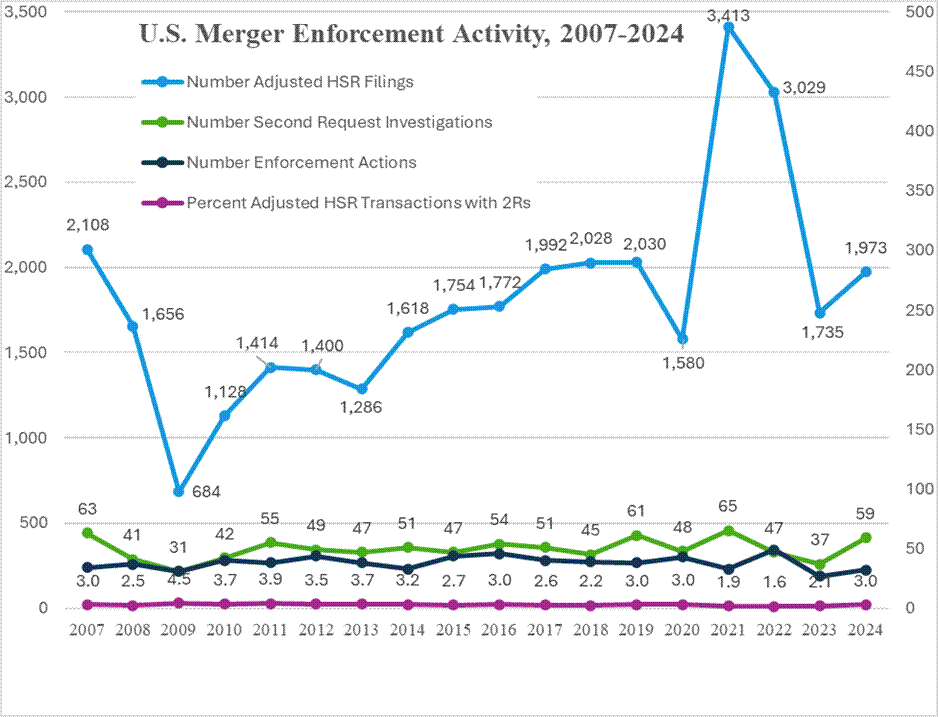
2024 is no outlier. From fiscal years 2007-2024, the percentage of Second Requests varied between a high of 4.5% in 2009, when the total number of HSR filings were at their lowest, to a low of 1.6% in 2022, when HSRs were at their second highest level. The low investigation rates likely reflect in large part both limited agency resources that sharply constrain the number of investigations and challenges that can be conducted and prevailing assumptions of some “standard efficiency credit”—a belief in some ubiquitous merger efficiencies— among regulators, rather than evidence that non-investigated mergers pose no threat to competition.
Agency budgets have failed to keep up with general inflation, let alone with the competitive wages of antitrust lawyers and economists, and have fallen dramatically in relation to the size of the economy and the magnitude of merger activity. Moreover, when the agencies investigate a merger, they almost always determine that the transaction poses some competitive problem, and, if litigated, courts almost always agree, at least for horizontal mergers. Across the time period represented in Figure 1, mergers were challenged, settled, or abandoned in nearly 80% of the 2R investigations. The fact that the number of investigations and enforcement actions has been roughly constant over time while the number of HSR filings has risen means that investigation rates have been gradually declining, consistent with agency resources constraining enforcement, particularly as those resources have been stretched still further by increased civil conduct litigation.
As we detail below, the focus of investigations and challenges has been on mergers that would further concentrate already concentrated markets. The 2023 Merger Guidelines tightened the Herfindahl–Hirschman index threshold for mergers presumed to be anticompetitive because of a perception that agencies should be investigating and likely enforcing against more mergers. Under the new guidelines, a merger in a market with five equal-sized competitors (a pre-merger HHI of 2000) falls within the scope of presumptive illegality. Furthermore, a merger in a market with four equal-sized competitors (a pre-merger HHI of 2500) would exceed the threshold for highly concentrated markets under both the 2010 and 2023 guidelines. The actual treatment of any specific merger would, of course, depend on the structure and change in concentration. Yet, Carl Shapiro and Howard Shelanski analyzed all mergers litigated to a decision between 2000-2010 and 2011-2020 and reported a mean post-merger HHI of 6535 and 5805 during each decade, respectively. The findings suggest litigated mergers involve, on average, a merger to symmetric duopoly or worse. This strongly suggests that many highly concentrating transactions may not be challenged, and it would be foolhardy to conclude that none of them poses threats to competition.
In fact, economic evidence supports the view that many anticompetitive mergers are not challenged, as John Kwoka argues in Mergers, Merger Control, and Remedies. Merger retrospectives provide evidence on the adverse competitive effects of many consummated mergers. Meta-analyses by Kwoka, Andrew Olsen, Reed Orchinik and Marc Remer, Annika Stöhr, and others find that mergers are more likely to adversely affect competitive outcomes like price than they are to improve them, as would have been expected if efficiencies dominate merger impacts. Studies that look at multiple mergers within a single sector such as hospitals or consumer products find a distribution of effects, generally with a mean effect adverse to competition and worse outcomes for mergers with the largest increase in or post-merger level of the HHI. An important study of the MillerCoors joint venture showed that even when significant merger efficiencies are realized, an increase in coordinated pricing post-merger can more than offset any benefit from those efficiencies, leading to net consumer harm.
Hovenkamp asserts that the vast majority of mergers are premised on “changes in the structure and operation of the firm” and not on “anticipated effects on the market.” What the merging parties anticipate, let alone publicly state as their intentions or their view of anticipated effects, is not necessarily a guide to realized competitive effects. After all, there are many motives for mergers that fall into neither the market power nor the efficiency buckets. The corporate finance literature suggests additional motivations for mergers that include tax savings, empire building and compensation-driven growth objectives, CEO hubris, and other agency problems. These motivations are not actionable under antitrust law, but neither are they generally pro-competitive or welfare-enhancing arguments for mergers.
We emphasized in our 2020 paper the historical but unverified assumption that horizontal mergers invariably produce efficiencies. Our view is consistent with the view Hovenkamp expressed in his 2017 paper, that “we tolerate most mergers because of a background, highly generalized belief that most—or at least many—do produce cost savings or improvements in products, services, or distribution.” As described above, this “generalized belief” is an insufficient basis under which to assume that non-investigated, non-challenged horizontal mergers are inherently lawful. But it is an even worse basis on which to form enforcement policy toward investigated mergers: that the large majority of mergers go unchallenged tells us exactly nothing about the competitive threats posed by the small minority that are thoroughly investigated and/or challenged.
We turn next to the appropriate legal framework for analyzing the small group of investigated mergers. Of course, investigated mergers are not reflective of mergers as a whole because, not surprisingly, merger investigations focus on the largest and most highly concentrating transactions. Our 2020 paper observes that a review of agency investigations “shows a very strong relationship between challenging a horizontal merger and market structure.” For example, Malcolm Coate’s comprehensive analysis of Federal Trade Commission merger investigations and challenges shows that 123 (41%) of the 301 merger investigations opened between 1993 and 2016 involved three-to-two firm mergers, and another 76 (25%) involved four-to-three firm mergers. Shapiro and Shelanski show that litigated challenges are even more focused on the most concentrating mergers.
There is no reason, and Hovenkamp offers none, that both merger investigation and litigation cannot incorporate a searching examination of “a merger’s effects on the firm’s own organization and operations” when the litigation standard is a merger-efficiencies defense, presented by the merging parties. Based on our experiences in the Antitrust Division, that is in fact precisely what happens.
The recognized judicial approach is the Baker-Hughes burden-shifting test, described in FTC v. Heinz, and which Hovenkamp, writing with Shapiro, has described as “critical for effective horizontal merger enforcement by the Department of Justice (DOJ) and the Federal Trade Commission (FTC).” Once the government has demonstrated a presumption that a merger will substantially lessen competition, “the defendants must produce evidence that show[s] that the market-share statistics [give] an inaccurate account of the [merger’s] probable effects on competition in the relevant market.” We know from recent experience that such a defendant’s showing of proffered pro-competitive efficiencies is closely inspected not only by the agencies, but also by courts, with exactly the kind of specificity that Hovenkamp seeks. In FTC v. Tapestry, Inc., the court rejected an efficiencies defense after finding, inter alia, that the magnitude of cost savings would not outweigh the merger’s harm to competition. Similar judicial scrutiny was applied, with varying results, in cases such asIllumina, Inc. v. FTC, State of New York et al v. Deutsche Telecom, and in both the district court in United States v. Anthem, Inc., and as affirmed by the D.C. Circuit Court on appeal.
Imposing the burden of proof on the government to demonstrate the source of potential efficiencies and then prove they are unlikely to occur as part of the affirmative case would unjustifiably burden governmental enforcement. Asymmetric information is a fundamental problem facing enforcers. As Hovenkamp has elsewhere argued, “evidence of efficiencies typically relates to a firm’s own internal production and processes. […] [F]irms almost always know more about their own internal processes and the costs of changing them than any outsider, including the merger enforcement Agencies.”
In other words, firms know a lot more than do enforcers about critical issues that include (i) the sources of possible efficiencies, (ii) the likelihood of realizing them, (iii) their magnitude, and (iv) whether they are merger-specific. Firms have little incentive to produce or share information that might suggest those efficiencies won’t materialize or won’t be sufficient to offset harm. They instead have a strong incentive to present the story in a way that gets their merger through.
Placing the burden on the government to prove that there are no efficiencies could allow merging parties, those with unique access to evidence on post-merger strategies and corporate operations, to entirely escape the need to provide any pro-competitive justification for the transaction, even in the face of substantial evidence of competitive harm. As one of us has written, “the strength of a prima facie case (established through a rebuttable presumption or otherwise) logically affects the defendant’s evidentiary burden to rebut evidence or presumption of harm,” and, as we have argued, only the strongest cases are fully investigated and/or litigated. Indeed, Hovenkamp’s proposal to require the government to prove there are no efficiencies as part of its prima facie case of harm fails to recognize the impossibility of proving that efficiencies do not exist under scientific hypothesis testing, which can reject a null hypothesis of no merger-specific efficiencies by an affirmative showing of likely efficiencies, or fail to reject that null hypothesis with available evidence, but cannot “prove” that none exist.
Hovenkamp suggests that the Supreme Court has already “incorporated efficiencies into the primary theory of harm.” However, the two Supreme Court decisions he relies upon for this assertion demonstrate that the lack of competitive harm is not the same as demonstrating positive benefits from efficiencies. In Brunswick Corp. v. Pueblo Bowl-O-Mat, Inc., the Supreme Court rejected damages awarded to firms that had challenged a merger. There, the plaintiffs had asserted that by rescuing struggling firms rather than allowing them to go out of business, the acquiring entity “preserved competition, thereby depriving [the plaintiffs] of the benefits of increased concentration” (emphasis added). The Supreme Court rightly recognized that such conduct was not “forbidden in the antitrust laws” and that the complaining firms could not prevail where the “entire proof of damages was based on their claim to profits that would have been earned had the acquired centers closed.” The reference to “cost savings” as a result of “investment in new equipment” relied upon by Hovenkamp to suggest the presence of an efficiencies analysis came in the portion of the opinion describing the lower court’s reasoning. But the Supreme Court vacated this lower court decision and, in any event, its reference to cost savings and investing in new equipment came in the portion of its decision describing the history of the case, not in the portion in which it decided the only question on which certiorari was granted: “whether antitrust damages are available where the sole injury alleged is that competitors were continued in business, thereby denying respondents an anticipated increase in market shares.”
Similarly, in Cargill v. Monfort, the Supreme Court granted certiorari to decide the question “whether loss or damage due to increased competition constitutes [antitrust] injury.” Relying on Brunswick, the Court held that it did not, reasoning that “t[he kind of competition that [plaintiff] Monfort alleges here, competition for increased market share, is not activity forbidden by the antitrust laws. It is simply, as petitioners claim, vigorous competition.”
To be sure, the plaintiff alleged that the lower prices harming its profitability would be the result of post-merger efficiencies, but the Court’s decision did not rest on any assessment of the likelihood that efficiencies would actually result or that savings would be passed along to consumers. Rather, it took the view that “[t]he kind of competition that Monfort alleges here, competition for increased market share, is not activity forbidden by the antitrust laws.” In other words, in both cases, the plaintiffs failed to demonstrate harm to competition, rendering consideration of the actual existence of claimed efficiencies, a critical component of any analysis of an efficiencies defense, unnecessary. In other words, the Supreme Court was resolving legal questions of competitive harm, not factual questions about the existence of cognizable efficiencies.
Thus, these two cases fail to support the view that disproving merger efficiencies is an initial burden for governmental enforcers to bear. And although the seminal decision in United States v. Philadelphia National Bank did not expressly address efficiencies, the court looked to evidence that would “rebut the inherently anticompetitive tendency manifested by these [market-share] percentages,” and considered the merging parties’ “affirmative justifications” for the proposed merger; a process that accords well with the modern treatment of an efficiencies defense.
In sum, the case for forcing antitrust enforcers to disprove efficiencies as part of a prima facie case has not been made. To do that would place a significant burden on antitrust enforcers that is justified neither by economics nor law. Merging parties have more than adequate incentive and ability to offer reasons to believe their transactions will be pro-competitive; we are aware of no study or empirical evidence to the contrary. What may sound like a technical disagreement of antitrust doctrine is, in fact, a fundamental challenge to the efficacy of merger enforcement. Where courts have placed the burden of proffering efficiencies on those proposing a merger, they should be celebrated, not contradicted.
Authors’ Note: The authors thank Sam Yu for his research assistance and feedback.
Authors’ Disclosures: Nancy L. Rose served as Deputy Assistant Attorney General for Economic Analysis at the Antitrust Division of the U.S. Department of Justice from 2014 – 2016. Jonathan Sallet has served as the Deputy Assistant Attorney General for litigation for the Antitrust Division of the U.S. Department of Justice and general counsel for the Federal Communications Commission. He has served as special assistant attorney general with the Colorado Attorney General’s Office since 2020. You can read our disclosure policy here.
Articles represent the opinions of their writers, not necessarily those of the University of Chicago, the Booth School of Business, or its faculty.
Subscribe here for ProMarket’s weekly newsletter, Special Interest, to stay up to date on ProMarket’s coverage of the political economy and other content from the Stigler Center.