






In new research, Norman Bishara and Lorenzo Luisetto analyze the nature and proliferation of state legislative activity to regulate noncompete agreements since 2009. In the absence of a federal rule, these developments represent a promising step toward curbing the abuse of noncompete agreements.
After a lull in executive branch attention during the first Trump Administration, employee noncompete agreements became the subject of campaign initiatives from then-presidential candidate Joe Biden. Upon taking office, Biden issued an “Executive Order on Promoting Competition in the American Economy” that, among other initiatives, directed the Federal Trade Commission under Chair Lina Khan to investigate labor-related issues. Subsequently, the FTC initiated rulemaking related to curbing or banning employee noncompetes and, after an extended notice and comment period, approved a final ban on April 23, 2024. However, a global tax services firm and several industry groups, including the United States Chamber of Commerce, challenged the rule in Ryan v. Federal Trade Commission, in part asserting FTC’s lack of authority to enact the ban. On August 20, 2024, the court issued a summary judgment, prohibiting the FTC from enforcing the rule under a court order.
Although the current FTC chairman, Andrew Ferguson, voted against the 2024 rule while serving as a commissioner, in a March 2025 policy directive memorandum he acknowledged that “[s]adly, deceptive, unfair, and anticompetitive labor practices are widespread.” Fast forward to September 2025 when Ferguson announced the FTC would abandon the noncompete ban promulgated under Khan but also renew the FTC’s commitment to pursuing individual enforcement actions, as well as a new public inquiry to “better understand the scope, prevalence, and effects of employer noncompete agreements, as well as to gather information to inform possible future enforcement actions.”
The future of federal regulation of noncompetes is muddled. Yet, though the actions of the federal government to address noncompetes have captured the media spotlight, they are not the only actors determining the future of noncompete agreements. Individual states have also been active in regulating noncompete agreements. In a recent working paper forthcoming in the Berkeley Journal of Employment and Labor Law, we present the first comprehensive analysis of state legislative activities in this domain and document a notable surge in such efforts since 2015. These efforts show no signs of abating. Strikingly, despite the debate over the FTC ban on noncompetes often falling across political lines, 40 percent of these legislative changes were passed on a bipartisan basis.
State reforms reshaping the noncompete landscape
Alongside the federal debate, states have responded to new evidence showing the potential negative effects of noncompetes and evidence of the number and scope of these agreements. While news about recent initiatives in several states (including various reforms passed in 2025) has reached public attention, we saw a need to provide a more complete picture. Building on prior work by one of us, who developed an index of noncompete regime restrictiveness in the U.S. covering 1991–2009, we now offer a comprehensive analysis of state-level noncompete reforms over the past fifteen years (2009–2024).
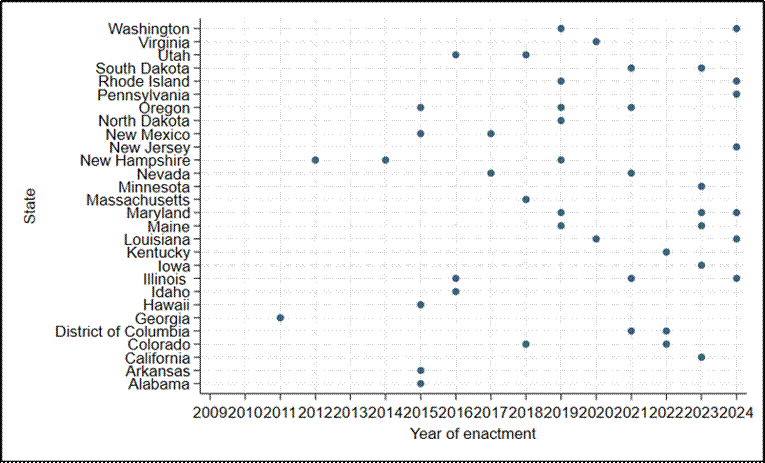
The baseline for our analysis is that, in 2009, 19 states had statutes of general applicability governing the use of noncompetes. Between 2009 and 2024, more than half of the states (a total of 11) with an existing noncompete statute in 2009 have revised their laws, while more than 15 states without such a statute at that time enacted new legislation. As illustrated in Figure 1, state-level legislative activity has surged since 2015, a period that aligns with growing awareness of the prevalence of noncompetes, and some states have even implemented multiple rounds of reform during this time.
Figure 1: Changes in legislation per year, by state (2009-2024)
Besides the number of these changes, what kinds of policies did states implement? Among these new revisions, only Minnesota opted for a complete ban akin to what the FTC proposed. California reinforced its longstanding ban by including additional measures, such as deeming noncompetes signed and executed out of state null and void. As a result, a total of four states now have bans: California, North Dakota, Oklahoma, and Minnesota—the first three having banned noncompetes long before 2009.
Besides outright bans, several states implemented specific rules governing noncompetes that focus on specific industries or occupations, especially in healthcare. There has also been a trend of increased scrutiny of noncompetes that cover low-wage workers. Firms argue that noncompetes encourage investments in employees through training and other benefits if firms know workers can’t leave for competitors before the firms can earn back those investments in human capital. Many fast-food employees, like cashiers and cooks, must sign noncompetes, for example. Several states have rejected the broad applicability of this logic and set wage thresholds below which noncompete clauses are deemed to be unenforceable. Illinois, for instance, has tightened its restrictions on noncompete agreements, moving from a 2017 noncompete ban for low-wage workers to a 2022 law that raises the threshold to an annual salary of $75,000.
Other commonly adopted policies aim at setting limits on the duration of the noncompete (specifically, the maximum time for which a former employee may be prevented from working for a competitor after the employment relationship ends). They also introduce procedural requirements related to how far in advance a prospective employee must be made aware of the noncompete clause and the divulgence of details about the clause. For example, Oregon provides that a noncompete is void and unenforceable unless the employer informs the employee in a written offer received by the employee at least two weeks before the first day of the employee’s employment that the noncompete is required as a condition of employment. Previously, employers might only make the new hire aware of the clause on their first day.
Though virtually all states have moved toward further restricting the use of noncompete agreements, there have also been recent efforts in the opposite direction. For example, in July 2025, Florida enacted the Contracts Honoring Opportunity, Investment, Confidentiality, and Economic Growth (CHOICE) Act, which significantly enhances the enforceability of noncompetes for high-earning employees by permitting restrictions of up to four years and making enforcement easier for employers.
Regardless of whether the changes are more or less restrictive, employers’ incentives to comply remain a central concern. The usual sanction for overbroad or invalid noncompetes is the mere invalidation of the clause but nothing more, making the costs for employers to attempt to enforce noncompetes very low. Meanwhile, the legal costs for employees trying to invalidate those noncompetes can be prohibitively high. To address these concerns, some states have introduced measures such as shifting legal costs to employers who lose lawsuits, imposing fines for overreaching, and providing for both private and public enforcement actions.
Finally, we tracked the political environment in each state (specifically, which party controlled the House, Senate, and governor’s office) at the time of regulatory changes from 2009 to 2024 (excluding D.C.). We classified reforms as Democrat- or Republican-led when one party controlled all three branches, and labeled all remaining cases of new legislation as bipartisan. Our analysis reveals that 40% of these regulatory changes occurred in states controlled by Democrats, 20% in states controlled by Republicans, and the remaining 40% in states where no single party held unified control. This pattern suggests that, in many cases, proponents of rules limiting noncompetes were able to achieve a notable degree of political convergence on this issue, and that legislators were potentially inspired by what other jurisdictions were doing in terms of policy adoption. An initial analysis of any differences in the details of Democratic, Republican, and Bipartisan legislation on noncompetes did not turn up anything meaningful, but any conclusive determination would require more research.
Too late for federal efforts?
Although states have been active in regulating noncompete clauses, only four have full noncompete bans, and because different state rules target different issues associated with noncompete clauses, there remains room for action at the federal level. A federal law could bring consistency to employees and employers and curtail opportunistic employer behaviors. Research shows that noncompete agreements are included in employment contracts even in states where they are already banned. In fact, one of the reasons states like California have further amended their legislation is to address the persistent use of unenforceable noncompetes.
In light of this, both the enforcement action launched by the FTC in 2023 against companies using noncompete agreements, including firms in the security guard and glass manufacturing industries, and the more recent action targeting companies in the pet cremation services industry in 2025, are important signals that abuses can still be addressed without a full ban. These enforcement actions may encourage companies to reconsider their assumptions about the lack of consequences for using unenforceable noncompetes.
Given the current state of affairs, it is difficult to predict whether Ferguson’s FTC will move forward on the rulemaking front or settle into bringing case-by-case actions. One possible intermediate strategy would be to pursue a narrower rule and adopt some of the policy solutions emerging at the state level. Overall, noncompetes remain a labor policy that has generated notable bipartisan support at both the state and federal level. Though a federal level ban appears no longer viable at this moment, the FTC has signaled it will continue to act on them in some instances. The states will inevitably move ahead and experiment with a range of policies, which means the noncompete debate will continue.
Author Disclosure: The author reports no conflicts of interest. You can read our disclosure policy here.
Articles represent the opinions of their writers, not necessarily those of the University of Chicago, the Booth School of Business, or its faculty.
Subscribe here for ProMarket’s weekly newsletter, Special Interest, to stay up to date on ProMarket’s coverage of the political economy and other content from the Stigler Center.