






Firms may file a strategic lawsuit against public participation (SLAPP) against civil society to silence criticism for socially harmful activity, such as the use of dirty technologies. In new research, Swarnodeep Homroy finds that legal protections for free speech push firms to address some of these criticisms by developing new technologies.
A strategic lawsuit against public participation (SLAPP) describes a civil action, often framed as a defamation or related tort claim, that is filed not because it is expected to hold up in court, but to deter public scrutiny with high litigation costs. A party files a SLAPP to drain the defendant’s time and resources and to prevent the disclosure of information that could harm its image or financial prospects. SLAPPs particularly affect investigative journalists, whistleblowers, and other civil society actors. Instances include politicians suing journalists for reporting on past misdemeanors or a natural gas pipeline suing an environmental organization for defamation for supporting a protest. Firms initiate the majority of SLAPPs in the United States.
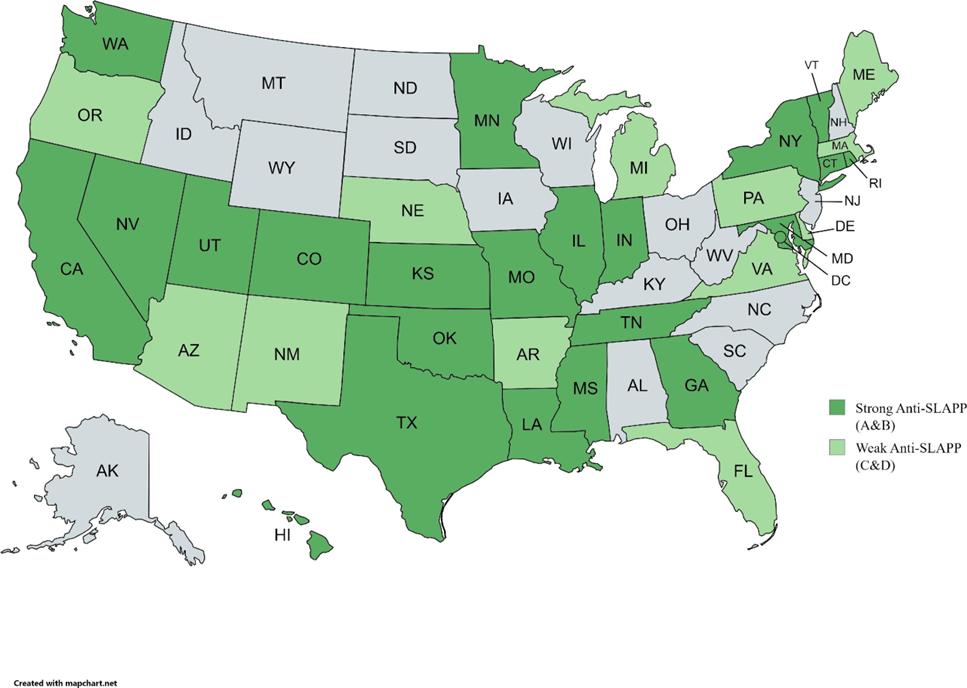
U.S. legislators have designed anti-SLAPP statutes to mitigate these retaliatory lawsuits by introducing procedural protections for speech on matters of public interest. They typically include early court dismissals of SLAPP cases, fee-shifting provisions, and discovery stays. Anti-SLAPP laws, therefore, protect free speech, lead to corporate and political transparency, and reduce the scope for strategic suppression. Thirty-one U.S. states and the District of Columbia have adopted anti-SLAPP statutes at different times between 1990 and 2019.
Figure 1. Anti-SLAPP laws across US States
Economists have long argued that freedom of speech and civil society matter for economic growth. One way civil society can spur economic growth is to publicize the social costs of incumbent technologies, be it from environmental damage, product safety failures, or labor safety violations. Public transparency can thus raise the reputational costs of continuing to use and sell those technologies for firms and whole industries. When filing a SLAPP is no longer an easy method of stifling scrutiny, firms are incentivized to innovate and adopt new technologies. They are particularly incentivized to be the first to create new technologies if they anticipate an industry-wide transition to their use. By doing so, they can capture licensing rents from patenting the new technology. In theory, then, protections for free speech and civil society should encourage innovation and generate economic growth.
Stronger free speech protections boost innovation
My research uses variations in anti-SLAPP laws within the U.S. to show that when civil society actors are shielded from retaliatory litigation for their work, firms are pushed to innovate. I compare patenting by firms headquartered in states that adopt anti-SLAPP laws to firms in states that never adopt them. I match these adoptions with information on patenting, new product announcements, and firm productivity to effectively measure firm innovation. Since these adoptions occur at different times across states, the measured effect is unlikely to be fully explained by other factors.
The innovation response is significantly stronger for consumer-facing firms that are most exposed to reputational consequences than for firms producing intermediate goods. Innovation is also more pronounced among firms with high environmental and reputational risk, for whom civic criticism translates most directly into market consequences.
Overall, firms in states that adopt anti-SLAPP laws file 19% more patent applications in the five years following legislative adoption. In states with the strongest protections (according to ratings by the Institute for Free Speech), including fee-shifting and mandatory stays on discovery, new patent applications increase to 33% more patent applications over the next five years after adoption.
Figure 2. Effect of anti-SLAPP laws on the number of Patent Applications

Importantly, the entire patent response to anti-SLAPP legislation is concentrated in breakthrough patents, i.e., those that are most cited within their technology class and filing year in future patent applications. Firms also patent in technology classes they have never patented before, consistent with genuine technological exploration rather than incremental development. Meanwhile, expenditures on research and development do not change. This suggests that firms are not spending more on innovation but shift their budgets towards newer technology projects.
To get a sense of whether the increase I document is large or small, I benchmark it with evidence from institutional reforms that shape innovation through non-fiscal channels. For example, strengthening the enforcement of non-compete clauses, which prevent workers from leaving for competitors, is shown to reduce patenting by 14-18%. Anti-SLAPP statutes generate effects of similar magnitude through a complementary channel. Whereas non-compete laws affect innovation by restricting the diffusionof knowledge via labor mobility, speech protections affect innovation by enabling the productionof information via civic participation.
Innovation is concentrated among top performers
Stronger speech protections induce firms to innovate earlier. A stronger voice for civil society means that firms can’t easily maintain high profits from using cheap technology that can be detrimental to public welfare. Therefore, all firms in the industry face pressure to innovate. In theory, this should lead to an industry-wide transition to innovate as efficiently as possible (measured as the revenue generated per patent application). Innovation should be more spread out among firms, including new entrants to the market. I find that disparities in innovative efficiency among firms in the same industry do decline significantly.
Further, some firms will have the incentive to innovate first to patent the technology and capture licensing rents. Thus, firms with a larger capacity to innovate, due to a large research budget or other organizational advantages, may capture more new investment and, ultimately, the new patents. Indeed, consistent with this intuition, I find that after anti-SLAPP adoption, innovation is concentrated among few firms, namely those with the largest research budgets. These firms are not necessarily large incumbents but can be smaller, more R&D-intensive competitors.
So, while innovative efficiency converges after anti-SLAPP adoption, as all firms compete to innovate, those with the largest R&D budgets tend to patent the most innovative technologies and accrue the majority of new investments.
The economic dividends from free speech
One of the most cited merits of democracy is its association with civic liberties and economic growth. However, the mechanisms that allow civic liberties, such as free speech, to influence innovation have so far been missing. I provide evidence that when civil society’s free-speech rights are legally protected, reputational consequences for firms that externalize social costs increase. This pushes firms to continue to innovate new technologies that reduce social costs and stay ahead of competitors.
These results have implications for innovation policy. Most countries rely on financial incentives, such as R&D tax credits, grants, and subsidies to stimulate innovation. These instruments work, but they also impose fiscal costs on the public and channel resources towards less–productive firms. Free speech protections do not lower innovation costs across the board. They shift competitive advantage toward more innovative firms. Strengthening civic institutions can therefore complement traditional innovation policy in a more targeted and less distortionary way.
Author Disclosure: The author reports no conflicts of interest. You can read our disclosure policy here.
Articles represent the opinions of their writers, not necessarily those of the University of Chicago, the Booth School of Business, or its faculty.
Subscribe here for ProMarket’s weekly newsletter, Special Interest, to stay up to date on ProMarket’s coverage of the political economy and other content from the Stigler Center.