


The Trump administration’s blacklist of Anthropic represents its greatest attack on free markets yet. America’s businesses must push back, writes Luigi Zingales.
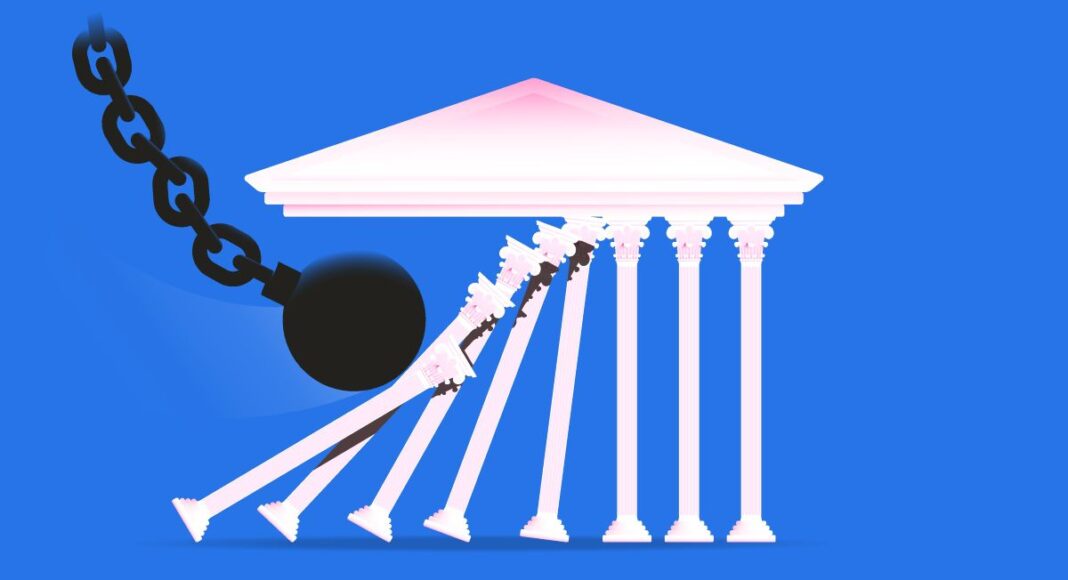
A company’s freedom to operate according to its shareholders’ wishes, rather than the state’s, is the cornerstone of capitalism. This freedom is indivisible from personal liberty, and without it there is no growth, and there is no progress. In its fight with Anthropic, the Trump administration has launched the most serious attack on this freedom in United States history. It is a direct assault on capitalism launched by a president who seems to respect our system only when it satisfies his financial and ideological interests.
Let’s start with the facts. The Pentagon contracted Anthropic to use its AI model, Claude, for military purposes. Anthropic, acting entirely within its rights as a private entity, included specific ethical restrictions in the contract regarding how its technology could be deployed, to which the Pentagon agreed. However, last week, the administration demanded the right to use Claude without these agreed-upon restrictions. When Anthropic refused to violate its own principles, the administration did not simply breach the contract. It designated Anthropic a “supply chain risk,” signaling to the market that the company cannot be trusted with U.S. national security. In practical terms, this means that any firm that contracts with the U.S. Department of Defense or the nation’s numerous intelligence and security agencies cannot use Anthropic’s products.
The U.S. military has the ultimate monopsony in the defense sector: there is no other buyer of national security services in the U.S. As such, it has the right to select the suppliers it prefers. It does not have the right to retaliate against them. But by having Defense Secretary Pete Hegseth designate Anthropic a “supply chain risk”—a label historically reserved for the firms of foreign adversaries like China’s Huawei—and banning all military contractors from doing commercial business with it, the government is acting as an abusive monopolist. It is using its massive market weight to blacklist a disobedient firm, jeopardizing its very existence. It is one of the largest federal boycotts of an American firm ever conducted and an antitrust violation orchestrated by the state itself.
The biggest threat to capitalism has always been the arbitrary abuse of government power. Historically, American conservatives have been the staunchest defenders against this abuse. They have long championed the right of corporations to hold and exercise values—even to the point of arguing that companies should be exempted from federal regulations, as we saw in the conservative defense of the Hobby Lobby exemption to the Affordable Care Act’s contraceptive mandate.
Anthropic was explicitly founded with ethical guardrails against the unrestrained use of AI. This is not a marketing gimmick; it is the stated welfare objective of its founders and investors. When the government demands that Anthropic strip away its ethical restrictions for military use—namely restrictions on using its products for mass domestic surveillance and fully-autonomous weapons—it is demanding that the company’s executives violate their fiduciary duty to their own shareholders. By weaponizing a ”supply chain risk” designation to bankrupt the firm for its refusal to violate its founding mandate and shareholders’ preferences, the administration is declaring that an American company’s corporate purpose exists only so long as it aligns with the ideological whims of the executive branch. This is not the behavior of a free marketer. It is the behavior of a Soviet dictator. If shareholders have the right to prioritize their religious values over compliance, why do they not have the right to prioritize the ethical deployment of their own AI?
We should expect our government to make procurement decisions in the public interest, not to financially ruin a company for its ideological independence. If the government believed our defense was at risk due to Anthropic’s ethical guidelines, it could have invoked the Defense Production Act to force the company to provide Claude without restrictions. Designating Anthropic a supply-chain risk is not intended to overcome Anthropic’s restrictions to protect the national interest; it is purely punitive. It is not patriotic; it weakens America’s rule of law and free markets—the engines powering its security and military prowess—solely to satisfy the president’s ideological and capricious obsessions.
In its negative connotation, the term “woke” has come to signify policies so blinded by leftist ideology as to defy any common sense. Many American capitalists have recently united in opposition to what they perceive as the excesses of wokeism, arguing that it deters innovation and growth. The moment has come for true capitalists to unite in opposing the Trump administration’s right-wing wokeism. An administration that uses the government’s monopsony power to force companies to behave according to its wishes is not capitalist; it is socialist. It is not conservative; it is authoritarian. It is not pro-market; it is destroying free markets.
Without a government that refrains from abusing its monopsony power, no entrepreneur would invest to supply the government. Without the freedom to manage its own operations, there is little incentive for a firm to innovate. Without respect for the rule of law, we cannot have capitalism. Only crony capitalism.
The moment has come for American capitalists to unite in opposing Trump’s attack on capitalism. Trump is not a capitalist. He is a socialist in sheep’s clothing. Capitalists of the world unite. You have nothing to lose but your chains. They might be made of gold, but always chains they are.
Author Disclosure: The author reports no conflicts of interest. You can read our disclosure policy here.
Articles represent the opinions of their writers, not necessarily those of the University of Chicago, the Booth School of Business, or its faculty.
Subscribe here for ProMarket’s weekly newsletter, Special Interest, to stay up to date on ProMarket’s coverage of the political economy and other content from the Stigler Center.