







In recent research, Pablo Balán, Agustín Vallejo, and Pablo M. Pinto examine how diversity affects cooperation between neighbors after a natural disaster. They find that more diverse neighborhoods were less likely to cooperate with each other on recovery efforts after Hurricane Harvey.
Across the world, natural disasters are becoming more frequent and increasingly costly. Prominent recent disasters include earthquakes in Haiti (2010) and Turkey and Syria (2023), tsunamis in the Indian Ocean (2004) and Japan (2011), typhoons in the Philippines (2013) and bushfires in Australia (2019-20). Hurricanes Katrina (2005), Irma (2017), Maria (2017), and Ian (2022) struck the United States and surrounding Caribbean countries, each causing tens to hundreds of billions of dollars in damage.
While disasters impose substantial human and financial costs, they are also natural laboratories for studying cooperation: situations where people sacrifice individual benefits to help others. Some experts believe that natural disasters can reduce cooperation, increase conflict, and destroy physical and social capital. However, mounting evidence suggests that natural disasters can increase prosocial behavior and that social capital plays a critical role in disaster recovery. Daniel Aldrich, one of the foremost experts in community resilience in natural disasters, writes that “social, not physical, infrastructure proves the most important for recovery.” Studies of the 2010 Chile earthquake—an 8.8 magnitude event and one of the strongest ever recorded—found increases in social cohesion and cooperative behavior such as volunteering, charity donations, and voting. Disasters may thus in theory both increase and decrease cooperation. We find in new research that their net effect might depend on the social context in which they occur, particularly the ways in which diverse groups in the affected areas interact with one another.
Diversity is central to this question because it shapes how cooperation is organized. Studies have found that in diverse settings, neighbors and community members are less likely to cooperate. Rather, cooperation relies on weaker social ties, such as shared religion, state institutions, and civil society membership. These features make cooperation both more demanding and more informative in the aftermath of a shock.
In our paper, we define cooperation as cases in which individuals incur a cost, such as financial, physical, or temporal, to benefit others. We build on this unified notion of cooperation, rather than use proxies such as trust or social cohesion, and measure it using concrete behaviors. We study multiple forms of cooperation—interpersonal helping, coordination with neighbors, and support for costly recovery policies—which rely on different social ties.
Hurricane Harvey is especially useful for conducting this study because it combined a large, localized shock with unusually high levels of ethnic diversity across neighborhoods. It struck the Houston metropolitan area in August 2017 and was the second-costliest disaster in U.S. history, causing roughly $125 billion in damages and widespread flooding from record-breaking rainfall. The storm affected a highly diverse urban area, generating substantial variation in exposure and losses across neighborhoods. The Houston metro area is one of the most ethnically diverse metro areas in the US, with a population that is 44.5% Hispanic or Latino, 24.1% white, 22.1% Black or African American, and 6.8% Asian. More than 28% of Houston’s residents were born outside the United States. This combination of severe damage and social heterogeneity makes Hurricane Harvey an ideal setting for studying how natural disasters shape cooperation, helping behavior, and support for collective recovery.
The response to Harvey included immediate efforts by local first responders, such as the Texas National Guard, the U.S. Coast Guard, and the Federal Emergency Management Agency (FEMA). Congress approved $15.25 billion in federal disaster relief, and over 890,000 households registered for FEMA aid. Beyond the government’s response, Harvey triggered grassroots civil society efforts and volunteer operations. These local volunteers and groups, such as the civilian “Cajun Navy,” provided boat rescues and evacuations. Using surveys conducted in the Houston area before and after the storm, we documented who helped whom, how residents coordinated with neighbors, and whether they were willing to support collective recovery efforts. We also ran survey experiments that asked respondents to make concrete trade-offs about rebuilding and future flood protection. These data allowed us to trace how residents coordinated prior to the storm, how cooperation responded to the shock, and how those responses varied with exposure to the storm and the social makeup of local communities.
First, we found that cooperation was lower in more diverse neighborhoods. Even before the storm, residents in these areas were less likely to coordinate with neighbors. Specifically, a one-unit increase in ethnic diversity is associated with a 21.7 percentage-point decrease in the likelihood of coordinating plans for the approaching hurricane with neighbors. This is a large effect given the average probability of coordinating with neighbors (12.7%). The key result comes from how diversity and damage from the storm interact. In less diverse neighborhoods, greater exposure to the storm was associated with more cooperation. In more diverse neighborhoods, this pattern reversed (Figure 1).
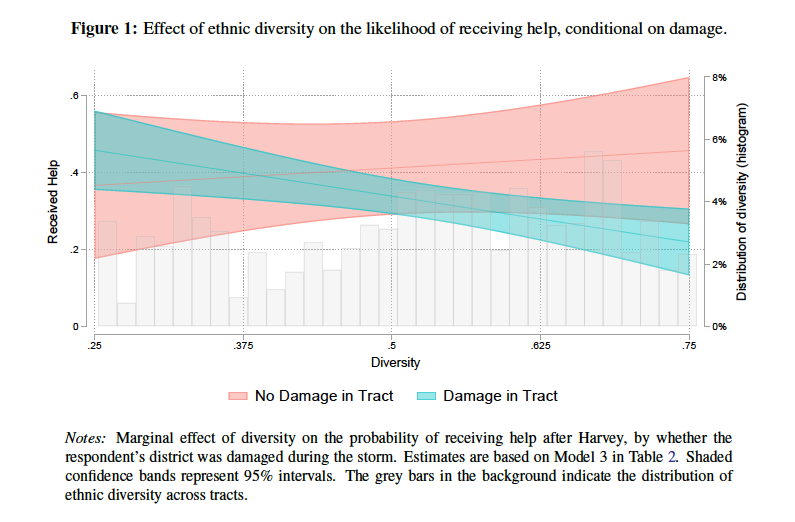
Figure 1. Effect of ethnic diversity on the likelihood of receiving help, conditional on the level of damage.
We then turned from interpersonal cooperation to support for collective recovery policies. We implemented a vignette experiment where respondents were presented with pairs of policy proposals that varied randomly along three dimensions: (1) project type, (2) geographic area covered by the policy (all of the Houston area vs. poor residential areas), and (3) the level of tax increase (high versus low increase). Across a set of policies, affected individuals were more likely to support policies requiring a higher tax increase. However, affected individuals in diverse neighborhoods were less likely to support costly policies (Figure 2). In other words, the same shock fostered cooperation in more homogeneous settings but muted it in more diverse ones.
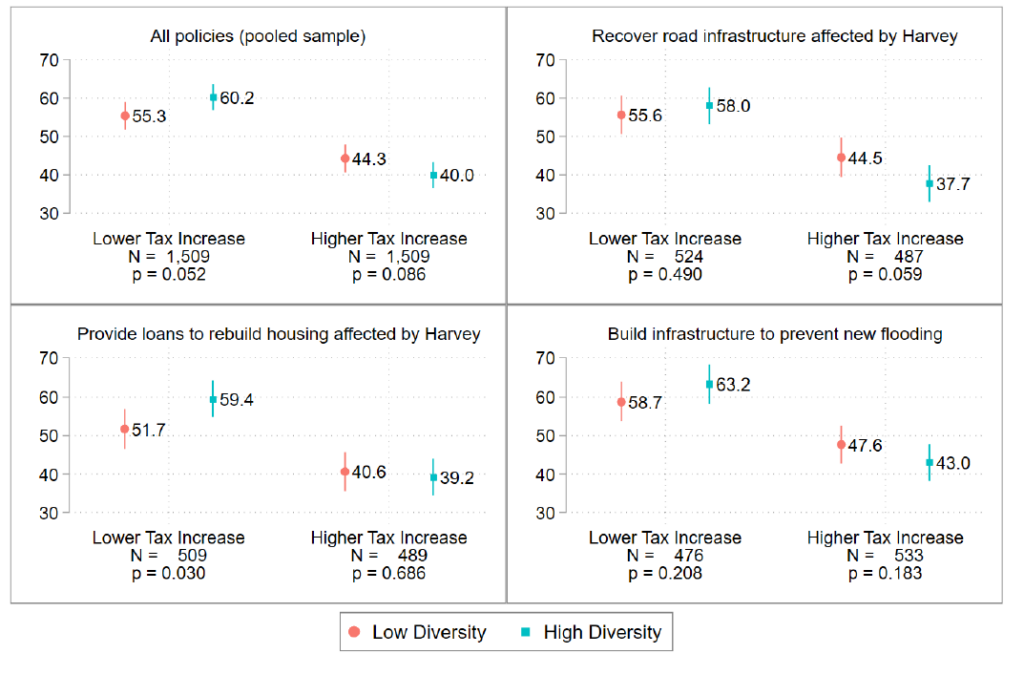
Figure 2. Predicted margins of choosing high versus low tax increases following Hurricane Harvey for affected respondents, conditional on ethnic diversity.
If overall cooperation declines in more diverse and affected neighborhoods, a natural question is how individuals choose with whom to cooperate after disasters. Human cooperation is parochial—we tend to cooperate with members of our in-group. With whom will individuals choose to cooperate in post-disaster settings? To answer this question, we designed an experiment in which individuals were assigned the task of choosing cooperation partners. We asked: “Now, let’s suppose that you are creating a neighborhood association to provide information and help to people in the neighborhood during future flooding. Which of these two individuals do you prefer to collaborate with?”
In each hypothetical profile, we randomized ethnicity, gender, names that are commonly perceived as signaling the indicated ethnicity and gender, party identification, religion, and civic association membership. The results in Figure 3 reveal a strong preference to cooperate with co-partisan and co-religious profiles. Notably, we find little evidence of ingroup preference for gender or race. While the preference to cooperate within similar partisan and religious groups is present in both homogeneous and diverse settings, in the latter, individuals also prefer to cooperate with members of their own civic associations (for example, YMCA or Rotary International). This result sheds new light on previous work, which hypothesized that “bridging” social capital, often embedded in civic and voluntary organizations, plays a central role in sustaining cooperation and accessing resources beyond “bonding” ties in the aftermath of shocks.
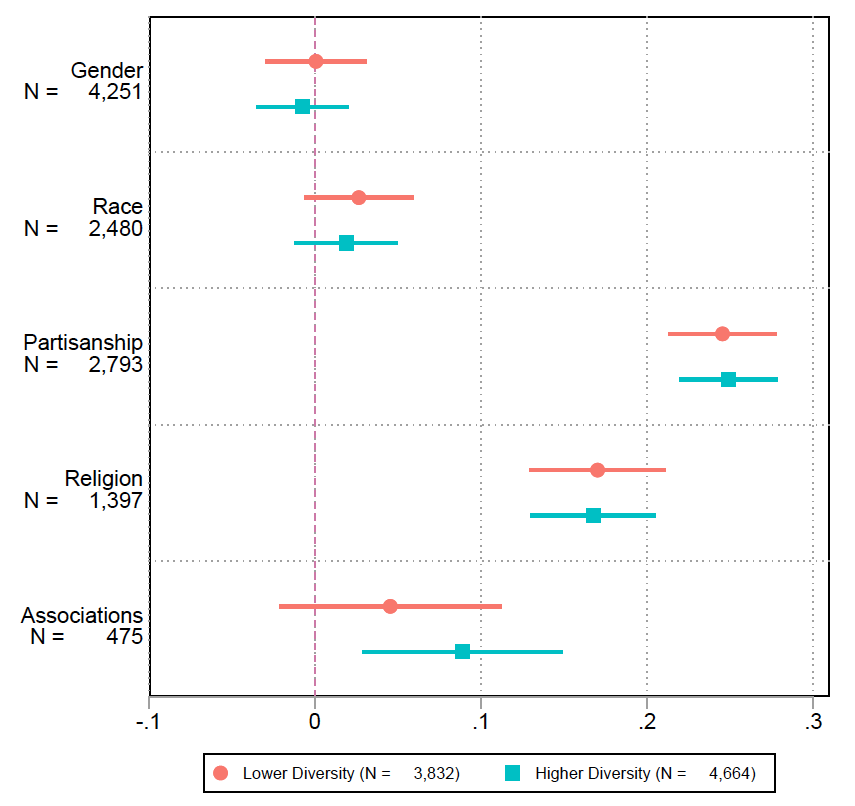
Figure 3. Probability of cooperating with individuals of the same ingroup in the event of future flooding.
In summation, our results show that ethnic diversity can condition how exposure to natural disasters affects cooperation. Across all outcomes—interpersonal helping, coordination with neighbors, and support for costly recovery policies—the effect of disaster exposure on cooperation depends on ethnic diversity. Our findings illustrate how group identities and organizational ties structure post-disaster cooperation. Recognizing this variation helps interpret heterogeneous community responses to shocks and can inform climate change adaptation policies.
Author Disclosure: The author reports no conflicts of interest. You can read our disclosure policy here.
Articles represent the opinions of their writers, not necessarily those of the University of Chicago, the Booth School of Business, or its faculty.
Subscribe here for ProMarket’s weekly newsletter, Special Interest, to stay up to date on ProMarket’s coverage of the political economy and other content from the Stigler Center.