








In new research providing the first systematic evidence on public notices, Kimberlyn Munevar, Anya Nakhmurina, and Delphine Samuels examine how Florida’s 2023 law allowing local governments to stop publishing public notices in newspapers has affected citizen engagement in local governance.
Since 1789, when the first United States Congress required federal proposals and actions to be published in newspapers, states have adopted public notice laws to keep citizens informed about, and able to participate in, government decisions affecting their rights and interests. These legally mandated announcements cover everything from zoning changes and budget hearings to upcoming elections, ensuring the public can meaningfully engage in local governance. Yet despite their long history, the efficacy of public notices and how they facilitate citizen engagement have never been empirically studied. Now, as state legislatures across the country consider moving these notices from newspapers to government websites in the name of cost savings and modernization, a critical question has emerged: Does the publication channel actually matter for constituent engagement? We find that it does.
In 2025 alone, 14 states introduced legislation to let municipalities bypass newspapers entirely and post notices exclusively on government websites. Proponents argue that shifting notices to government websites would save taxpayer money on newspaper ads and modernize disclosure practices. But critics warn that such changes could make it harder for citizens to stay informed and easier for officials to bury information that doesn’t align with their interests.
To shed light on this timely debate, in a new paper with Kimberlyn Munevar and Delphine Samuels, we examine the implications of Florida’s House Bill 7049, the first modern statewide law to revoke the long-standing requirement that public notices be published in newspapers. Beginning January 1, 2023, Florida’s local governments were permitted to publish notices on county-operated websites instead of—or in addition to—newspapers.
The bill’s path to passage was contentious. Its sponsor, Representative Randy Fine, argued that newspaper publication was an outdated subsidy for a declining industry. Opponents countered that the real motivation was retaliation: local newspapers had published articles critical of Fine’s conduct, and similar allegations of officials threatening to pull notice contracts as punishment for unfavorable coverage have surfaced in New York and New Jersey.
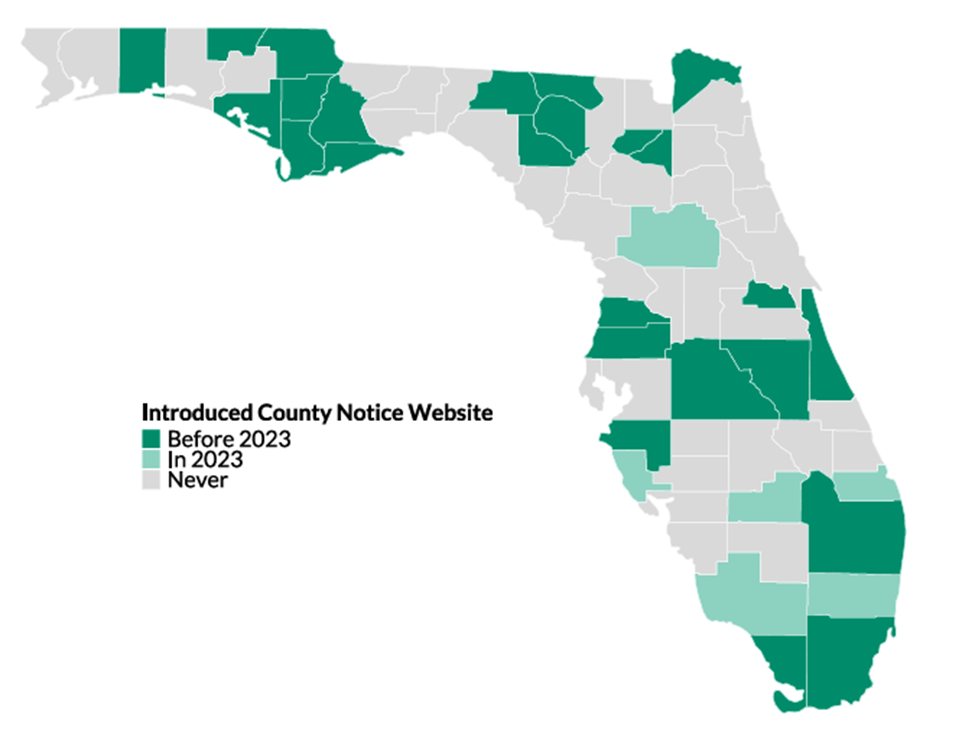
We collected every public notice published in Florida newspapers between 2020 and 2024—more than 150,000 notices from over 2,100 local governments. Critically, not all Florida counties had public notice websites ready when the law took effect. Although counties and the municipalities within them operate as independent entities, municipalities may use county-operated websites when available. This variation allows for an empirical comparison: governments in counties with existing websites could immediately switch away from newspapers, while those without such websites had to continue the traditional practice of publishing in newspapers. 25 of Florida’s 67 counties had a public notice website in place before January 1, 2023, several of which launched their sites in the final months of 2022. An additional six counties adopted a website later in 2023. The remaining 36 counties have never introduced a county notice website (Figure 1). For those who did choose to switch, the transitioning municipalities needed to issue a notice of where to find future announcements. In smaller counties, transitioning municipalities needed to call a public meeting before transitioning.
Figure 1.
Municipalities shifted away from newspapers
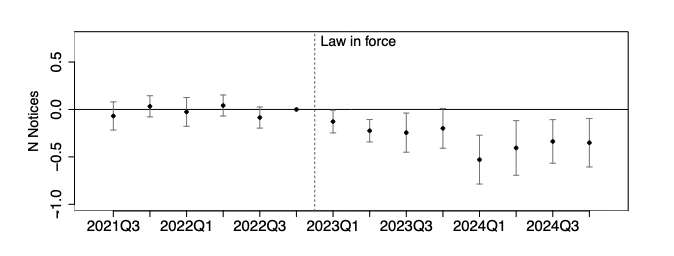
We found that local governments in counties with existing public notice websites reduced their newspaper publications by 37 percent after the reform, compared to governments without this option (Figure 2). Cities showed the largest declines, cutting newspaper notices by 48 percent on average. The types of notices most likely to disappear were those conceivably most likely to prompt citizen engagement: public hearing announcements declined by 44 percent, planning and zoning notices dropped by 27 percent, and ordinance proposals fell 30 percent.
Figure 2.
Citizens didn’t follow the transition
The key question for policymakers is whether citizens seamlessly transitioned to finding notices on government websites instead of newspapers. If so, the reform might have modernized disclosure without reducing transparency.
We found no evidence of such a transition. Traffic to county public notice websites showed no discernible increase after the reform. This suggests that citizens who had been exposed to notices through newspapers—whether by actively reading them or encountering them while browsing—did not appear to be seeking them out on government sites.
This finding aligns with a basic insight about information consumption: newspaper notices are encountered incidentally during routine reading, while accessing notices on a government website requires knowing where to look and actively seeking out the information. Most people simply don’t do that.
Fewer citizens showed up to public meetings
Theoretically, if fewer citizens see notices, especially those prompting engagement, fewer citizens will then show up to participate in local government. That is exactly what we found.
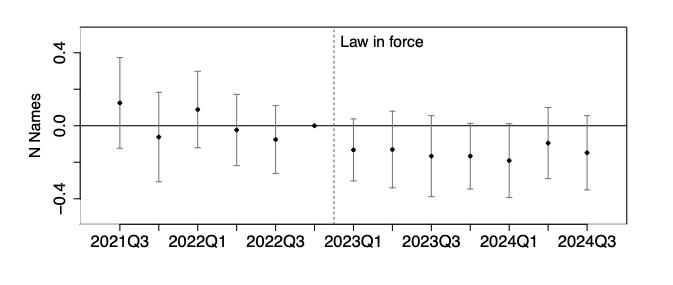
Under Florida law, all local government meetings must be open to the public and include time for citizen comment. Because speakers must introduce themselves before addressing the board, we were able to analyze YouTube transcripts from city council and commission meetings, counting unique names mentioned to create a proxy for how many residents spoke.
Public meetings in cities with access to county notice websites experienced a 14 percent decline in the number of speakers after the reform, relative to cities that continued publishing in newspapers (Figure 3). This represents a meaningful reduction in democratic participation: these are the forums where residents question proposed budgets, challenge development plans, and raise concerns about how their community is governed.
Figure 3.
Municipalities issued more commercial permits
Planning and zoning meetings are particularly consequential for residents. These meetings review proposals for new construction before permits can be issued. Prior research has shown that such meetings often attract opposition to commercial development from local residents concerned about property values, traffic, or neighborhood character. If citizens are less aware of upcoming decisions, opposition to new construction should decline.
After the reform, cities with access to county notice websites issued 28 percent more commercial zoning permits than comparable cities that continued newspaper publication. The pattern suggests that reduced public scrutiny translated into easier approval for developers.
Future implications
While our research design does not allow us to draw definitive causal conclusions, our findings are relevant to the ongoing policy debate about the appropriate placement of public notices.
First, dissemination through newspapers (and related centralized websites) appears to play an informational role that government websites don’t easily replicate. The issue isn’t technological capability—county websites can certainly post notices—but rather how information reaches citizens in practice. Newspapers, despite declining readership, may still serve as an incidental dissemination channel that catches people who weren’t actively looking.
Second, giving governments discretion over notice publication seems to reduce transparency in predictable ways. When officials can choose between newspapers and government websites, they appear to systematically choose the option with lower visibility, particularly for notices that might generate pushback. This pattern is consistent with what economists call regulatory capture: the possibility that transparency policies can be shaped to serve the interests of officials rather than citizens.
Third, reduced dissemination appears to carry real consequences. Fewer public meeting speakers and more approved permits represent substantial changes in local governance.
None of this means that public notice modernization is inherently misguided. Well-designed digital notification systems could potentially improve on newspaper publication by delivering targeted alerts to residents. But the Florida experience suggests that simply allowing governments to post notices on their own websites—without investments in discoverability and citizen outreach—reduces rather than enhances democratic participation.
Author Disclosure: The author reports no conflicts of interest. You can read our disclosure policy here.
Articles represent the opinions of their writers, not necessarily those of the University of Chicago, the Booth School of Business, or its faculty.
Subscribe here for ProMarket’s weekly newsletter, Special Interest, to stay up to date on ProMarket’s coverage of the political economy and other content from the Stigler Center.